Story
£3.7m project aims to provide unprecedented analysis of mesophotic coral reefs
20 January 2026
The five-year initiative will assess the response and resilience of mesophotic coral reef communities to future climate change
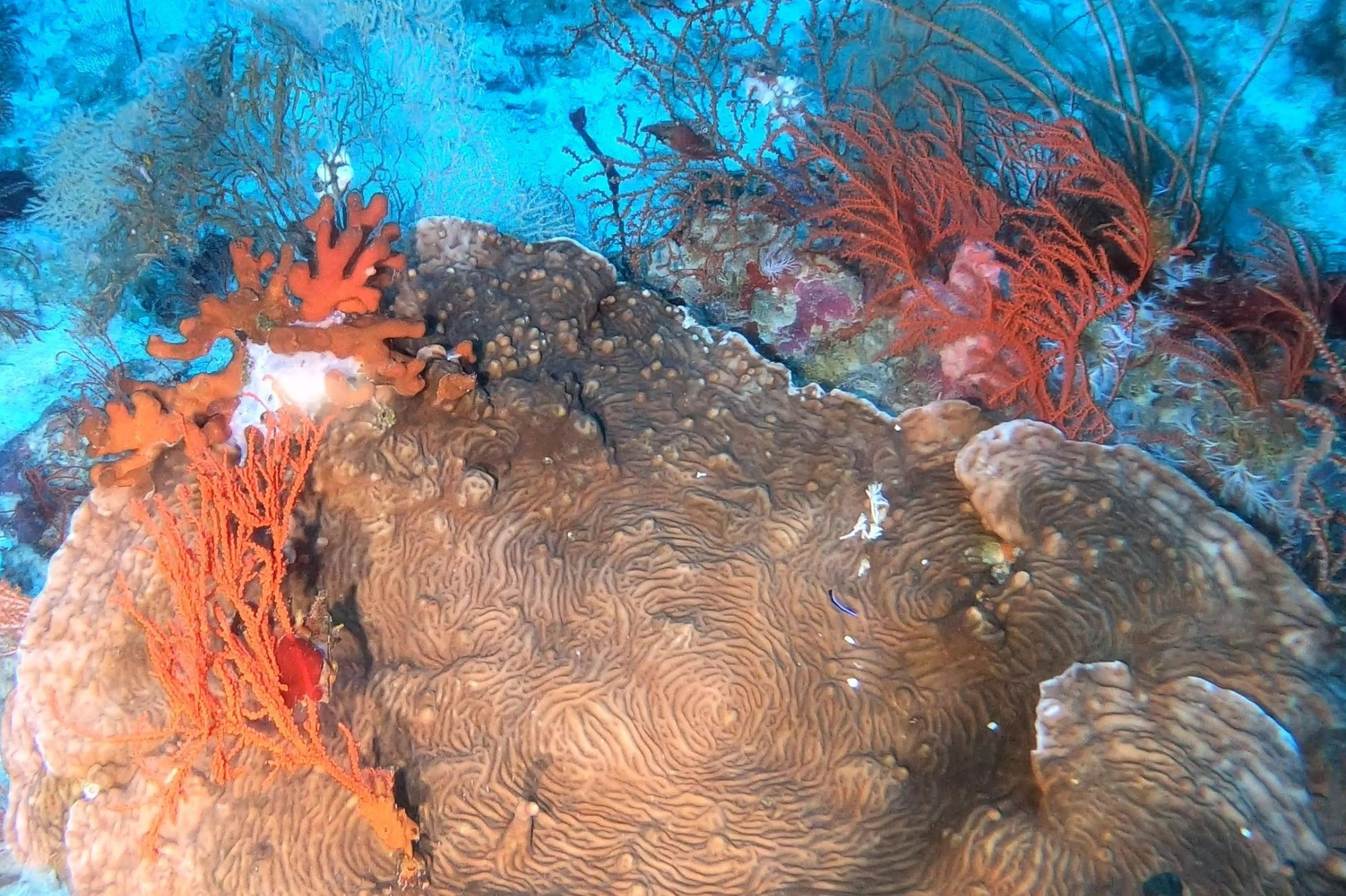
Image caption: This image was taken at 60m depth at Egmont Atoll, Chagos Archipelago, Indian Ocean in March 2022 using a drop-camera system. The image shows a healthy colony of the reef-building coral species, Pachyseris speciosa. There are other soft corals in the background. Image credit: University of Plymouth
Over the next five years, the groundbreaking project will focus on these deeper coral ecosystems below the surface of the Indian Ocean and employ a number of methods to assess their vulnerability to climate change. In addition to assessing the threats they face, the project will also seek to inform ways the reefs can be protected now and in the future.
The project starts in February 2026, and is being led by the University of Plymouth, with a core team also including experts in coral reef biodiversity from Imperial College London and specialists in numerical modelling at Plymouth Marine Laboratory. They are being supported by public investment of £3.7million from the Natural Environment Research Council, part of UK Research and Innovation.
The project will use state of the art survey technologies for in-situ measurements of biodiversity, health and physical environmental parameters at locations across the Indian Ocean – with data also generated through high-resolution numerical modelling.
Dr Molly James, Marine Ecosystem Modeller at PML, added: “At Plymouth Marine Laboratory we are using cutting-edge, fine-scale ocean modelling to uncover how internal waves, thermocline shifts, and larval pathways influence the vulnerability and resilience of these deep reefs. By revealing where mesophotic ecosystems are most at risk and most capable of recovery, this work will help decision-makers target protection where it can have the greatest impact.”
Through previous work in the Indian Ocean, researchers uncovered the deepest known evidence of coral reef bleaching. However, major knowledge gaps remain around the diversity, distribution, environmental conditions and vulnerability of deeper coral ecosystems — and how they may respond as ocean temperatures rise.
Dr Nicola Foster, Lecturer in Marine Biology at the University of Plymouth and the project lead, said: “Coral reefs are vital for the health of our planet. But we know shallow water corals are extremely vulnerable, with predictions suggesting that they could be almost entirely lost as a result of future climate change. Until recently, we thought deeper coral reefs might be protected against similar threats, however our work in the Indian Ocean has challenged that assumption. This project aims to further our understanding of how resilient these deeper coral ecosystems are to warming waters, and the impact any changes in their structure and function could have on coral reef biodiversity in the Indian Ocean and globally.”
Dr Phil Hosegood, Associate Professor of Oceanography at the University of Plymouth, has been working across the Indian Ocean for decades and is co-leading the new project. He added: “This project is unprecedented in terms of its scale and ambition. It will enable us to use state-of-the-art technologies for comprehensive long-term data collection across multiple locations and during significant climate events. That will deliver a fundamental step-change in our understanding of these deeper coral ecosystems, and directly inform conservation and management plans across the Indian Ocean. In doing so, it has the potential to benefit biodiversity, ecosystem services, and the livelihoods of those dependent on coral reef ecosystems at a local and regional scale.”
Studies will also take place in the Coral Spawning Laboratory at the University of Plymouth, assisted by support and training from experts at the Horniman Museum and Gardens in London, to investigate the reproductive strategies and thermal tolerance of mesophotic coral species.
Through this, researchers hope to quantify the potential for the western and central Indian Ocean to sustain coral reef biodiversity and function under future climate scenarios, with a particular focus on identifying critical areas of biodiversity and sites more vulnerable to the impacts of climate change due to their location and specific oceanographic conditions.
Dr Emma Ransome, an Associate Professor at Imperial College London, is leading the Imperial team and a work package on the biodiversity and health of mesophotic coral ecosystems. She said: “Coral reef research often focuses on a few charismatic groups of species, leaving the vast majority of coral reef biodiversity understudied. By developing a comprehensive approach to monitor long-term changes in deep reef biodiversity, we aim to understand the role deep reefs could play in the persistence of marine biodiversity under future climate scenarios and better protect that biodiversity for generations to come.”
The project will also see scientists collaborating with organisations across the Maldives, Seychelles and Mauritius, countries that rely on a healthy ocean for food, environmental protection and economic prosperity. Those partner organisations include the Maldives Environmental Protection Agency, Maldives Marine Research Institute, Seychelles Island Foundation, Island Conservation Society (Seychelles) and the Government of Mauritius.
They will jointly undertake field work and long-term monitoring programmes, with staff from the international partners also undertaking Masters-level training at the University of Plymouth, building capacity and providing critical information to inform conservation and management across the Indian Ocean.