Story
Navigating tricky trade-offs in busy seas
22 January 2026
Study shows how ‘Blue Justice’ is key to delivering fairer and more equitable use of marine space.
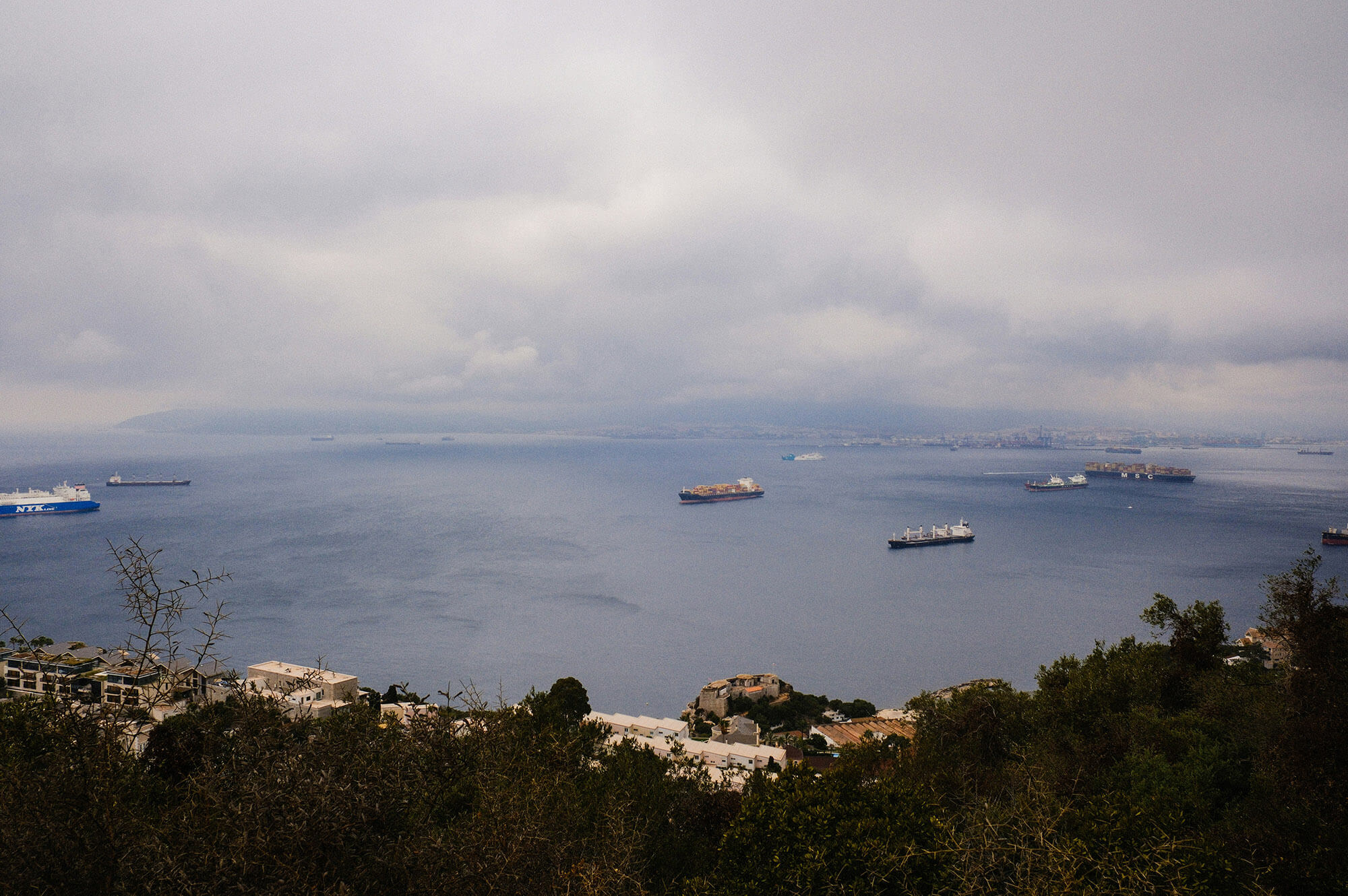
Busy marine environment near Gibraltar. Alexis Presa | Unsplash
As resource demands continue to grow and land resources are becoming more limited, many are looking towards to ocean to help meet space and material requirements. Using the sea for food, transport, materials and infrastructure is not new but the competition for marine space and resources has reached an unprecedented scale and speed.
To manage this accelerated and growing interest in marine uses, complex decisions need to be made about which marine sectors, marine resource users, and environmental, social and economic policy objectives should be prioritised over others, in different locations.
Decisions also need to balance the interests and wellbeing of current generations with those of future generations and marine environmental sustainability. Such trade-off decisions can have major implications for livelihoods, marine biodiversity and the overall resilience of coastal communities.
Previous studies have identified many types of social, economic and environmental trade-offs, however, there remains a critical knowledge gap in how they are navigated in policy and practice.
Dr Matt Fortnam, lead author and Senior Research Fellow at University of Exeter, said:
“There are social and environmental injustices stemming from growth of the ocean economy. Blue justice encompasses recognition of different rights, values and forms of knowledge, procedural fairness in how decisions are made, and distributional equity in who benefits and who bears the costs”.
A study team from the University of Exeter and Plymouth Marine Laboratory investigated how trade-offs are being decided, and the associated challenges for blue justice, through an investigation of the diverse and often overlapping marine decision-making processes in England.
England provides a valuable case study, having experienced unprecedented changes in marine governance over the past 15 years. The UK government faces difficult choices in some of the most intensively used seas in the world, alongside ambitions to expand the blue economy, making an ideal context to explore how competing priorities are currently balanced and how this process could be improved.
Drawing on a literature review, interviews with a wide range of marine managers and policy makers and a stakeholder workshop, the study team found that trade-offs are not addressed systematically, with decision-making biased by evidence gaps, limited stakeholder participation and inconsistent reasoning.
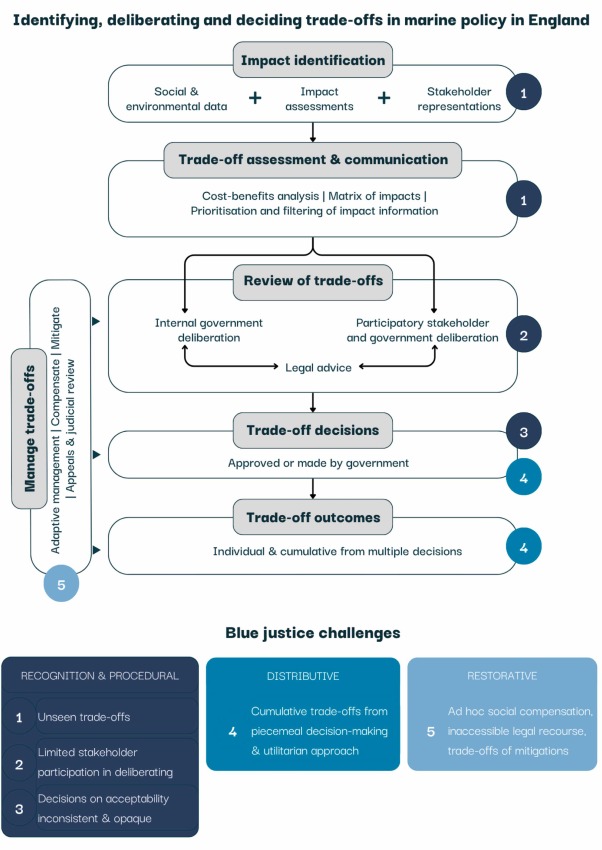
The study revealed that the piecemeal approach to decision-making resulted in a significant impact on who is heard and which trade-offs are considered. Social impacts were found to be particularly underrepresented due to data limitations and consultation processes favouring well-resourced stakeholders. Also access barriers, such a stakeholder resource availability and sectorial ‘busy seasons’, often prevents certain stakeholder from responding to consultations and therefore, data can be skewed.
By bringing blue justice principles to the fore in marine decision-making, this analysis suggests a number of priority areas for reform:
- developing systematic approaches to trade-off assessment that capture the full range of impacts, particularly social dimensions (procedural justice)
- strengthening mechanisms for meaningful stakeholder participation in trade-off deliberation, addressing representation and power dynamic issues (recognition justice)
- enabling transparent and accountable final trade-off decisions at higher levels (procedural justice)
- identifying transparent thresholds, principles or guidelines for determining unacceptable environmental and social trade-offs (distributive justice)
- establishing clearer frameworks for both environmental and social compensation when negative impacts cannot be avoided (restorative justice)
- moving beyond current piecemeal approaches to develop integrated frameworks that consider cumulative trade-offs (distributive justice)
Dr Océane Marcone, co-author and Social Science Researcher at Plymouth Marine Laboratory, commented:
“With increasing competition for marine space and resources, the need to make difficult trade-off choices will only grow. Making blue justice central to how these choices are made offers a pathway to decisions that protect both environmental sustainability and human wellbeing. The experience of England demonstrates both the costs of failing to do so and potential opportunities for positive change.”