Story
Octopus bloom off Southwest UK: New report reveals scale, causes and consequences
27 January 2026
A new report, involving scientists from Plymouth Marine Laboratory, has revealed that a dramatic population bloom of the common octopus (Octopus vulgaris) off the southwest coast of the UK is having significant effects on fisheries and marine ecosystems, and calls for better early warning systems.
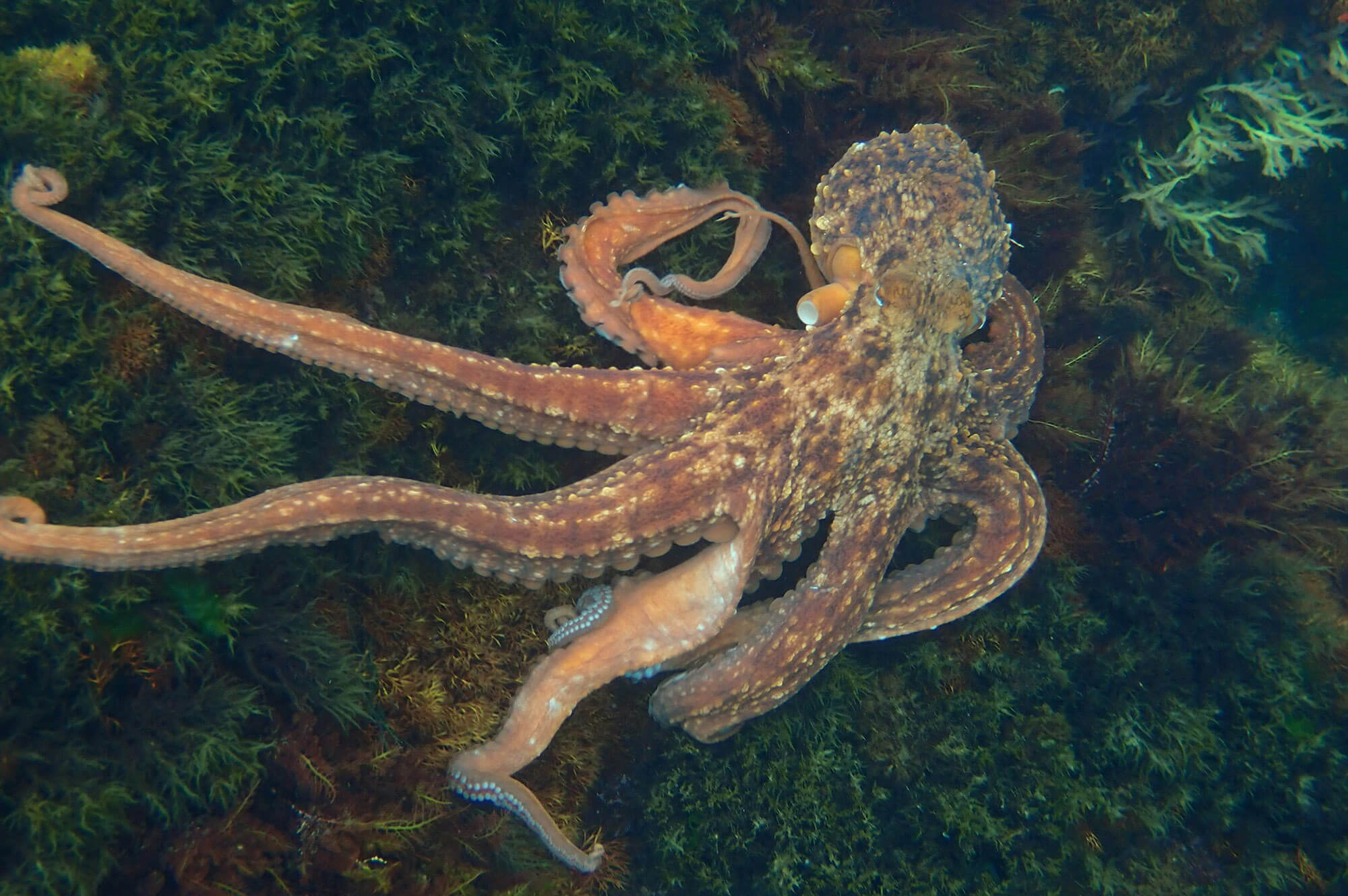
Common Atlantic Octopus (Octopus vulgaris). Flavien Saboureau (CC BY)
A rare but dramatic event
The common octopus is native to UK waters but is typically rare, favouring warmer seas further south in Europe and the Mediterranean. Only four major population ‘blooms’ have been recorded in the past 125 years, in 1899–1900, in 1932-33, in 1950–51, and now in 2025.
The current bloom, which really accelerated from January 2025, appears to be at least as extensive as any previously recorded and is still continuing.
The report, ‘Common octopus (Octopus vulgaris) blooms off the Southwest of the UK: History, trends, causes and consequences’, reveals these key insights:
- Dramatic increase: This bloom of common octopus is the largest seen for at least 75 years.
- Climate-driven pattern: All major octopus blooms including this one have coincided with unusually warm conditions, which are becoming more frequent due to climate change.
- Breeding breakthrough: Common octopus breeding in UK waters, previously very rare, has been widespread in UK waters this year, alongside reports of juvenile octopus in catches.
- Ecosystem ripple effects: Researchers warn that the sudden influx of this adaptable predator could disrupt food webs, with unknown consequences for biodiversity and resilience.
- Fisheries at risk: Over half of surveyed fishers reported negative impacts, mainly from octopus predation on crabs, lobsters and scallops. Some adapted to octopus fishing for a period of time but many fear an uncertain future.
- Assessing impact: There is therefore an urgent need to more fully assess the economic and social impact of the octopus bloom on fisheries and coastal communities
- Urgent need for tools: The report calls for predictive modelling of ocean conditions, detection of larval octopus in the plankton, and digital reporting systems to provide early warnings and guide management.
The report concludes that octopus blooms could become a regular feature of UK seas, requiring support for gear adaptation and sustainable fishery development.
Professor Tim Smyth, Director of Science at Plymouth Marine Laboratory, added:
“Thanks to Plymouth’s unique wealth of long-term marine records, stretching back more than a hundred years, and the extensive references held in the National Marine Library documenting historic octopus blooms, we were able to forensically investigate the causes behind last summer’s outbreak. What we are seeing is clear: shifts in the marine climate are reshaping our ecosystems.”
Lead author Dr Bryce Stewart, Senior Research Fellow at the MBA and Associate Professor at the University of Plymouth, said:
“This is an extraordinary event that tells us a lot about how marine life is responding to a warming ocean, and the survey reveals the mixed effect that this has had on fisheries.”
Climate link and cross-Channel connections
The research team found that unusually warm sea temperatures during bloom years and the preceding year were a consistent factor in all recorded blooms. Sustained easterly winds may have helped transport young octopus larvae from the Channel Islands and northern France. Ocean current modelling supports this, showing that larvae from Guernsey, which has seen its own octopus bloom since 2024, likely contributed to the UK surge.
Fisheries feeling the effects
A survey of 40 fishermen revealed mixed impacts from the octopus surge. While some adapted to catching octopus and benefited economically for a period of time, over half reported negative impacts, particularly those targeting brown crabs, lobsters and scallops, which suffered heavy predation from the octopus. Catch rates for those species dropped by 30% to 50% in 2025. Concerns are therefore growing about long-term damage to crab, lobster and scallop stocks.
“Establishing the full effect of the current bloom on other species such as crabs, lobsters and scallops will require further research and monitoring,” said Dr Stewart.
Councillor Julian Brazil, Leader of Devon County Council, said:
“These findings are a concern, and it justifies the urgency in carrying out this vital research at the earliest opportunity. The study has highlighted that the influx of octopus on our waters is an issue which is likely to be increasingly frequent. Attention must now focus on how best to support the needs of our fishing communities and local marine life.”
Looking ahead: monitoring, modelling and management
The report calls for continued monitoring through MBA trawl surveys, University of Plymouth BRUV work, and enhanced Cefas stock assessments. It also recommends the proposed OctoPulse model of ocean conditions, which was developed at Plymouth Marine Laboratory; early detection of octopus larvae in plankton, and easier ways for fishermen to report sightings via apps or digital systems.
Dr Stewart added:
“If these conditions persist, octopus blooms could become a more regular feature of our changing seas. Understanding their causes and consequences is vital to help both ecosystems and coastal communities adapt.”
Councillor Tudor Evans, Leader of Plymouth City Council, said:
“This is a crisis for our local fishing community. Our fishers felt the pressure of the bloom earlier this year and now the science backs up what they have been telling us: the octopus bloom is not a blip – it’s a sustained threat.”
A signal of change
Multiple reports of octopus breeding and sightings of juveniles in UK waters in 2025, previously almost unheard of, suggest the current bloom may continue or reoccur again soon. The team stresses the need to help fisheries adapt to the changing abundance of different species, and recommends further research into how sudden influxes of previously rare species affect marine ecosystems under climate change.
Professor Emma Sheehan, Professor of Marine Ecology at the University of Plymouth, said:
“As a result of our long-term monitoring datasets we have a great opportunity to measure changes in the octopus population to inform sustainable ecosystem-scale management. It is essential that we monitor any changes in abundance, distribution and movement, and that we assess octopus relationships with other species such as useful associates, prey or predators.”
“We need to move beyond reactive measures and there needs to be serious investment in predictive tools and support to help fishers to adapt and safeguard a fishing fleet for the future. This is not a one-season issue. It’s a long-term challenge that demands a long-term fix,” added Councillor Evans.
Dr Stewart concluded:
“This is not just a fisheries story; it’s an ecosystem story. We need to understand how these octopus blooms affect everything from shellfish stocks to top predators, and how to adapt in a rapidly changing ocean.”
The study, ‘Common octopus (Octopus vulgaris) blooms off the Southwest of the UK: History, trends, causes and consequences’, was funded by Defra, Plymouth City Council and Devon County Council, led by the Marine Biological Association (MBA) in collaboration with Plymouth Marine Laboratory (PML), the University of Plymouth and an independent consultant, and draws on data from scientists, fishermen and citizen scientists.
Related information
Full report: ‘Common octopus (Octopus vulgaris) blooms off the Southwest of the UK: History, trends, causes and consequences’