Story | 20 June 2026
Blueprint for a climate-resilient ocean future: Orkney Islands research points a way forward
The MSPACE report shows how balance can be found between ocean conservation and economic development in a changing climate.
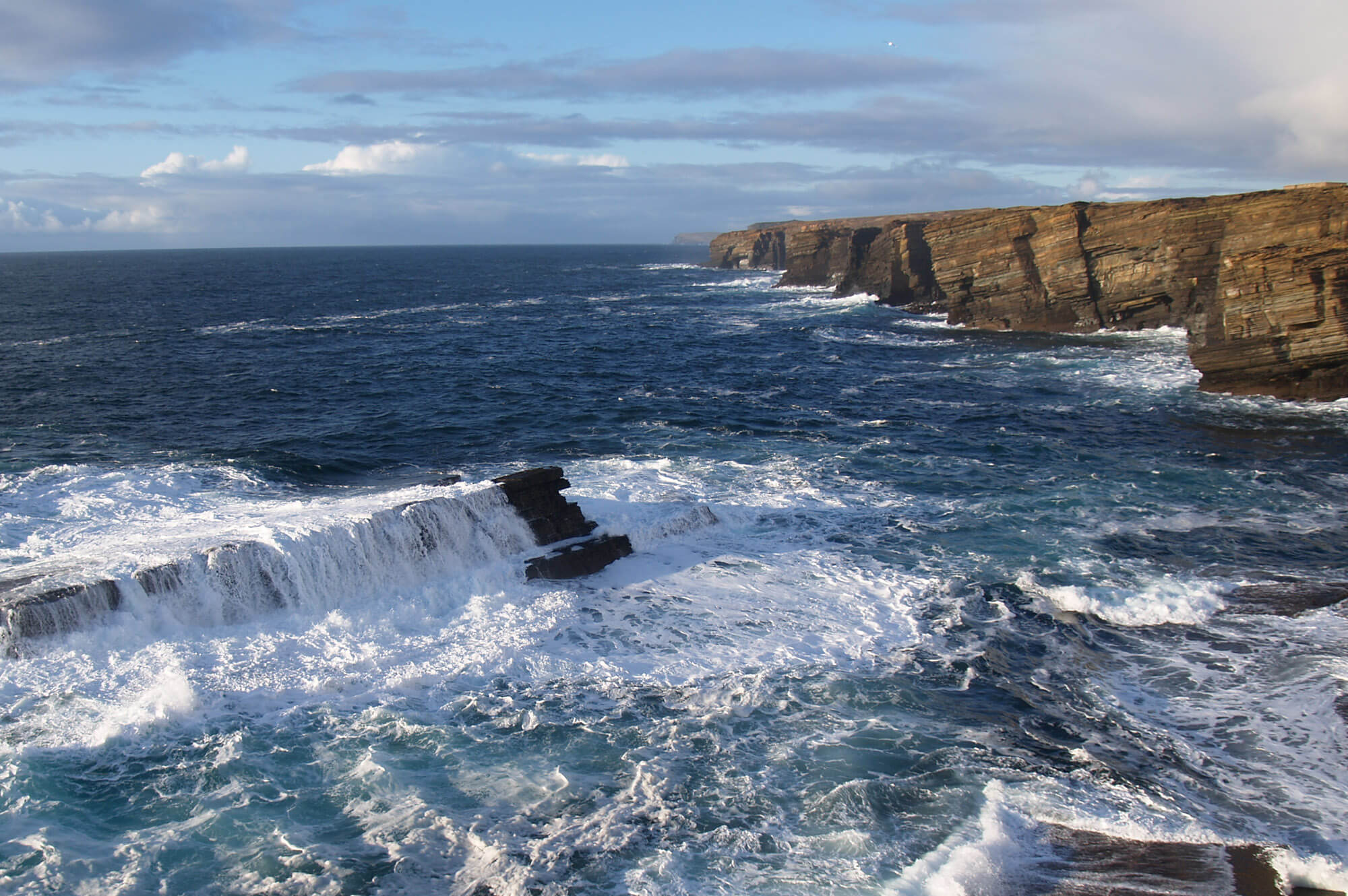
Yesnaby, Orkney Island, Scotland
A major UK research project has brought together researchers and ocean practitioners to develop practical steps which marine planners and local communities can take to protect both nature and livelihoods.
Economic development is often seen as a major barrier to climate-resilient options for ocean conservation. However, the findings, published this week (and coinciding with London Climate Action Week 2026) by the Marine Spatial Planning Addressing Climate Effects project (MSPACE) project, show that a balance can be found between nature conservation and economic development, revealing new insights into how to develop social license for climate change adaptation at local level.
The work was co-developed by scientists from Plymouth Marine Laboratory (PML), University of Essex, University of York and Heriot-Watt University, alongside marine planners at the Orkney Islands Council.
Initially the team developed the most detailed analysis yet of how climate change will affect the Orkney Islands – an archipelago north of Scotland’s mainland – its marine habitats, fishing grounds, aquaculture and the coastal communities that depend on them.
The team then spent two years working with marine planners at Orkney Islands Council to explore the region’s opportunities for climate-resilient marine nature conservation, fisheries, and aquaculture. This involved assessing how those opportunities could be realised within the context of local economic goals and broader economic structures, alongside understanding how people perceive and value the marine space.
Professor Ana Queirós, MSPACE project lead and PML’s Climate Change lead said:
“The picture is sobering. Climate change hotspots – areas where conditions are projected to shift dramatically, are putting species, habitats and at risk in the immediate future, even under the current commitments to the Paris Agreement.”
“This is causing substantial risk to the dependent economy and highlights how even countries fairly sheltered from the worst impacts of climate change – such as the UK – may still experience quite significant impacts if we don’t make stronger commitments to decarbonisation.”
“However, by working within the context of real-life policy development in Orkney, and the needs of local communities, we were able to co-develop specific solutions for adaptation that can have positive economic outcomes.”
“We found that how you consult on different options for adaptation during policy development is also key. Projects such as MSPACE provide unique lessons about how research co-developed with its users, has the greatest potential to create transformative change we need in to create sustainable ocean policy and governance in real life.”
“We desperately need to mainstream these approaches to ensure ocean life can thrive in an uncertain future, and to protect people that depend on it. We hope lessons learned from this project and the tools we developed together will be useful to others seeking to deliver a climate-resilient future for ocean life.”
How the research was carried out
Based on in depth analyses of what future climate change may hold for the UK’s conservation, fisheries and aquaculture sectors, and working with Orkney Islands Council, the research team co-developed and tested three ocean management scenarios as alternatives to the status quo, each representing a different set of priority outcomes:
- The ‘Conservation Scenario’ focused on increasing the resilience of nature to climate change. For example, it identified priority areas for climate-resilient conservation of for sharks, skates, rays and seafloor habitats under future climates.
- The ‘Food Provision Scenario’ prioritised fishing and aquaculture outcomes under climate change, identifying new priority areas for demersal and pelagic fisheries, and for water column aquaculture.
- The ‘Compromise Scenario’ attempted to balance other scenarios and economic goals under climate change
The research team also tested how acceptable each scenario was to marine planning stakeholders. In addition to surveys, separate analysis investigated what stakeholders valued most about marine space, without being shown the projected outcomes of different scenarios.
The results reveal a telling gap between stated preferences of stakeholders and their responses to concrete evidence. When ask solely about their preference regarding different aspects of the scenarios, without comparing directly the performance of each scenarios, stakeholders tended to favour a balanced approach – reflected in the Compromise Scenario ranking highest in the indirect preference analysis.
But when they were shown the actual ecological, economic and social consequences of each possible alternative scenario, they consistently rated the Conservation Scenario as the most acceptable alternative to business-as-usual, even above the Compromise.
The researchers draw a clear lesson from this divergence: the way climate change adaptation solutions are communicated in public policy consultations matters enormously. General questions about values produce general answers; specific evidence (ecological, economic, social) about specific choices produces more considered, and sometimes quite different, responses.
The timing matters. The Orkney Islands Regional Marine Plan – the statutory marine plan that helps to govern how the waters surrounding the islands are used and managed – has just been adopted in 2026. The findings and recommendations from the Orkney case-study provide new insights that can help to inform the plan’s policy framework and wider management into the future.
For example, a result of the study the team was able to develop a series of key recommendations for the spatial management of the waters surrounding Orkney islands, including:
- Protecting refugia for sharks, skates and rays to the east of the islands and around Sanday SAC and Sule Skerry and Sule Stack SPA – species of both conservation and commercial importance.
- Safeguarding priority areas for seabed habitats to the west of Orkney, which would benefit both nature and local fisheries.
- Protecting the North-West Orkney MPA from activities that disturb the seabed and release stored carbon, including trawling.
Several of these sites currently lie outside the designated protected area network, meaning changes to this network could be beneficial to bring these sites into better management. Changes to national legislation could enable protected area networks to be more agile and responsive to a changing climate – a point the report flags as a structural limitation of the current planning system.
The report also calls for stronger integration between the various planning mechanisms operating across UK waters: Fisheries Management Plans, the upcoming Scottish National Marine Plan 2, and the UK Marine Policy Statement. Without deliberate coordination, the authors warn, these processes risk working at cross-purposes.
James Green, Team Manager for Marine Planning, Orkney Islands Council, commented:
“Our Marine Planning team and local stakeholders have gained valuable insights from the MSPACE Orkney case-study. Working with the MSPACE team has significantly enhanced our understanding of how climate change will affect Orkney’s marine environment. The project recommendations will inform how we plan for a more resilient future, and work with our partners to find solutions that support our communities, environment and local economy.”
Professor Joanne Porter, MSPACE Orkney case-study lead and Deputy Director of the International Centre for Island Technology, Heriot Watt University (Orkney Campus), added:
“The MSPACE Orkney case study provides an insightful mechanism for state-of-the-art climate models to be developed and shared with regional stakeholders to support inclusive conversations about planning for the future of the archipelago’s marine environment and blue economy.”
Background
MSPACE was funded by the UK Natural Environment Research Council and the Economic and Social Research Council through the Sustainable Management of UK Marine Resources Strategic Priorities Fund WEBSITE.
The Orkney Islands is one of four case study regions examined by the project; the others cover different planning areas across UK waters. The initiative continues as an endorsed action under the United Nations Decade of Ocean Science for Sustainable Development 2021–2030.