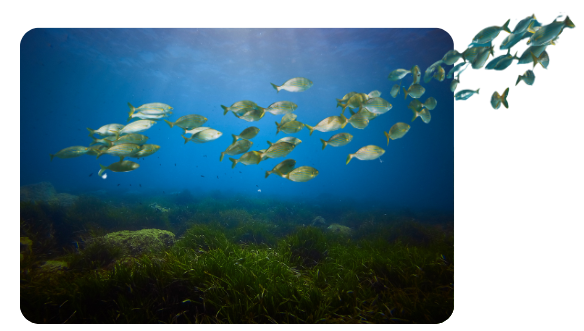
One of the greatest challenges facing our world is how to feed an ever-increasing global population in a context of climate change, economic uncertainty and growing competition for natural resources. The sustainability of fisheries is crucial to the livelihoods, food security and nutrition of billions of people, but fish stocks are under threat due to overfishing, and many other pressures including pollution and coastal development. In order to maintain and even restore the productivity of the ocean we need to ensure cohesive fisheries management, sustainable aquaculture practices and protection of key habitats.
At PML we aim to improve the security of food resources by understanding the drivers of food-webs supporting them; by striving to understand how environmental and climate change impact these living resources and their distribution; by modelling marine productivity and ecosystems to drive fisheries models investigating different climate and management strategies; by understanding that food resource exploitation occurs within a diversity of other marine resource uses, and that managing these often conflicting interests requires an understanding the structure of their associated economy.
Aquaculture or farming of both shellfish and finfish is a huge global industry which will likely have to expand to meet future needs. Our research can help to better understand how aquaculture interacts with the changing surrounding environment and how it may be affected by climate and other human-induced changes.
Harmful algal blooms (HABs) are a particular threat to aquaculture, potentially contaminating seafood and reducing production. They are characterised by a fast and extensive growth of phytoplankton, which can be harmful to organisms by depleting oxygen and releasing dangerous toxins.
High density HABs can be observed in the satellite images by using the chlorophyl estimate and ocean colour signatures. However, the discrimination of harmful and non-harmful algal blooms is a challenging task. To solve this problem we use a machine learning approach. The developed algorithms are trained on the historical satellite images of algal bloom and then then applied to estimate the risk of HAB using new images in near real time.
We use this system is to warn the fish farmers about the approaching algal blooms and the risk they may have for the farms at different locations. Of particular importance is how soon the farmers can be warned about upcoming HAB event. To reduce this time we developed a methodology that uses a dispersion modelling technique to produce a one to three day forecast of HAB risk maps. This methodology is being tested in the project Safe and Sustainable Shellfish funded by BBSRC.
-
 AgZero+ Towards sustainable, climate-neutral farming
Plymouth Marine Laboratory (PML) is a partner in a major five-year £13.8 million research programme, named “AgZero+’, to support the…
-
 Addressing Challenges of Coastal Communities through Ocean Research for Developing Economies (ACCORD)
The coastal and marine environments of South East Asia and the Western Indian Ocean (the regional foci of ACCORD) are…
-
 PRIMROSE: Predicting Risk and Impact of Harmful Events on the Aquaculture Sector
The aquaculture sector of Europe’s Atlantic Arc is negatively impacted by the effects of harmful blooms and microbial pathogens. The…
-
 S-3 EUROHAB – Sentinel products for detecting EUtROphication and Harmful Algal Bloom events
S-3 EUROHAB will use the latest satellite technology to improve the way water quality and harmful algal blooms (HABs) are…
-
 SOLSTICE-WIO: Sustainable Oceans, Livelihoods and food Security Through Increased Capacity in Ecosystem research in the Western Indian Ocean
SOLSTICE – WIO is a four year collaborative GCRF project that aims to strengthen capacity in the Western Indian Ocean…
-
 ShellEye
The ShellEye project will use Earth observation data from satellites and environmental data, such as weather forecasts, to monitor and…
- Safe and Sustainable Shellfish
- Scottish Karenia HAB
- Physics to fish ecosystem models