Story
From Treaty to reality: the science the High Seas cannot do without
02 April 2026
Following the 3rd BBNJ Symposium in Rio, a new PML-led publication outlines how science can and must underpin its delivery.
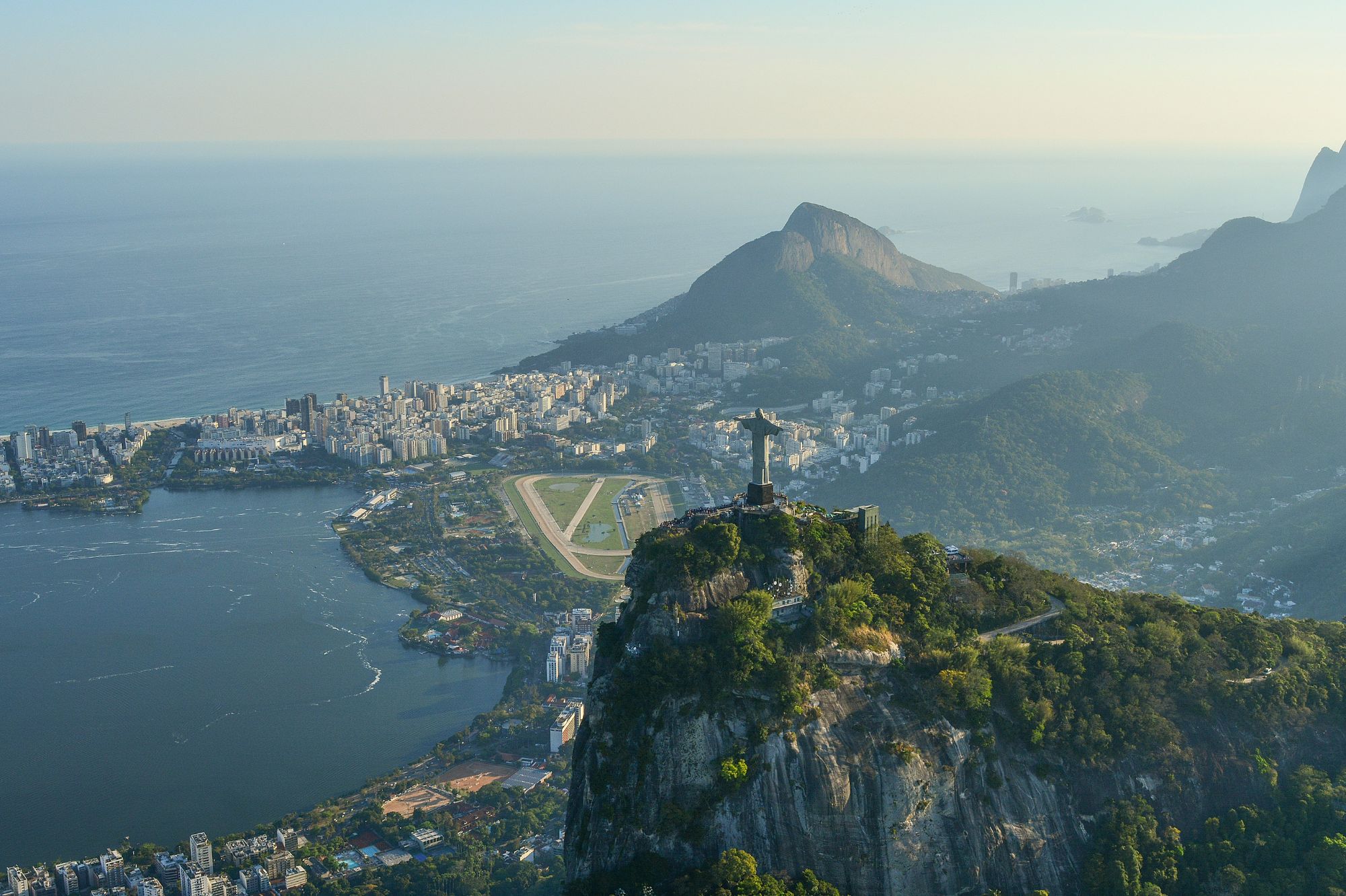
A team of experts led by Plymouth Marine Laboratory (PML) are playing a leading role in efforts to turn the world’s most significant ocean protection treaty from historic commitment into real-world impact – publishing a scientific roadmap and helping shape national and international policy discussions, including at last month’s Third BBNJ Symposium in Rio de Janeiro, Brazil.
After nearly two decades of negotiations, the United Nations adopted the High Seas Treaty – officially known as the Biodiversity Beyond National Jurisdiction (BBNJ) Agreement – in June 2023. In September 2025, it crossed a critical milestone: 60 countries had ratified, giving it the legal weight to become binding international law as of January 2026.
Watch now: United Nations Secretary‑General’s message on the entry into force of the BBNJ Agreement
The Treaty protects the vast stretches of international ocean that lie beyond the Exclusive Economic Zones (EEZs) of coastal nations and is regarded as a monumental diplomatic achievement. It enshrines conservation, sustainable use, and fairness, and is designed to ensure that the benefits of ocean resources are shared equitably rather than harvested solely for the benefit of the most powerful.
But the scale of the challenge is staggering. Less than 30% of the deep sea has been mapped to modern standards, and an estimated 90% of marine species have yet to be discovered.
This brings with it the complex issue of how science can best be leveraged by the Treaty and mobilised at the pace and scale required to ensure it delivers on its ambitions.
PML scientists have been actively engaged in shaping the Treaty’s implementation from the outset – convening experts at international fora (e.g. UN Ocean Conference), contributing to the UK’s development of its own legislation on the BBNJ, attending international preparatory committee meetings in 2025 and working with bodies supporting BBNJ implementation at the national level such as the International Panel for Ocean Sustainability (IPOS).
Professor Matt Frost (PML’s Head of the International Office) and Professor Ana Queirós, (PML’s Ocean Challenge Lead for Climate Change and a specialist in climate-smart marine spatial planning) attended the Third BBNJ Symposium in Rio de Janeiro on 10-12th March, leading a satellite event focused specifically on climate-smart pathways for the high seas.
“The BBNJ is an incredible opportunity, including in terms of how it will consolidate and achieve global marine protection goals. But making the rules is actually the easier part – ensuring delivery is where the real challenge lies.”
“This unprecedented exercise in global diplomacy requires the strategic mobilisation and utilisation of the best available scientific data, expertise and technology. Furthermore, it will require major capacity-building in those geographic areas where resources have historically been limited or inaccessible.” said Professor Frost.
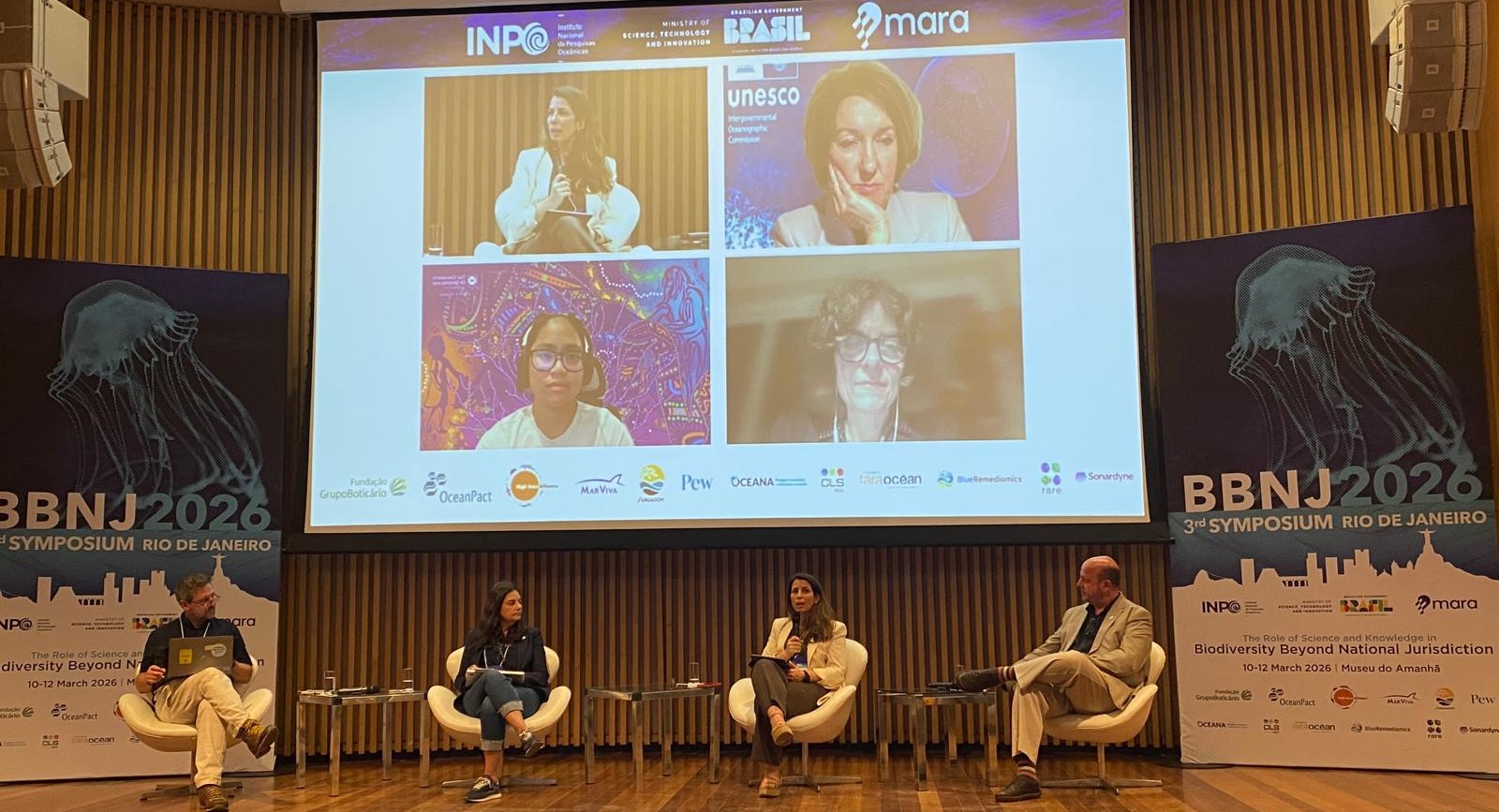
Image: PML’s Professor Matt Frost (left) and Professor Ana Queirós (second from right) led a side event titled: ‘A climate-smart pathway for BBNJ’ at the Third BBNJ Symposium this month.
Making the Treaty Work
Hot on the heels of the Symposium, a new paper, led by Dr Claire Szostek (PML and University of Plymouth) alongside a team of colleagues from PML, the Nature Conservancy and the Natural History Museum, sets out a comprehensive scientific roadmap for delivering on the Treaty’s ambitions – assessing the critical knowledge gaps, identifying solutions that are ready to be scaled up, and charting the path ahead.
The paper addresses each of the Treaty’s four pillars in turn – Marine Genetic Resources, Area-based Management, Environmental Impact Assessments, and Capacity Building and Technology Transfer – identifying where knowledge is lacking, where solutions already exist, and where investment and innovation are urgently needed.
Under the pillars of ‘Marine Genetic Resources’ and ‘Area-based Management’, the paper highlights that scientists must close fundamental gaps in biological and molecular data – using novel and evolving tools such as environmental DNA sampling, AI-powered image analysis and open-access databases – while also tackling the challenge of mapping vast, poorly understood ocean spaces.
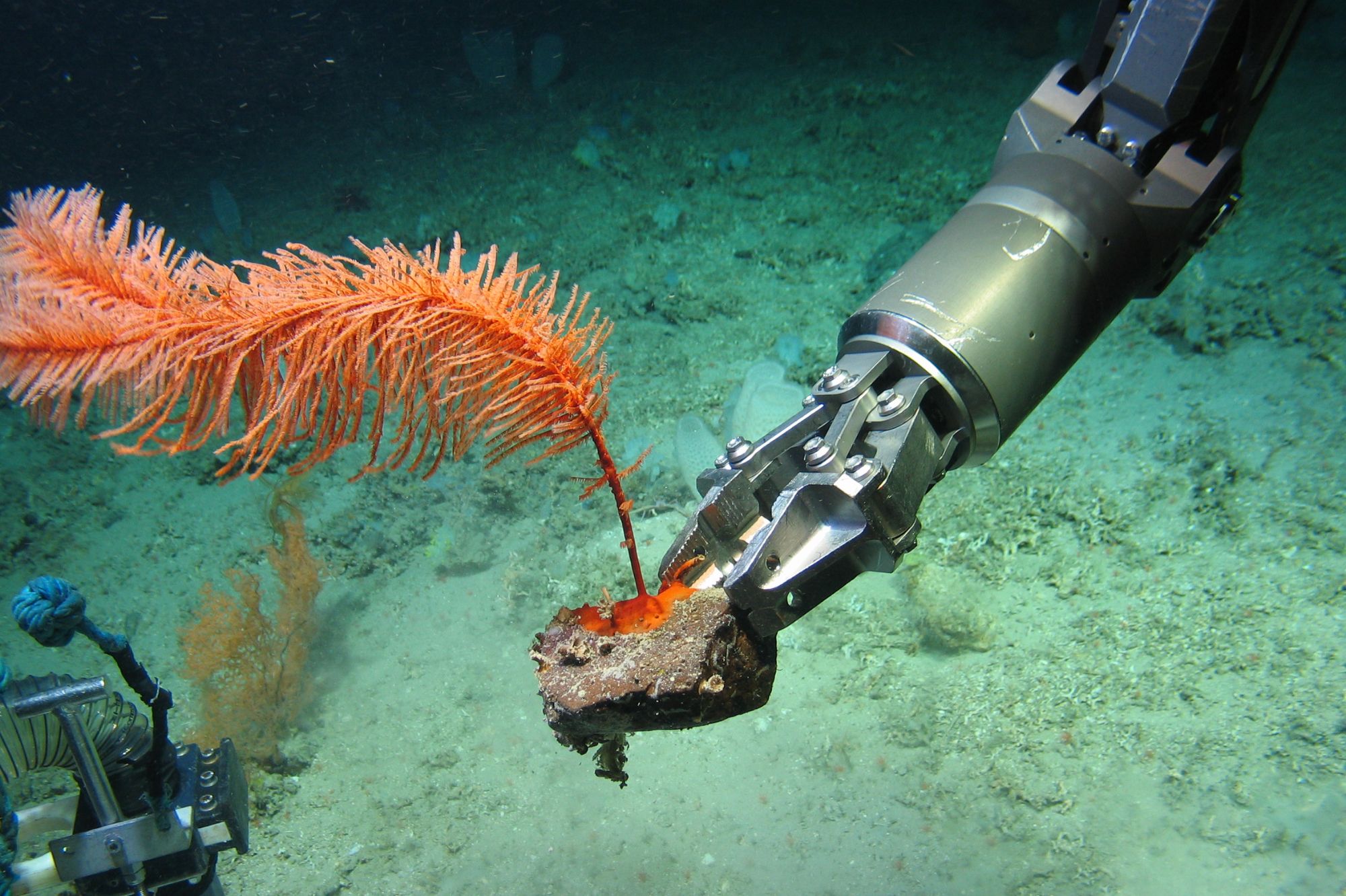
Image: Sampling marine life on the deep seabed – Image courtesy of Eurofleets 2, Marine Institute, University of Plymouth. Just this month, PML’s Kerry Howell launched the ‘Deep Vision’ project to help guide marine management and conservation in the High Seas. The project will use AI to unlock critical biodiversity data from thousands of hours of seafloor imagery.
Dynamic marine protected areas, satellite species tracking, and decision-support tools that integrate both ecological and economic data will all be essential. So too will Environmental Impact Assessments that move beyond isolated, localised studies to capture the full, cumulative scale of human pressure on the high seas – drawing on regional collaboration, shared data, and advanced modelling.
Underpinning all three is the Treaty’s fourth pillar, and perhaps its most important: Capacity Building and Technology Transfer. The Treaty will only succeed if the science behind it is truly global – and that requires deliberate investment in low-cost technologies, international knowledge-sharing networks, and support for early career researchers across all nations.
“The high seas are not simply a bigger version of coastal waters – they are a fundamentally different scientific challenge. Many of the existing tools and methods were built for shallower, more accessible environments, and they fall short when we push into the deep open ocean,” said lead author Dr Claire Szostek.
“The data we need, from the surface all the way to the seafloor, simply doesn’t exist yet at the scale required. And all the while, climate change is restructuring these ecosystems, pollution is causing damage to marine life far from shore, and commercial exploitation is accelerating. We are trying to protect something we do not yet fully understand, under a timeline we did not choose. That means we cannot afford to do science at the usual pace. We need new technologies, smarter monitoring systems, and increased levels of international collaboration.”
Co-author, Dr Jeff Ardron, of The Nature Conservancy, said:
“For States to meet their commitments to protect the global ocean, we will have to get serious about understanding the high seas. Fortunately, we already know enough to get started. For example, the Walvis Ridge acts as a biological bridge from Namibia’s continental shelf out to the mid-Atlantic Ridge, even though the details remain unstudied. There are many such ecologically significant areas that that deserve our research attentions and protections.”
Co-author, Chris Lyal, a researcher at Natural History Museum, London added:
“The new Treaty marks a new and exciting prospect for managing and protecting marine biodiversity, and a global determination to improve how we protect the oceans. The next challenge is how we put this into practice. The number of species of microorganisms, animals and plants in the oceans of our world is huge – but we know surprisingly little about what they are or how they live. Every year many species new to science are discovered and named – but there are many more which are awaiting analysis. Part of the roadmap to implementing the treaty is improvement of our data collection and the process of identification, description and monitoring of oceanic biodiversity. The political will that enabled the treaty must now turn to supporting the science that will make it work.”
One of the most pressing questions now facing the Treaty is how its incoming Scientific and Technical Body – expected to comprise just 25-30 individuals – will effectively connect with the wider global science community. PML and its partners are committed to helping bridge that gap: ensuring science is better coordinated, more accessible, and ready to be deployed at the scale and speed the ocean – and the Treaty – demands.
“There is a great sense of optimism around the BBNJ, plus a clear need to learn from, and harmonise it with, the commitments under the UNFCCC, the CBD and the anticipated Plastics Treaty,” concludes Professor Frost.
“At the core of it though, while the Treaty exists, only science can make it count.”
Access the full paper, ‘Science challenges and solutions to support implementation of the Biodiversity Beyond National Jurisdiction Agreement’ >>
Related information
- The paper “Science challenges and solutions to support implementation of the Biodiversity Beyond National Jurisdiction Agreement”, is led by Dr Claire Szostek of Plymouth Marine Laboratory and the University of Plymouth (from February 2026) alongside PML’s Prof Angus Atkinson MBE, Dr Victor Martinez-Vicente, Prof Ana Queirós, Dr Peter Miller, Prof Kerry Howell, Dr Rebecca Millington, Dr Susan Kay, Dr Karen Tait, Dr Elizabeth Talbot, Prof Andrew Rees and Prof Matthew Frost, and Matthew Faith (The University of Plymouth / Alan Turing Institute), Chris Lyal (Natural History Museum), and Dr Jeff Ardron (the Nature Conservancy).
- The BBNJ Agreement entered into force on 17 January 2026.
- The Third BBNJ Symposium took place in Rio de Janeiro, Brazil, in March 2026: Third BBNJ Symposium 2026