Story | 16 April 2026
International team of scientists launch Atlantic-wide coral mapping project
Coral Cartography is being formally launched at the All-Atlantic Ocean Research and Innovation Alliance in Brazil.
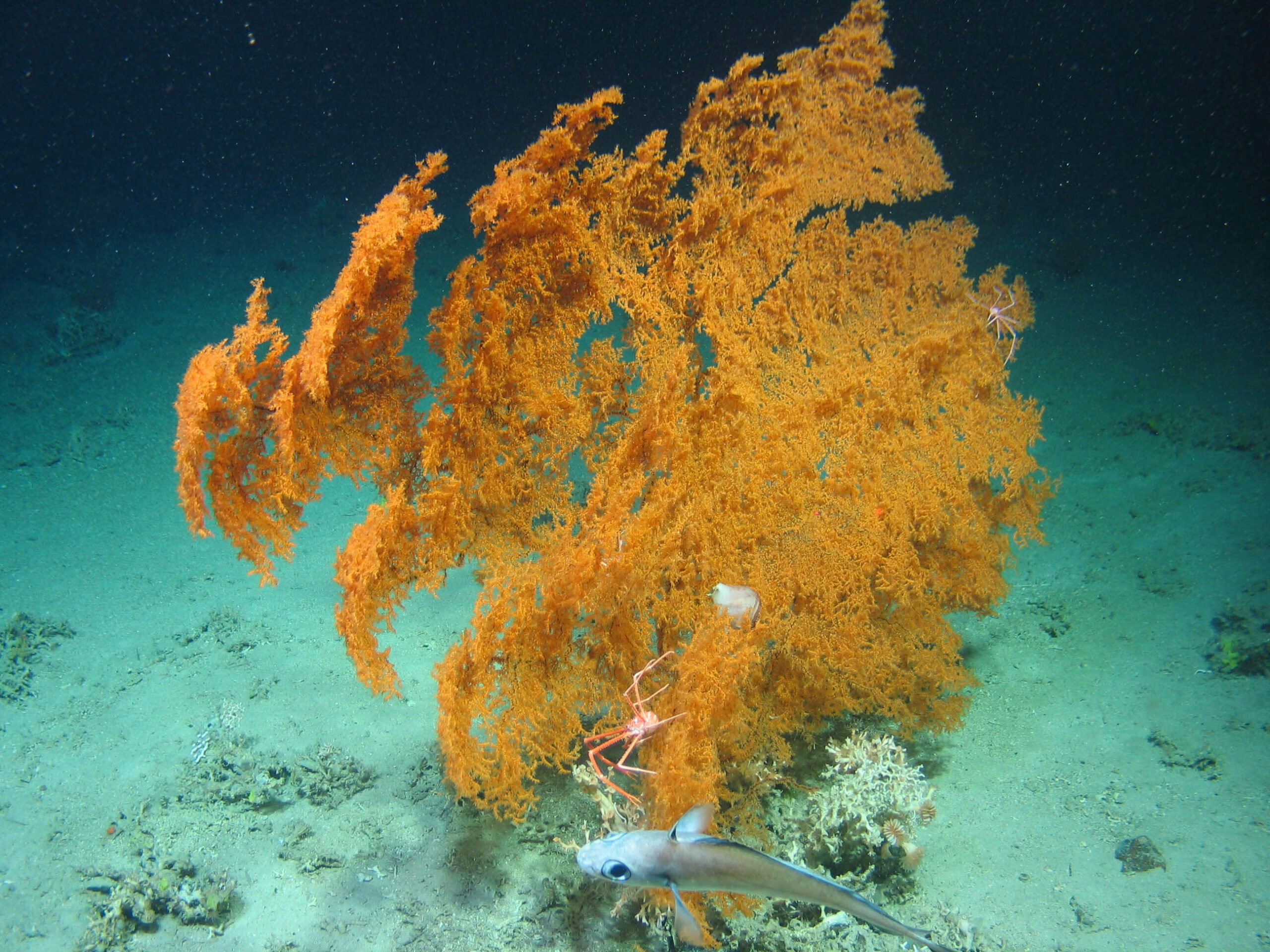
Image: Deep-sea fan. Courtesy of Eurofleets 2, Marine Institute, University of Plymouth
An international team of scientists is today (16 April) launching Coral Cartography: Mapping Atlantic Cold-Water Corals to support Area Based Management at the 2026 All-Atlantic Ocean Research and Innovation Alliance (AAORIA) Forum – a flagship gathering of the Atlantic scientific community.
Funded through one of the funding calls of the Coral Research and Development Accelerator Platform (CORDAP) – a G20 initiative launched in 2020 to fast-track solutions to protect the world’s corals – the project unites experts from nine countries across the Atlantic in image-based survey, coral taxonomy, mapping, management, and policy engagement, including Norway, UK, Portugal, Germany, Mauritania, Namibia, South Africa, Uruguay and Brazil.
Cold-water corals (CWC) are a critical component of deep-sea ecosystems, facing growing threats from fishing, deep-sea mining, and climate change. While the North Atlantic benefits from relatively rich data on coral distribution, the Central and South Atlantic remain significantly under-researched. The international team will address that gap by unlocking large repositories of previously unanalysed imagery data – including from the EAF Nansen Programme off the West African Margin, and new data to be collected later this year off Brazil – bringing together knowledge and expertise from across the Atlantic basin to build a comprehensive picture of cold-water coral habitats for the first time.
The project will develop a standardised dataset of coral distribution and density in the Atlantic for those areas already explored. These will then be used to train machine-learning models to predict the distribution of corals in other areas, effectively enabling the team to fill the gaps.
It is hoped that the resulting maps of cold-water coral distribution, density, and diversity – under both current conditions and future climate change scenarios – will be used to identify areas at risk and candidate sites for protection within national Exclusive Economic Zones and on the High Seas.
Crucially, findings will be communicated directly to key international decision-making bodies, including Regional Fisheries Management Organisations, the International Seabed Authority, the Convention on Biological Diversity, OSPAR, and national governments, with the aim of securing legal protections for critical cold-water coral ecosystems. A central pillar of the project is training a new generation of cold-water coral researchers and forging lasting collaborative relationships among Atlantic nation scientists.
The project is being led by Plymouth Marine Laboratory (PML) alongside 11 project partners. PML’s Professor Kerry Howell, project lead and co-lead of the UN Ocean Decade Programme Challenger 150, said:
“Cold-water corals support some of the most remarkable ecosystems in the deep ocean, yet vast stretches of the Atlantic remain unmapped and unprotected. By bringing together previously inaccessible data, machine-learning, and an internationally connected team of experts, this project will give decision-makers the evidence they need to protect these fragile habitats – now and as our ocean changes. Critically, we will be building the scientific capacity essential for the long-term stewardship of the Atlantic.”
Dr Ana Hilário co-lead of the Challenger 150 Programme, said:
“In the North Atlantic, we have accumulated big volumes of deep-sea video and imagery over the past two decades, but most of it remains unanalysed because manual interpretation is so time-consuming. By unlocking these archives, we can significantly accelerate our understanding of the deep-sea and develop robust species distribution models to predict their occurrence under current and future climate conditions, helping to guide the protection of these vulnerable ecosystems.”
Dr Lara Atkinson of the South African Environmental Observation Network, said:
“Forging collaborations within a growing international network of deep-sea researchers unlocks opportunities for countries like South Africa, simultaneously elevating the scope and quality of our national research and expanding the scale at which we can advance knowledge of our deep-sea ecosystems. Projects like Coral Cartography are initiatives that enable us to provide more accurate, actionable information on the critical areas that require management interventions. Showcasing South Africa’s progress in deep-sea research and exchanging knowledge with others through platforms like AAORIA, means our collective research becomes far greater than the sum of its individual parts, and this amplification is what we need to achieve the ocean we want.”
The project launch is taking place at the AAORIA Forum in Salvador, Bahia – hosted by the Brazilian Ministry of Science, Technology and Innovation – which brings together the Atlantic community to advance ocean science, international cooperation, and collaborative action. The Forum advances the All-Atlantic Declaration, signed in 2022 by Argentina, Brazil, Cabo Verde, Canada, Morocco, South Africa, the United States of America, and the European Union, with growing support from further countries and partners.