Story
Joining forces on harmful algae: PML leads satellite project with NZ partner
07 January 2026
As South Australia confronts one of its most damaging harmful algal blooms on record, a new UK–New Zealand research project led by Plymouth Marine Laboratory (PML) will boost monitoring of phytoplankton that produce toxins, early-warning systems and coastal resilience across the Southern Hemisphere.
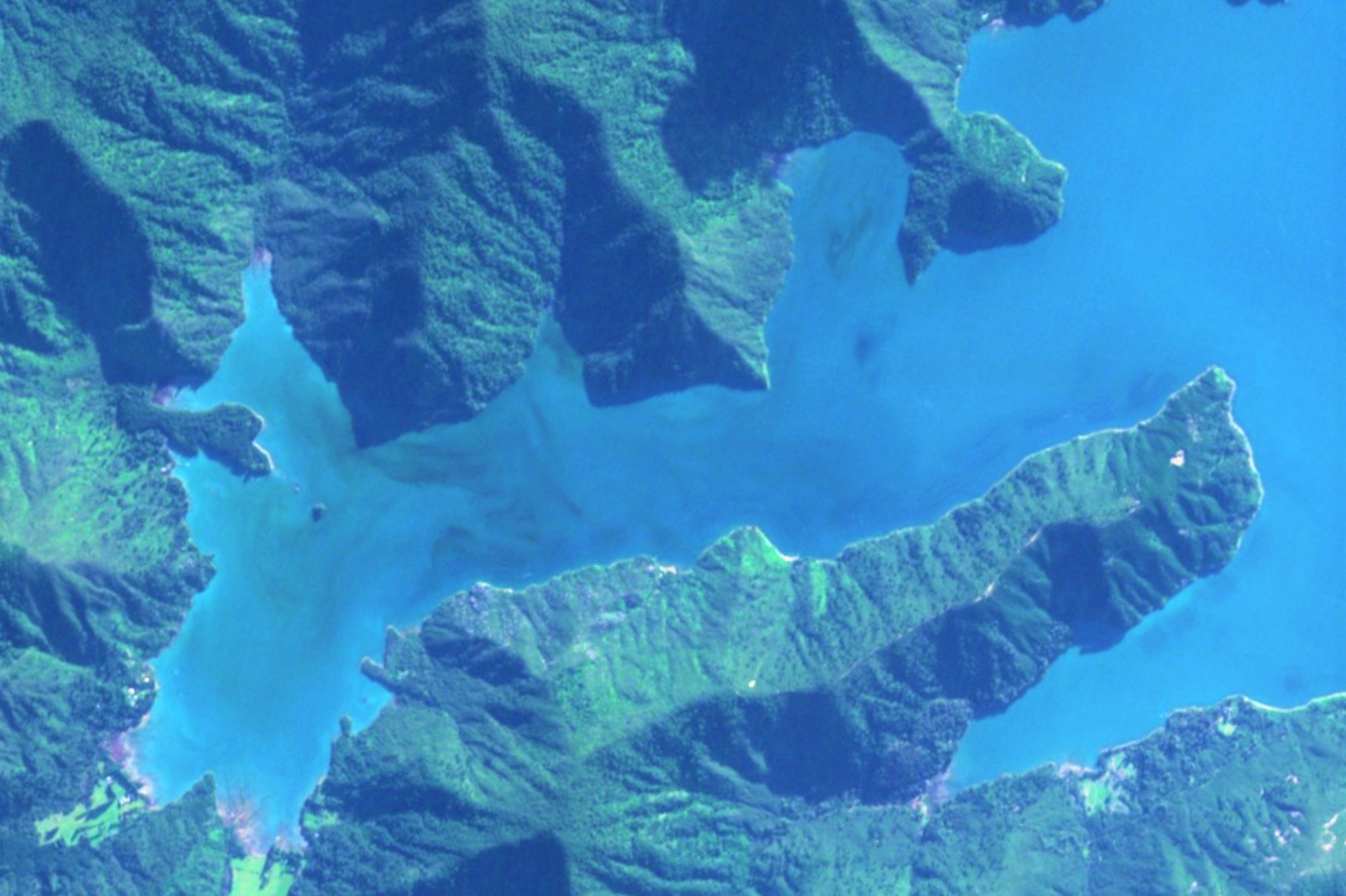
Image: “One of the biggest toxic blooms we have observed by satellite,” said Ben Knight, Marine Biophysical Scientist at the Cawthron Institute. The satellite image shows an Alexandrium pacificum bloom in Pelorus Sound – north of the South Island, New Zealand – in 2018. Cell counts were more than 1 million/L in this event. Image credit: ESA Sentinel 2, Cawthron supplied.
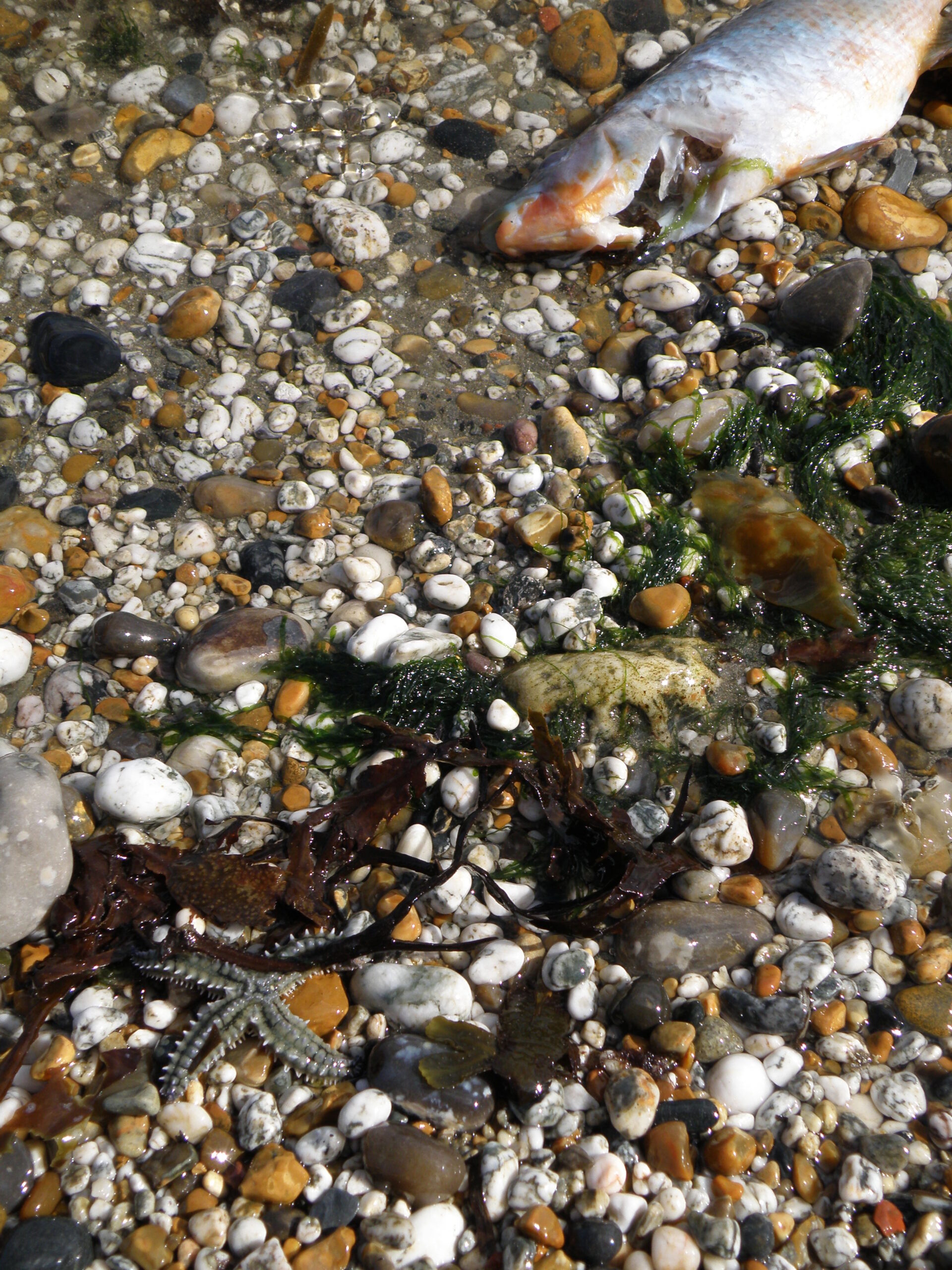
In Australia, an unprecedented harmful algal bloom, described like an “underwater bush fire”, has swept through coastal waters, leaving devastation in its wake. Across social media and news outlets, harrowing images of dead fish, seahorses, octopuses and rays illustrated the sheer scale of the crisis.
According to Professor Jochen Kaempf of Flinders University, Australia, the scale of the bloom is unlike anything previously recorded – and shows no signs of stopping:
“An underwater bloom of toxic algae has wreaked havoc off the coast of South Australia since mid-March 2025. After eight months [and still ongoing], this harmful algal bloom is the longest and one of the most environmentally devastating events ever recorded in Australian waters.
The bloom has affected more than 390 species, with more than 87,000 dead animals reported to the iNaturalist database. The true number of deaths is likely in the millions.
There is still no end in sight for this environmental disaster. It’s impossible to know exactly what might happen to this vast toxic bloom this summer, as the ocean heats up.”
[Source: The Conversation Australia and New Zealand]
Watch now: ‘Environmental Disaster’: Algal bloom decimating Australian coasts and industries
The Harmful algal blooms (HABs) hitting Australia and those affecting New Zealand are not directly linked – they arise from different local ocean conditions – but scientists agree that the underlying drivers are shared: warming seas, shifting circulation and upwelling patterns, and changing nutrient inputs may all contribute to increased HAB risks throughout the Southern Hemisphere.
The causes and effects of algal blooms
Algal blooms occur when environmental conditions – like warm temperatures, stable water columns, sunlight, rainfall, and nutrient-rich runoff – promote the growth of naturally present algae or cyanobacteria.
These blooms happen in both freshwater and marine environments worldwide, sometimes lasting for weeks or months, and when in high enough concentration, are visible from space.
While many blooms are harmless, some involve species that:
- produce toxins harmful to fish, shellfish, and humans,
- can clog or mechanically damage fish or shellfish species,
- reduce oxygen levels in the water,
- block sunlight needed by underwater plants, or
- smother aquatic habitats.
HABs can carry serious ecological, economic, and health impacts – and their frequency is expected to rise with climate change, due to rising temperatures, that favour many HABs, and more frequent heavy rainfall, (that fuel surface waters with nutrients) or storm events, (that remove other phytoplankton whilst bringing nutrients to the sunlit surface from depth).
Against this backdrop of escalating environmental pressure, a new research partnership – funded through the International Science Partnerships Fund – has been launched to enhance satellite-based tracking of phytoplankton communities and harmful algal groups.
The project, entitled: ‘Detecting phytoplankton communities and HABs with next-generation hyperspectral sensors’ (PhytoHAB-EO4NZ) is a collaboration between PML and the Cawthron Institute (New Zealand). It will develop new methods to determine phytoplankton community composition from hyperspectral optical sensors. HABs absorb light at specific wavelengths which is subtly different to other phytoplankton groups. The project is determining the signature of this light absorption using optical sensors, developing equations to reproduce it, and applying them to hyperspectral ocean colour satellite sensors such as NASA’s PACE instrument, so that the principle HAB groups can be detected from space.
Understanding the succession of phytoplankton groups – that lead to HABs – is essential for developing early warning systems to protect marine life in both New Zealand and the UK. Previous satellite ocean colour sensors such as MODIS-Aqua provided high quality imagery of phytoplankton blooms, but were not able to distinguish the different groups within a bloom, since they measure the colour at specific wavebands. The recently launched NASA PACE mission now makes this possible.

Image: Satellite data can be used to support faster, more accurate and wider-scale monitoring of water quality and phytoplankton communities than traditional in-situ field monitoring alone. With the launch of NASA PACE (pictured in this image), detection of HAB groups from space is now possible.
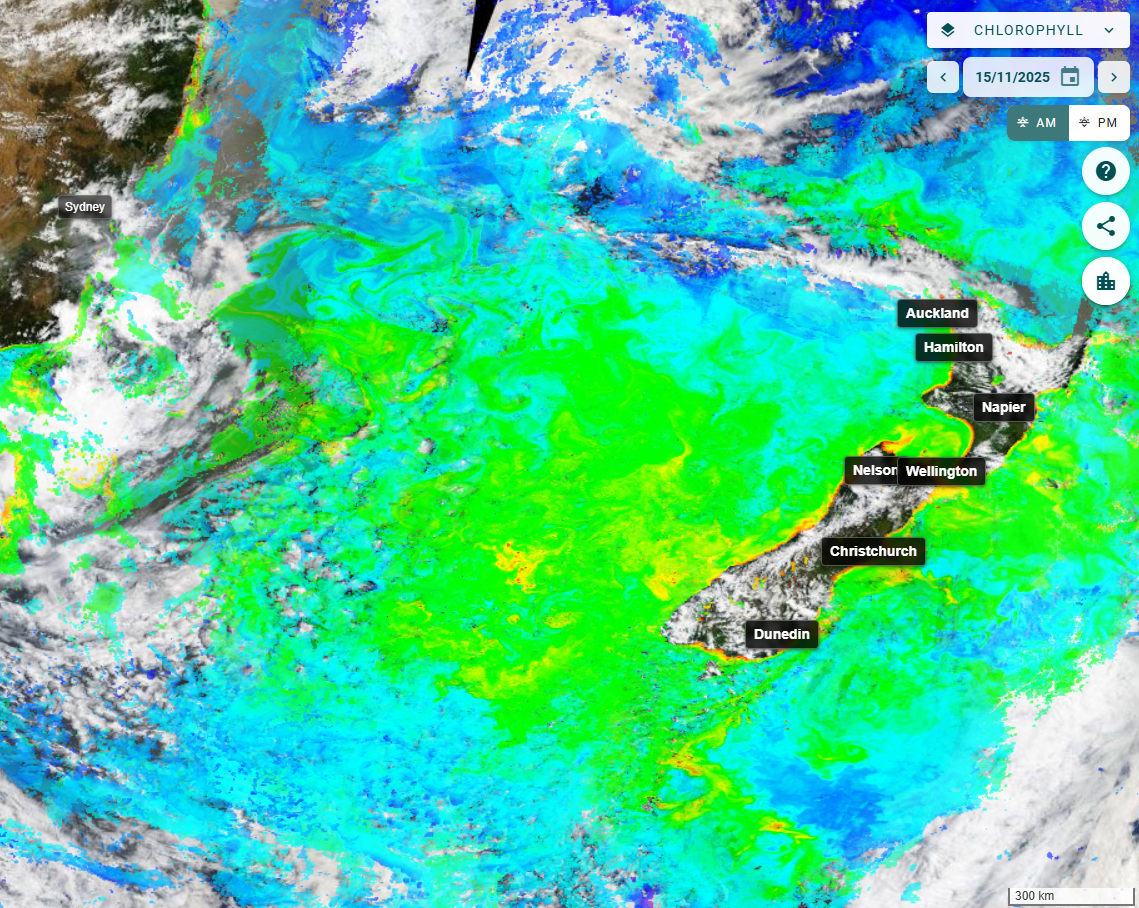
Image: MODIS-Aqua image showing high concentrations of chlorophyll-a in the Tasman Sea during the spring bloom period. Image credit: NASA MODIS, CawthronEye.
This partnership project will use the new hyperspectral satellite reflectance data from PACE and information derived from in field optical sensors about the absorption of light by different phytoplankton groups that lead to – and include – HABs, to enable fast and wider-scale monitoring of HABs that cannot be achieved by traditional field sampling alone.
The methods are applicable to both autonomous optical sensors in the field and the new generation of hyperspectral ocean colour satellites – such as the sensors onboard NASA’s PACE mission – and will advance the monitoring of harmful algae from both field- and space-based measurements.
This year’s high-profile HAB in South Australia has heightened public concern across the region. While the Australian event is not directly connected to New Zealand waters, both countries are grappling with similar climate- and anthropogenic-driven pressures.
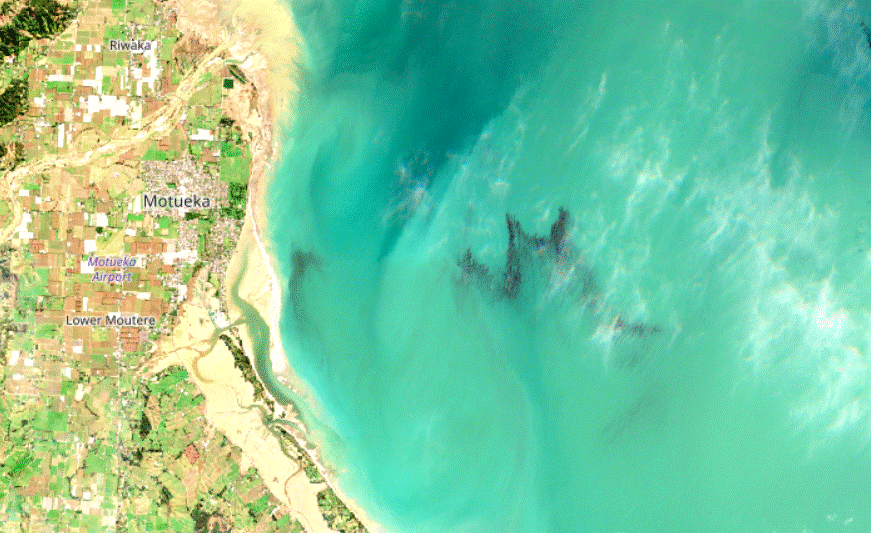
Image: A non-toxic Mesodinium bloom near to Motueka (South Island, New Zealand) on 1 August 2025, from the ESA Sentinel 2 satellite. Image credit: ESA, Cawthron supplied.
This new UK–NZ collaboration arrives at a crucial moment – building the scientific tools needed to detect and respond to environmental risks before they escalate into crises that threaten marine life, coastal communities and the blue economy.
Dr Gavin Tilstone, project lead at PML, said:
“With increasing climate-driven pressures and pollution, we’re entering a period where coastal ecosystems can change faster than we can possibly sample it using boat surveys and in-water measurements.”
“Satellite technologies in concert with conventional water samples, can provide us with a truly scalable way to track these shifts in real time. With our partners in New Zealand, we can develop next-generation tools, for both the UK and New Zealand, that detect harmful algal blooms before they become problematic.”
“This new project with New Zealand is developing an early warning system for HABs, using both satellite ocean colour images and autonomous optical sensors, to support a faster response to HABs and facilitate quicker mitigation strategies from marine managers and aquaculture companies”.
Cawthron researchers Dr Kirsty Smith and Ben Knight note that:
“The UK and New Zealand are both maritime nations with our economies and culture tied to the oceans around us – collaborating on the development of these important tools just makes sense. We are excited to be working with PML on the next generation of spectral monitoring tools that will help us better understand changes in the phytoplankton communities that support and challenge our ocean ecosystems.”
The project is led by Dr Gavin Tilstone and Dr Tom Jordan as the PML team, and Tom shared the image below as a ‘first look’ of potential HAB groups from the hyperspectral Ocean Color Instrument onboard PACE in New Zealand waters which are being processed for the project.
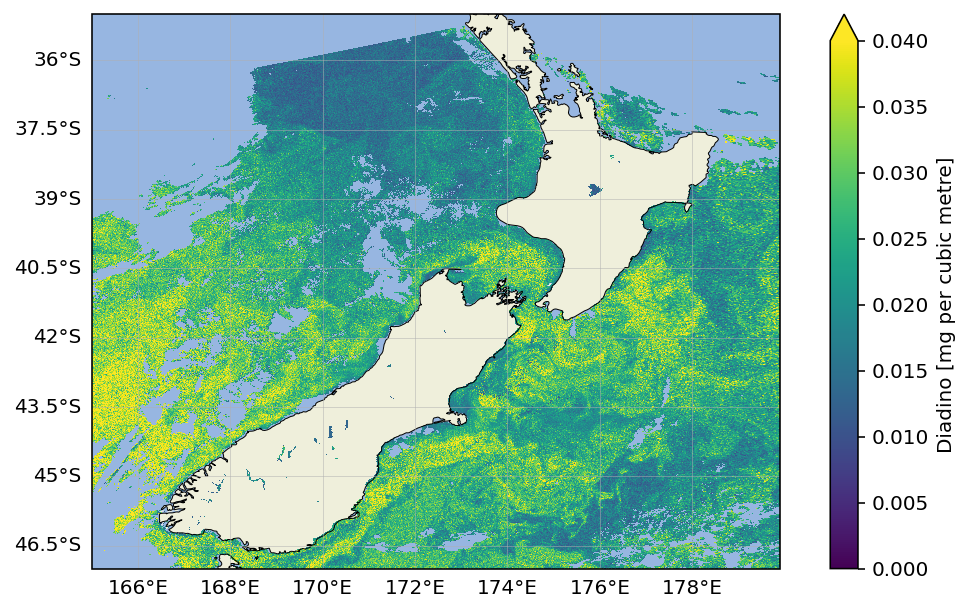
Image: “This image shows our first look at predictions of the pigment diadinoxanthin from hyperspectral PACE reflectance in New Zealand waters on 16th Nov 2025,” said PML’s Dr Tom Jordan. Diadinoxanthin is a key accessory pigment in many types of algae, particularly dinoflagellates and diatoms, which are two of the most common groups responsible for HABs.
Stay tuned on our website and social media channels for further updates on the project.
Related information
The project is funded through the International Science Partnerships Fund, started in October 2025 and will finish in March 2026. New Zealand participation is also supported through the MBIE “Changing Microalgal Communities” research programme (https://www.cawthron.org.nz/research/our-projects/changing-microalgal-communities-research-programme/).