Story
MEDIA: Drastic seaweed growth threatens marine life and fishing – but also offers opportunities
13 February 2026
PML’s Dr Yanna Alexia Fidai writes for The Conversation UK on how native and invasive (non-native) seaweeds are appearing in quantities that are hard to ignore.
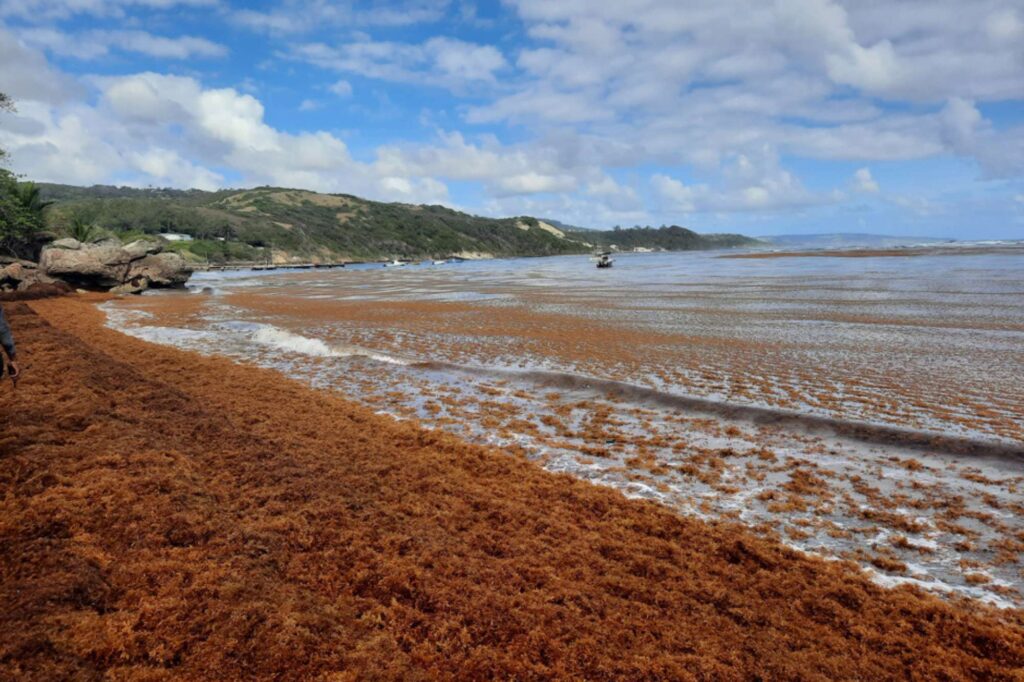
Image above: Sargassum chokes a popular tourist beach in Barbados. As the seaweed decomposes, it emits harmful gases such as hydrogen sulfide, methane, and ammonia. These emissions, along with the leaching of arsenic and heavy metals, can pose risks to both human health, ecosystem biodiversity, and local water supplies. Image credit: Dr Yanna Alexia Fidai.
“Seaweed blooms are not a new phenomenon. But over the past 15–20 years, their scale and persistence have increased noticeably.
Of particular concern are free-floating seaweeds: species that float at the ocean surface, either because they detach from the seabed or because they spend their entire lives drifting. Unlike seaweeds that are anchored to the seafloor, floating seaweed can travel long distances to new territories and accumulate in large mats or wash ashore in huge quantities.
One example I have spent much of my career studying is sargassum. Like something from a sci-fi movie, I’ve seen swathes of sargassum seaweed spreading across the tropical Atlantic, with mats reaching depths of 7 m and spanning hundreds of square miles.” [Excerpt from The Conversation UK]