Story
PML project will help predict future octopus blooms
31 March 2026
A diverse range of PML researchers have come together to develop a methodology that would help stakeholders – from fishers and citizens, to scientists and decisionmakers – in the Southwest anticipate future octopus blooms, adapt to changing conditions, and support more resilient, data-driven decision-making.

Image: Two Common octopus and the remains of a lobster hauled in from a lobster pot. Image credit: South Devon and Channel Shellfishermen Ltd.
The team, bringing skills from a range of disciplines – including Earth observation, data modelling, research software engineering and digital infrastructure – secured funding for the novel research last year when they were selected as one of the three winning teams in the 2025 Blue-Cloud Hackathon.
In the Hackathon, through their project titled ‘Octopulse’, the team analysed both historical and real-time data from the Western Channel Observatory – an oceanographic time-series and marine biodiversity reference site in the Western English Channel, and one of the most widely studied bodies of water in the world – alongside satellite and model data, to help communities to identify the ‘perfect’ conditions that drive octopus blooms.
Following their success in the Hackathon, the team is now using the funding to develop the concept further.
Background: the octopus bloom in the Southwest
The Common octopus (Octopus vulgaris) is native to UK waters but is typically rare, favouring warmer seas further south in Europe and the Mediterranean.
The current bloom in the Southwest UK, which really accelerated from January 2025 – and is still continuing over one year on – is having significant effects on both fisheries and marine ecosystems.
Beshlie Pool, Executive Officer of the South Devon and Channel Shellfishermen Ltd, explains the situation as it stands, and the impacts on local livelihoods:
“2025 brought huge changes to traditional fisheries across the Southwest. In our area, Common octopus began appearing in huge numbers from late February, leaving a trail of destruction behind, with crab and lobster pots filled with the remains of eaten shellfish.”
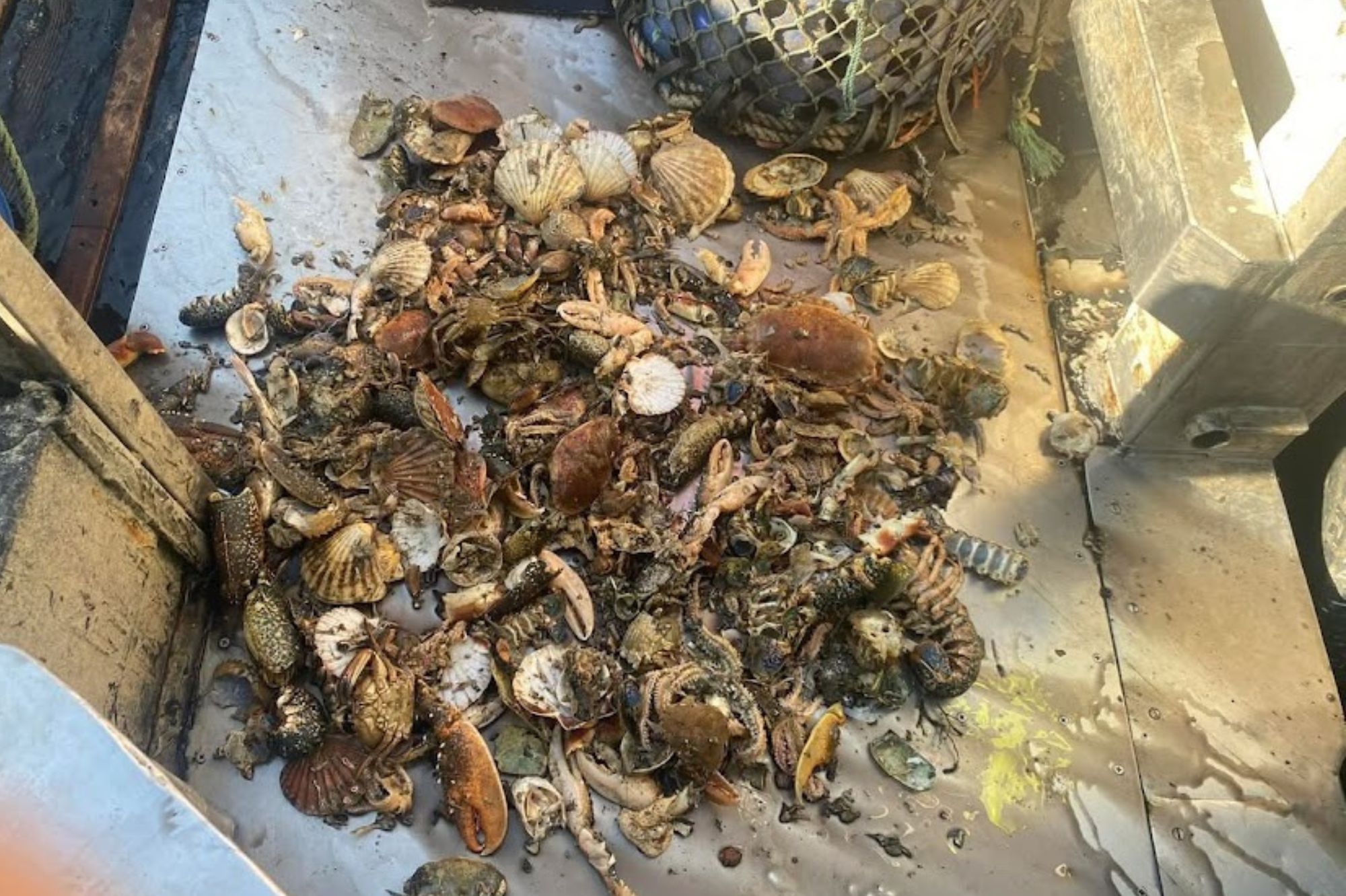 Image: Fishermen from Plymouth haul up pots full of empty shellfish, crab and lobster shells. Image credit: South Devon and Channel Shellfishermen Ltd.
Beshlie continues:
“As a community of crab fishermen, for whom crab and lobster is our heritage and regional identity, the influx of Common octopus has been incredibly concerning.”
“Whilst there are some who have been able to catch octopus – because of where they fish – others have not, and instead have only seen the remains of what has been eaten. It is a very difficult time for our community.”
“We value all work that can help us learn to predict what may come next.”
Crab and lobster populations are not the only species affected, as Jack West of Ann Louise Fishing in Mevagissey, Cornwall explains:
“I’m a scallop fisherman, and since the octopus bloom we’ve seen a major impact on the scallop population – scallops are now almost non-existent in some bays. While it’s created an opportunity for some of us to target octopus, and in the short term that’s been financially beneficial as they return good prices, the longer-term picture is a real concern. Fishing has already been very poor over the past couple of years, and there are worries about what this means for future stocks and breeding populations.”
“Although I’ve personally been able to build a market for octopus and adapt – building a good client base with pubs and restaurants to buy octopus catches – the situation is so severe for scallops that, this year, I won’t be fishing for scallops at all.”
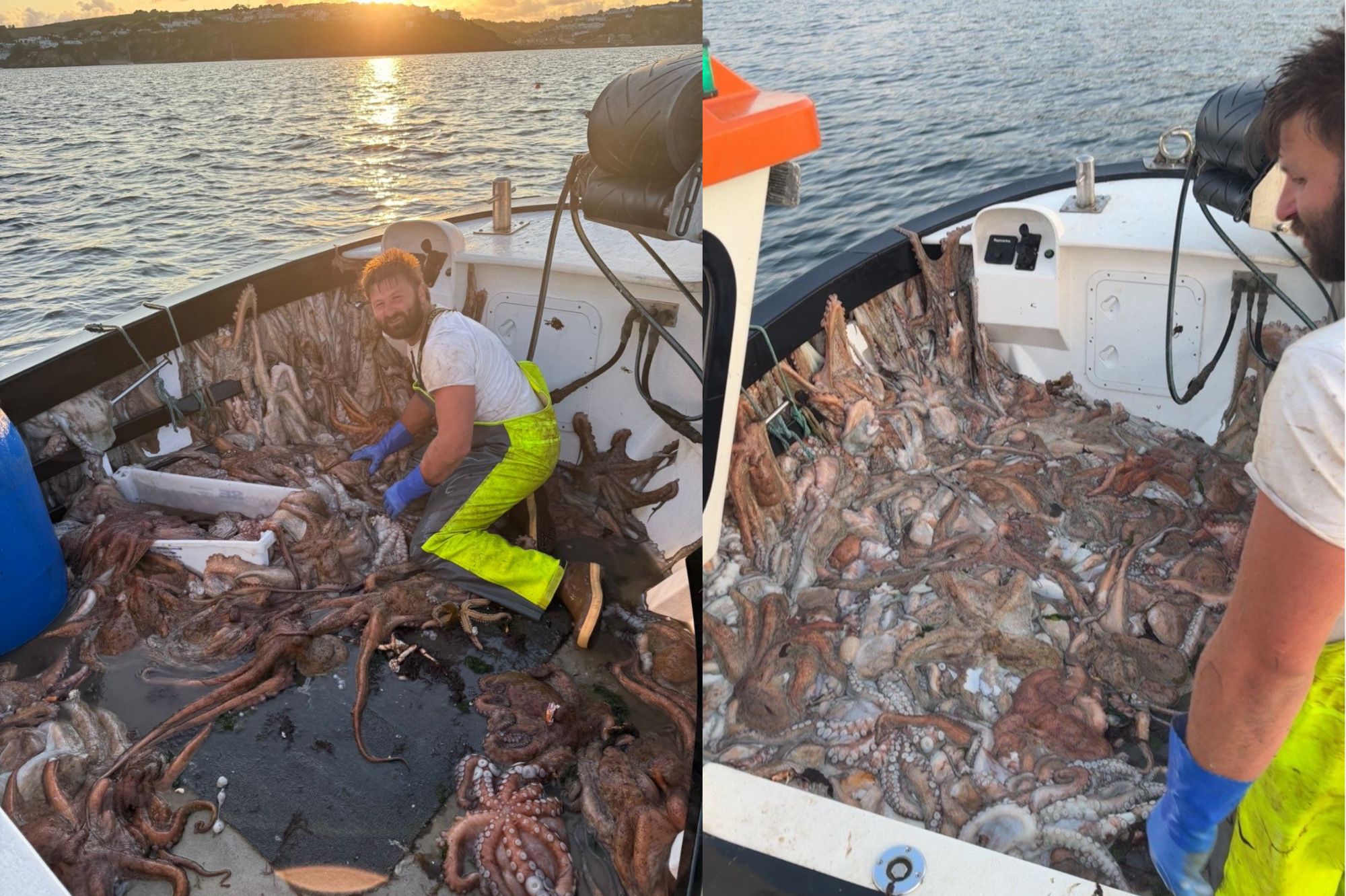
Image: Jack West of Ann Louise fishing pictured in a boat brimming with octopus, July 2025. Image credits: Jack West.
“Now in March, we’re already fishing for octopus again this year. It’s still early in the season, but we’re getting catches and expect to see much more as the weather warms.”
“Others in the industry – particularly those in crab and lobster fisheries – have been hit even harder and some have not been able to adapt like we have. The longer-term impacts on shellfish stocks and the wider fishing industry remain a serious concern.”
In January this year, a report involving scientists from Plymouth Marine Laboratory revealed the scale, causes and consequences of the bloom.
The report, funded by Defra, Plymouth City Council and Devon County Council, and led by the Marine Biological Association (MBA) in collaboration with Plymouth Marine Laboratory (PML), the University of Plymouth and an independent consultant, drew on data from scientists, fishermen and citizen scientists.
Access the full report: ‘Common octopus (Octopus vulgaris) blooms off the Southwest of the UK: History, trends, causes and consequences’
The report found a climate-driven pattern – all major octopus blooms, including this one, have coincided with unusually warm conditions, which are becoming more frequent with climate change.
Sustained easterly winds may have also helped transport young octopus larvae from the Channel Islands and northern France. Ocean current modelling supports this, showing that larvae from Guernsey, which has seen its own octopus bloom since 2024, likely contributed to the UK surge.
Watch now: Octopus larvae movement between the Channel Islands and the UK
Furthermore, Common octopus breeding in UK waters – previously very rare – was found to have been widespread in 2025, alongside reports of juvenile octopus in catches.
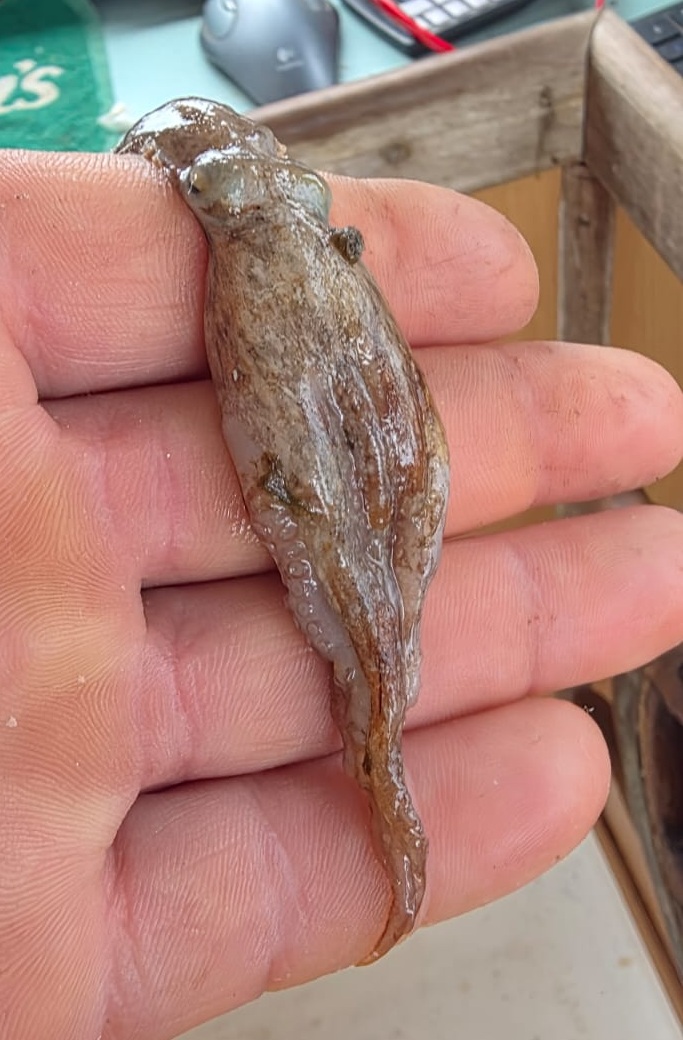
Image: A juvenile octopus caught in the Southwest – July 2025. Image credit: South Devon and Channel Shellfishermen Ltd.
The researchers warned that the sudden influx of this adaptable predator could disrupt marine food webs, with unknown consequences for biodiversity.
It also found fisheries were at risk; over half of fishers who responded to surveys reported negative impacts, mainly from octopus predation on crabs, lobsters and scallops. Some adapted to octopus fishing for a period of time, but many feared an uncertain future.
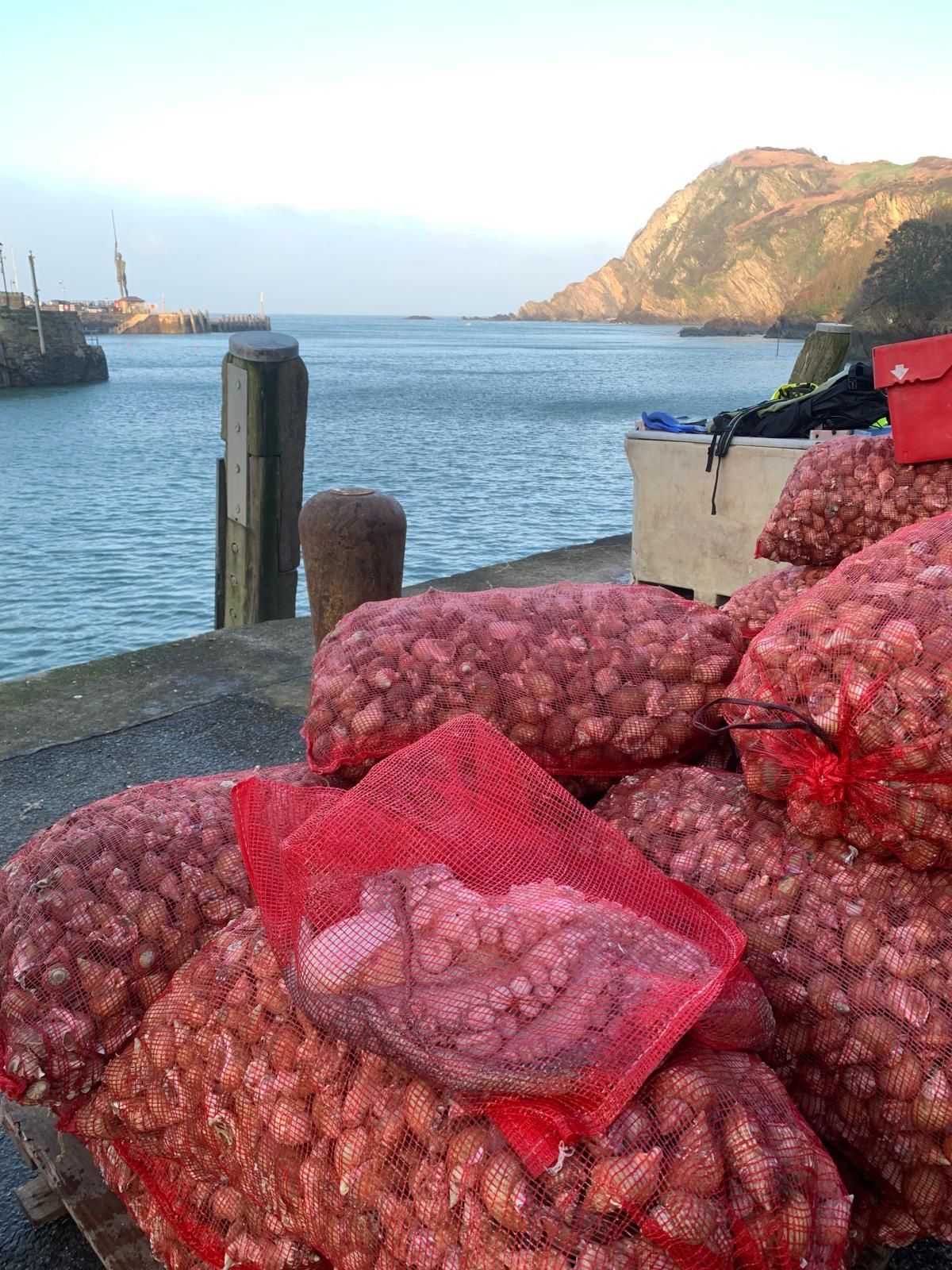
Image: “O.vulgaris showing up in Ilfracombe (we have not yet seen any large numbers on the north coast). Bittersweet feelings from the industry knowing the export prices are good but potentially those bags of whelks won’t be as full next year, or sooner.” – Madalein Bradshaw, Marine Enforcement Officer (Devon, Cornwall and Isles of Scilly).
The report stated there was an urgent need to more fully assess the economic and social impact of the octopus bloom on fisheries and coastal communities, and also called for better ‘early warning systems’ to guide future management.
Lead author of the report, Dr Bryce Stewart, Senior Research Fellow at the MBA and Associate Professor at the University of Plymouth, said:
“This is an extraordinary event that tells us a lot about how marine life is responding to a warming ocean, and the survey reveals the mixed effect that this has had on fisheries.”
Predicting future octopus blooms – and developing resilience
The Octopulse project team is currently developing an open-access dashboard that will integrate data from the Western Channel Observatory into the Blue-Cloud and EDITO platforms, allowing them to become a resource that can support a wide range of future, multi-community collaborative toolsets.
Octopulse team leader Dr Tom Mansfield, Data Systems Architect at PML, said:
“We have been working hard on producing an accessible platform – openly available to the public – funded by our Hackathon prize. We’re building a simple dashboard to host live data from the Western Channel Observatory that will be hosted on both the Blue-Cloud platform and within in the European Digital Twin Ocean (EDITO) environment, allowing the dashboard to be shared among communities.”
“We’re also producing a step-by-step tutorial to help users navigate the dashboard and make use of the data, enabling scientists, fishers, policymakers and the wider public to better understand the conditions that drive octopus blooms.”
The aim of EDITO is to make ocean knowledge available to all, empowering decision-makers, researchers, innovators and citizens to access ocean insights and tools, grow shared knowledge, and act for the future.
Dr Benjamin O’Driscoll, Research Software Engineer, also working on the project said:
“EDITO offers an exciting platform to work effectively with collaborators across Europe and beyond. We are excited by the opportunity to work with European partners and develop this idea further. If we can secure future funding to move it forward, then the EDITO platform is an obvious location to host it.”
Dr Mansfield added:“We have recently successfully ported the code to Blue-Cloud, and hope to make the tutorial available very soon, so please stay tuned!”
This rapid-response project highlights how innovative, data-driven science can quickly adapt to emerging environmental challenges. By bringing together real-time observations, modelling and digital tools, Octopulse has the potential to support future marine research and inform more responsive, evidence-based decision-making – helping build resilience in the face of a changing climate and ocean.
The team will present their work at the Blue-Cloud Conference in Brussels on 28 May, where they will share progress on the project and contribute to wider discussions on the future of ocean data and digital innovation.
Related information
Octopulse team members:
PML team celebrates win at Blue-Cloud Hackathon 2025 >>
Octopus bloom off Southwest UK: New report reveals scale, causes and consequences >>
Marine heatwaves and octopus outbreaks >>
About Blue-Cloud
Blue-Cloud 2026 is a collaborative project that leverages Europe’s expertise in aquatic environmental observation and data handling. Building on existing infrastructures like Copernicus and EMODnet, Blue-Cloud aims to create a federated ecosystem for FAIR and open data in marine research. Through a web-based platform, it offers simplified access to multidisciplinary datasets, analytical services, and computing facilities.
Over 42 months, Blue-Cloud 2026 will expand its core services, integrate more analytical tools, and enhance data discovery and access. With a focus on supporting the EU Blue Economy and environmental agendas, it strives to contribute to the EU Green Deal and UN Sustainable Development Goals. Coordinated by CNR, Trust-IT Services, and MARIS, the project brings together a dedicated team of 40 partners from 13 EU countries.