Story
Test your knowledge: is this plankton real or AI-generated?
21 February 2026
Can you tell the difference between real plankton images and those generated by artificial intelligence? Researchers are inviting experts and non-experts alike to take part in a short online quiz that will test your eye – but more importantly also help improve tools for biodiversity monitoring.
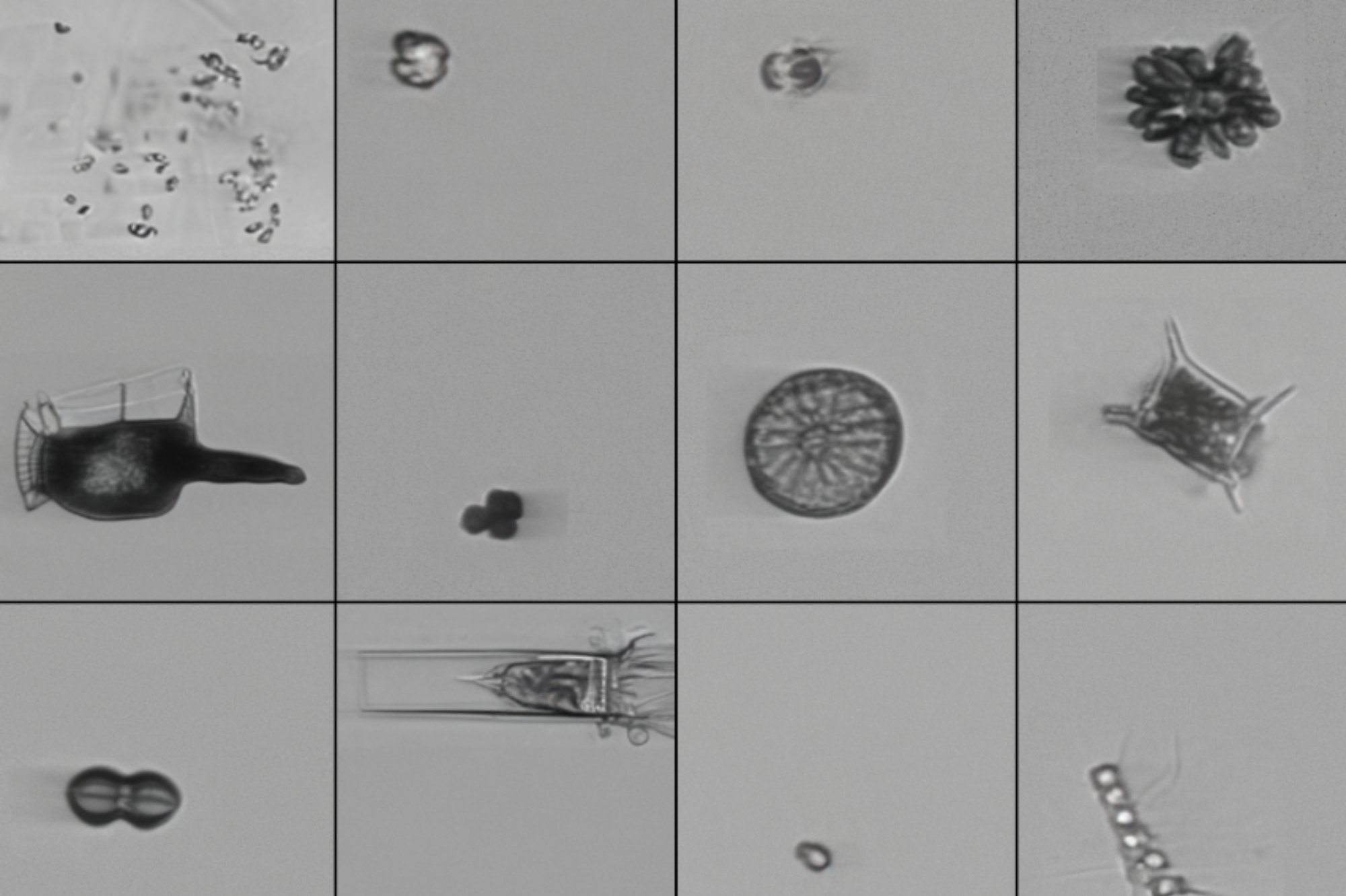
In the quiz, developed by Dr Daniela Ivanova of the University of Glasgow, you will be shown pairs of plankton images, one of which will be real – captured using an Imaging FlowCytobot system – and the other synthetic: generated using artificial intelligence. Your challenge is to decide which image in each pair looks more realistic.
Take part in the quiz ‘Is this Plankton real?’ here >>
Background: How can this quiz help biodiversity monitoring?
Modern autonomous imaging platforms like the Imaging FlowCytobot system can generate millions of images of plankton directly from the ocean – offering the potential to transform how we observe and monitor marine ecosystems. However, it would be impossible for a human to manually classify each image in such a vast collection, and so, automated classification tools are essential.
Machine learning models can achieve reliable classification – but only when they are trained on sufficient, high-quality labelled data. But there is a challenge: for some plankton species, especially rare taxa, there simply aren’t enough real-world images available to train robust models.
To address this gap, researchers have been experimenting with generative AI to create synthetic images of rare plankton species, and if these AI-generated images are realistic enough, they could be added to training datasets to improve the accuracy and robustness of the classifier.
The work forms part of the DEAL project (DEcentrAlised Learning for automated image analysis and biodiversity monitoring). DEAL is a collaborative project between Plymouth Marine Laboratory and AI researchers at the University of Glasgow. The team is developing a powerful classifier that will sit at the heart of a new application designed to improve marine biodiversity monitoring.
As highlighted by the UN Decade of Ocean Science for Sustainable Development (2021–2030), high-quality ocean observations are critical for effective marine management and decision-making. Yet marine biodiversity remains under-observed, with many monitoring methods still dependent on infrequent and costly ship-based sampling. DEAL aims to change that – by developing a decentralised, collaborative network to enable data owners to work together to build better, more accurate image classification systems. If successful, the approach could help unlock the full potential of marine imaging systems and support operational biodiversity monitoring at unprecedented scales.
Principal investigator of the DEAL project, Dr James Clark said:
“We’re at a point where ocean imaging technology can generate data at extraordinary scales – far beyond what humans alone can process. The real challenge now is ensuring we have intelligent, reliable tools to interpret that data. If we get this right, it will transform how we monitor marine biodiversity and respond to environmental change.”
Expert taxonomists have already been invited to take part. Now, the researchers are keen to compare their responses with those of non-experts.
Your responses will help researchers assess how well AI-generated images are perceived – and whether they are suitable for strengthening machine learning models used in biodiversity monitoring.
The quiz:
- Takes around 20 minutes
- Can be paused and resumed
- Collects only your responses and information about your familiarity with plankton imaging and/or machine learning
- Does not collect names, email addresses, or other personal information
The online quiz has been developed by Dr Daniela Ivanova, Dr Nicolas Pugeault and Claire Widdicombe, and will be showcased next week at the Ocean Sciences Meeting in Glasgow, in the Marine Research Plymouth Alliance exhibition stand (stand 38).