Story | 02 March 2026
New satellite mapping reveals recent and large-scale habitat changes across the Southern Ocean’s seascapes
New research reveals that changes following the recent and dramatic decline in Antarctic sea ice could help a low-nutritional species prosper, with major ramifications for food webs and biogeochemical cycles.
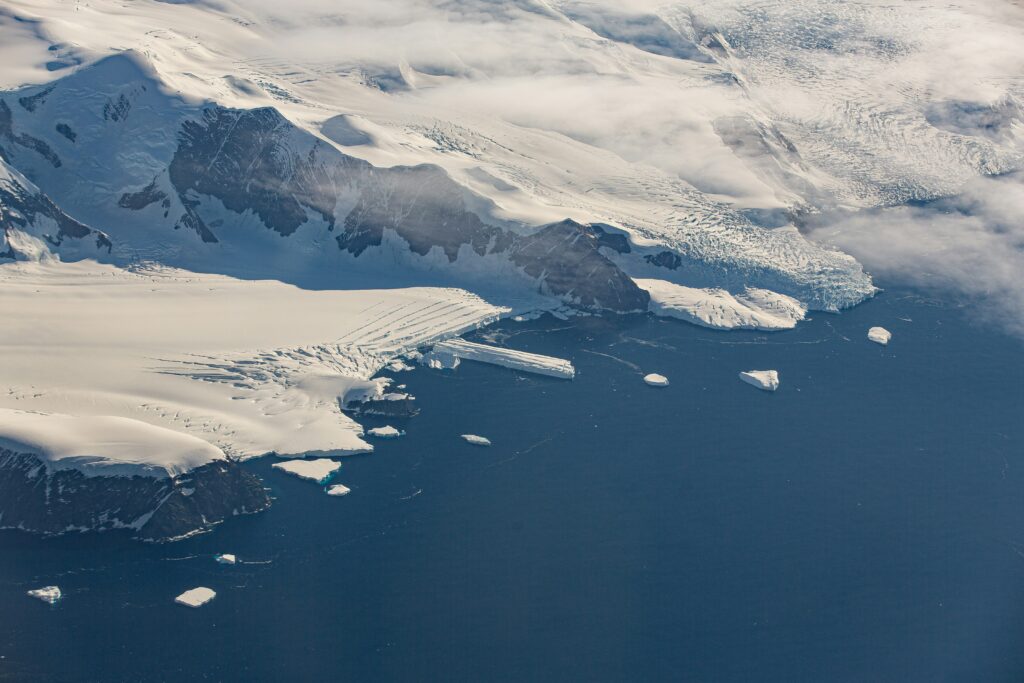
Coast of Antarctica. Matt Palmer | Unsplash
The period 2016–2017 marked an abrupt decline in Southern Ocean (Antarctic) sea ice and it has remained around this new record low ever since. This has resulted in an increase in summer open water of over 1 million km2 with associated changes in thickness and concentration of the remaining ice.
These changes are leading to a growing consensus that there has been a recent system shift or structural change in the sea ice environment, which will likely have impacts on how the ecologically- and economically-important Antarctic ecosystems function.
Sea ice has a myriad of impacts on the oceanic food web but despite the known importance of sea ice, surprisingly little is known about how its recent and dramatic decline is impacting oceanic food webs.
A new study, led by Plymouth Marine Laboratory in collaboration with the University of British Columbia, University of Exeter, British Antarctic Survey and University of Plymouth, sought to explore how the Southern Ocean species are responding to the reduction in sea ice.
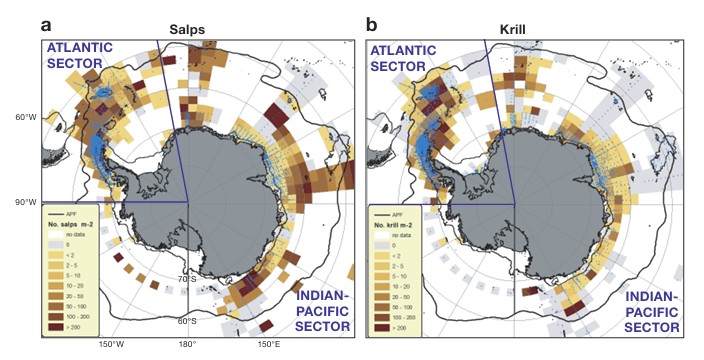
Given the paucity of direct field data, the study team combined ocean regionalization based on optical satellite “seascapes” with KRILLBASE, a large historical salp and krill database, to examine how the new, low-ice era has changed the feeding habitat of these key plankton species.
Krill: small, shrimp-like crustaceans found in all oceans, with Antarctic krill (Euphausia superba) being the most well-known and abundant species. They are vital to marine ecosystems, acting as a primary food source for whales, penguins, and seals.
Salps: filter-feeding tunicates that float through the water column consuming phytoplankton. Primarily composed of water, salps are considered more nutritious than jellyfish but less so than carbon-rich crustaceans, such as krill.
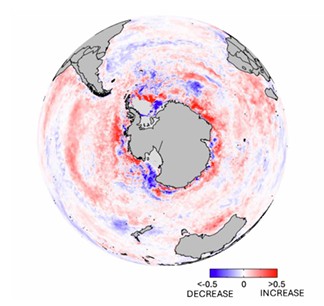
The novel study divided the Southern Ocean into 14 “seascapes”, based on the types and concentration of phytoplankton, and found that salps were strongly associated with the seascapes that increased in area during the most recent, low ice era. Nearly 70% of the Southern Ocean experienced an increase in phytoplankton concentrations, and the changing seascapes map this in more detail.
Large oceanic areas, formerly too low in food to support salps, have now increased to the levels that are much more supportive of their blooms. This change does not favour krill since they do not inhabit such low food-source habitats as found in the Indian-Pacific sector.
Prof. Angus Atkinson MBE, Senior Marine Ecologist at Plymouth Marine Laboratory, said:
“This recent reduction in Antarctic sea ice is massive and after years of relative stability, we are now in a situation more akin to the Arctic where large tracts of open ocean are becoming ice-free with major consequences for food webs and for carbon storage.”
Dr Victor-Martinez-Vicente, Bio-optical oceanographer at Plymouth Marine laboratory and Co-ordinator of the European Space Agency (ESA) Biodiversity in the Open Ocean: Mapping, Monitoring and Modelling (BOOMS) project, added:
“This study went beyond the usual satellite-derived indices of phytoplankton to look into the finer nuances of satellite imagery – the individual reflectance characteristics of seawater that are monitored by satellite. These changing seascapes were key to identifying the improved feeding conditions of salps in the modern, low ice era, and point to their utility for monitoring large scale changes in ocean biodiversity.”
To gain a better understating of how large shift in sea ice cover could impact polar food webs, large-scale field sampling is needed alongside satellite and modelling developments. The next phase of this research will be to explore how both the quantity and quality of food interact with other environmental factors to drive changes in salp and krill abundance across the Southern Ocean.