Story | 13 May 2026
PML’s Professor Shubha Sathyendranath MBE awarded prestigious Nansen Polar Bear Award
A legacy of marine science: PML’s Professor Shubha Sathyendranath MBE has been awarded the 2026 Nansen Polar Bear Award in recognition of her outstanding contributions to environmental research.
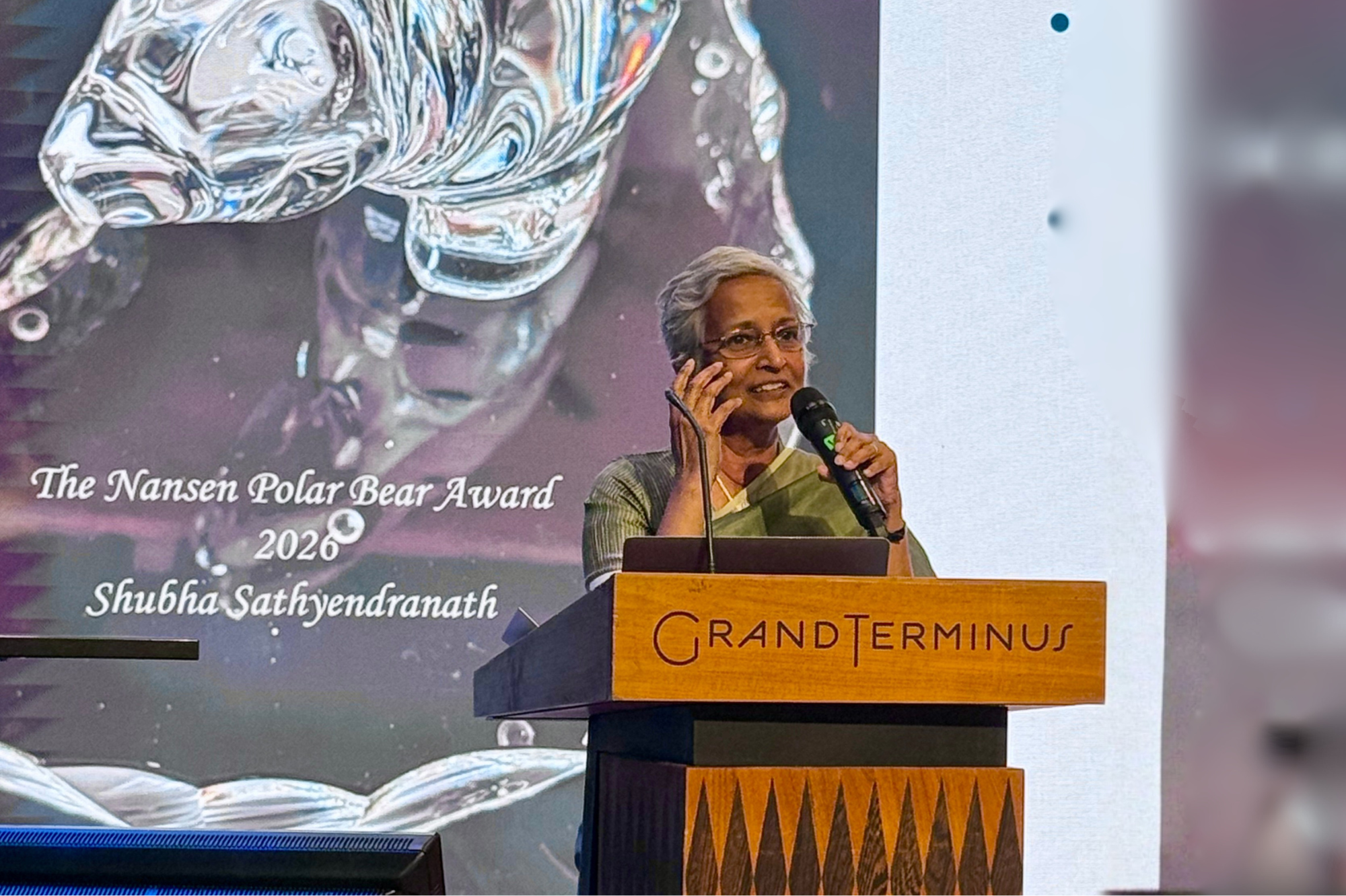
The award was presented yesterday (12th May 2026) during The Nansen Center’s 40th anniversary symposium in Bergen, which brought together international researchers to celebrate four decades of advances in ocean, sea-ice and climate science.
The Nansen Environmental and Remote Sensing Center, also known as NERSC, described it as “an honour” to present the prize to Professor Shubha Sathyendranath, noting that the prestigious accolade recognises individuals who have made exceptional contributions to environmental research, with particular emphasis on the use of remote sensing.
Tore Furevik, Director of the The Nansen Center, said:
“Shubha Sathyendranath has helped change how we observe and understand the ocean. Through her work on ocean colour from satellites, she has contributed new knowledge about phytoplankton [marine microalgae], primary production [photosynthesis] and the ocean’s importance for the climate. She combines scientific excellence with a strong ability to build international collaboration and new generations of researchers. This makes her a highly deserving recipient of the Nansen Polar Bear Award.”
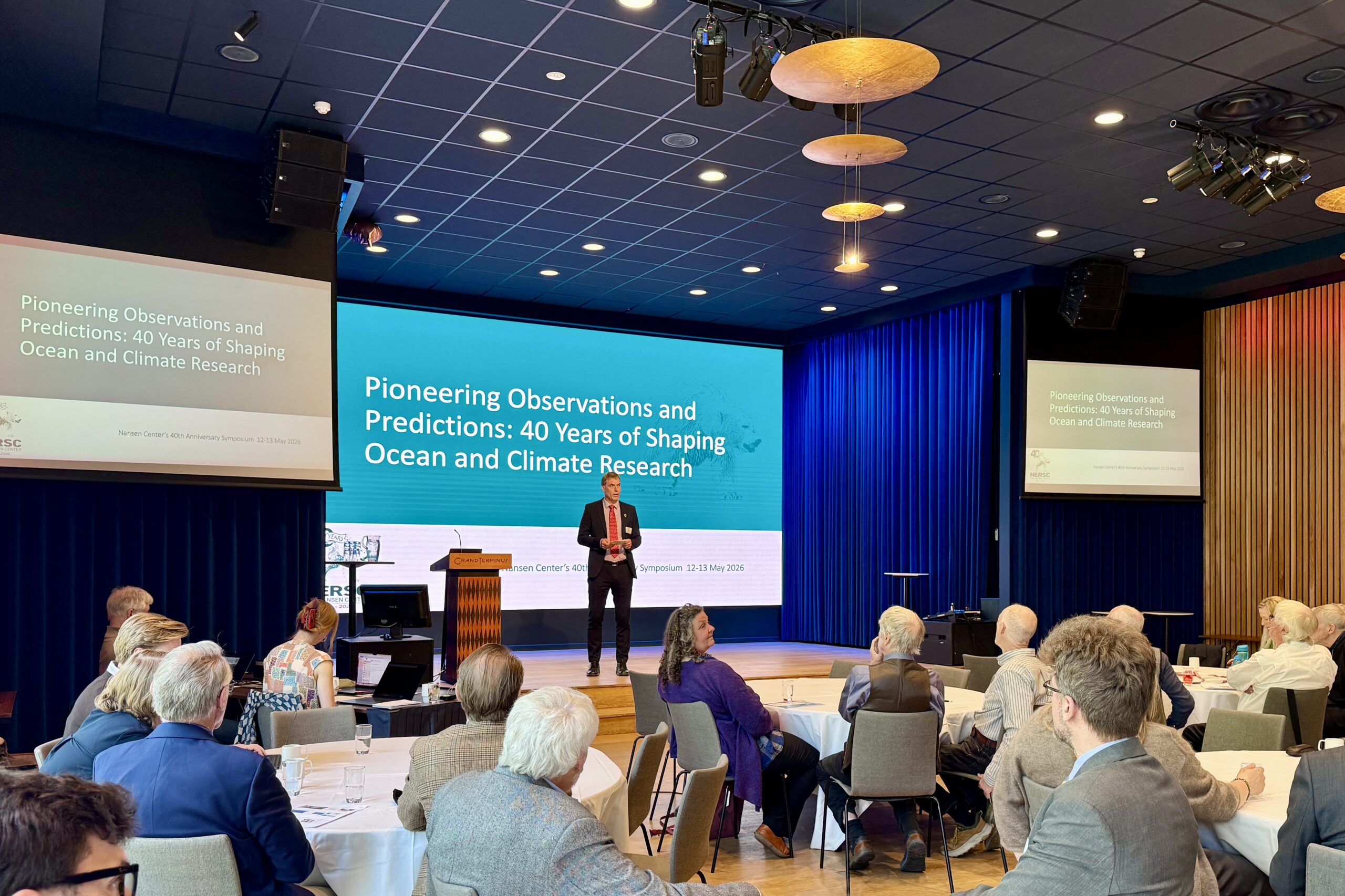
Image: The award ceremony took place yesterday during The Nansen Center’s 40th anniversary symposium, “Pioneering Observations and Predictions: 40 Years of Shaping Ocean and Climate Research” in Bergen.
With an impressive career spanning nearly 50 years – and across India, France, Canada and the United Kingdom – Professor Sathyendranath has published over 500 scientific contributions, with over 55,000 citations.
Her early research focused on the development of algorithms to define water masses based on their optical properties – and how phytoplankton change the absorption of light in water.
She then progressed this area of research to use satellite data to quantify primary production in seawater, through research alongside her husband Professor Trevor Platt, who was also a world-renowned biological oceanographer. This research led to the first global estimates of primary production. Her research also revealed that diatoms and growth rates of phytoplankton could be defined from satellite imagery.
In the following years, Shubha held the position of Lead Scientist at the Partnership for Observation of the Global Oceans in 2003, before joining Plymouth Marine Laboratory in 2006, where she is a highly respected Merit Scientist in PML’s remote sensing team.
Her interests include the bio-optical properties of phytoplankton, marine primary production, biological-physical feedbacks in the ocean, phytoplankton phenology, ecological provinces in the ocean, development of algorithms for remote-sensing of phytoplankton and the use of ocean-colour data in climate studies.
She has also been pioneering research on water-borne infectious diseases, focusing on the ecology of microbial pathogens in water, notably Vibrio cholerae and Escherichia coli, using field observations, models and proxies amenable to remote sensing, mostly with partners from India and Brazil where the risk to human health can be high.
Shubha has created significant impact on many aspects of biological oceanography, and she was one of the first oceanographers to see the potential of ocean-colour satellite observations to study various aspects of biological oceanography at both global and regional scales.
Her research has transformed how scientists observe life in the ocean from space, advancing understanding of phytoplankton, primary production and the ocean’s role in climate and global carbon cycling, while also contributing to fields including bio-optics, climate change and marine biogeochemistry.
In a statement to press, The Nansen Center added that, “Her research has had an impact far beyond a single scientific community. It has strengthened the links between biology and physics, between the ocean and the atmosphere, and between observations and climate research.”
Her work has been central to major international initiatives, including serving as Science Lead for the European Space Agency’s Ocean Colour Climate Change Initiative and chairing the International Ocean Colour Coordinating Committee; both recognised as having advanced international collaborations in remote sensing. She has also contributed to the Intergovernmental Panel on Climate Change Sixth Assessment Report, helping to advance understanding of ocean–climate interactions at a global scale.
In a heartfelt video taken by The Nansen Center on the night of the award ceremony, Shubha said:
“Well, you have caught me in the aftermath of a big announcement! That was totally unexpected but totally delightful. I’m so happy. I won’t debate whether I deserve it – I will just be happy that they decided to give it to me.”
“As I mentioned at the time [of receiving the award], this is a moment that makes me miss Trevor [Platt] all the more – because I owe him so much. And if I am here, to a large extent, it is because of him.”
“I also wish to thank all of my colleagues over the years who have worked with me, colleagues, friends and students, to whom a owe a lot. This is not an award for a single person, for a single achievement – it is for our collective work, and for that I am grateful. Thank you.”
PML’s Director of Science Professor Tim Smyth warmly welcomed the news and congratulated Shubha on the award:
“Shubha’s pioneering work has transformed our understanding of the ocean and its role in the Earth’s climate system. Through decades of scientific leadership, innovation and international collaboration, she has helped establish ocean-colour remote sensing as a vital tool for monitoring marine ecosystems and climate change. This award is a fitting recognition of her exceptional contributions to marine science, and we are delighted to see her honoured in this way. On behalf of everyone at Plymouth Marine Laboratory, I offer Shubha my warmest congratulations.”
Professor Sathyendranath’s latest recognition by The Nansen Center adds to a long and well-deserved list of international honours.
In 2023, it was announced in the King’s Birthday Honours that Shubha had been made a Member of the Order of the British Empire (MBE), which mark “the extraordinary contributions and service of people across the UK” and awarded to recognise her services to oceanography.
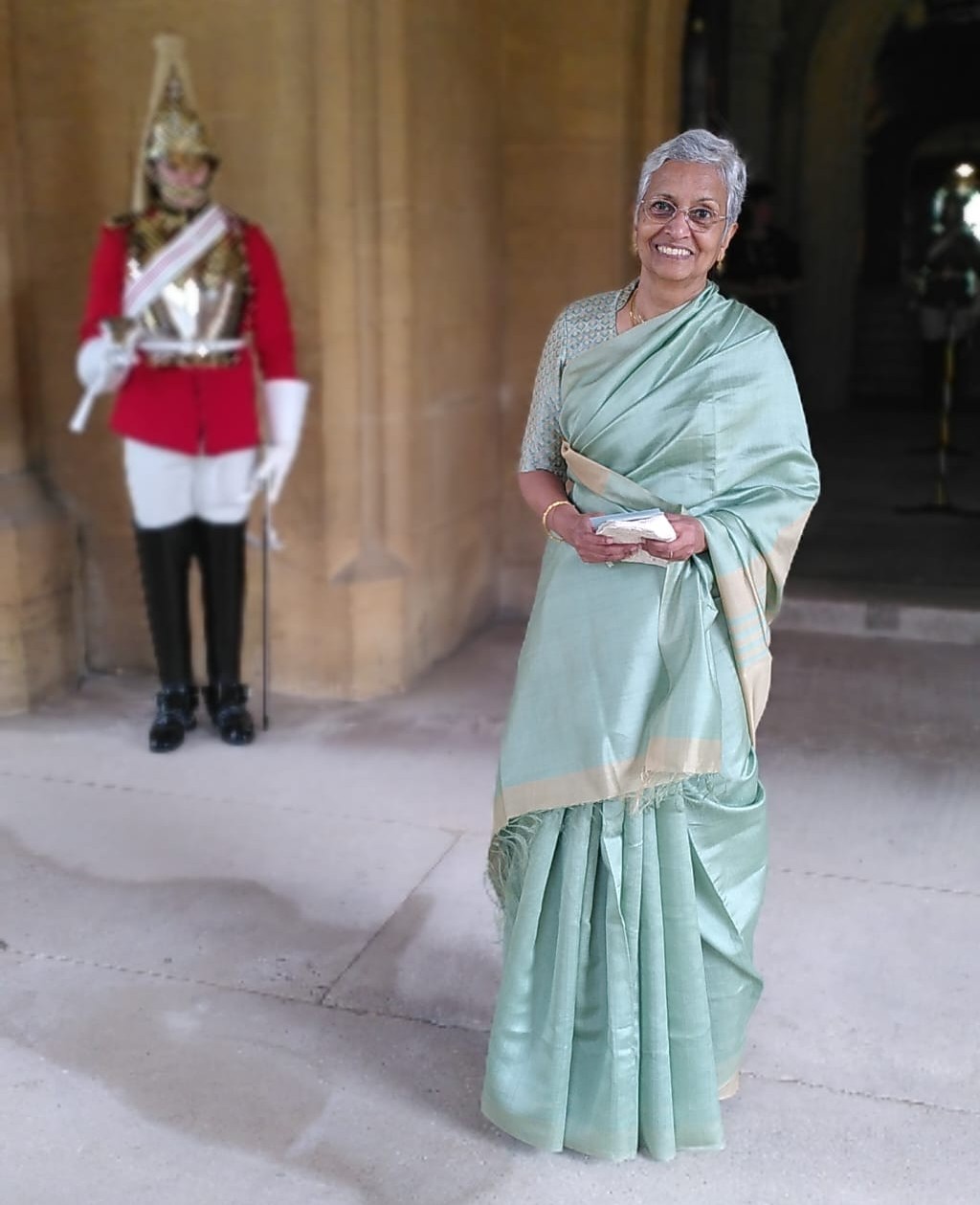
Image: In 2023, Shubha was awarded an MBE at a ceremony in Buckingham Palace in recognition of her services to oceanography.
The year previous, in November 2022, she was awarded Knight of the Order of Cultural Merit, the fourth highest Order of the Principality of Monaco, the fourth highest Order of the Principality of Monaco, awarded to those who have made a distinctive contribution to the arts, letters or science through their work or teaching.
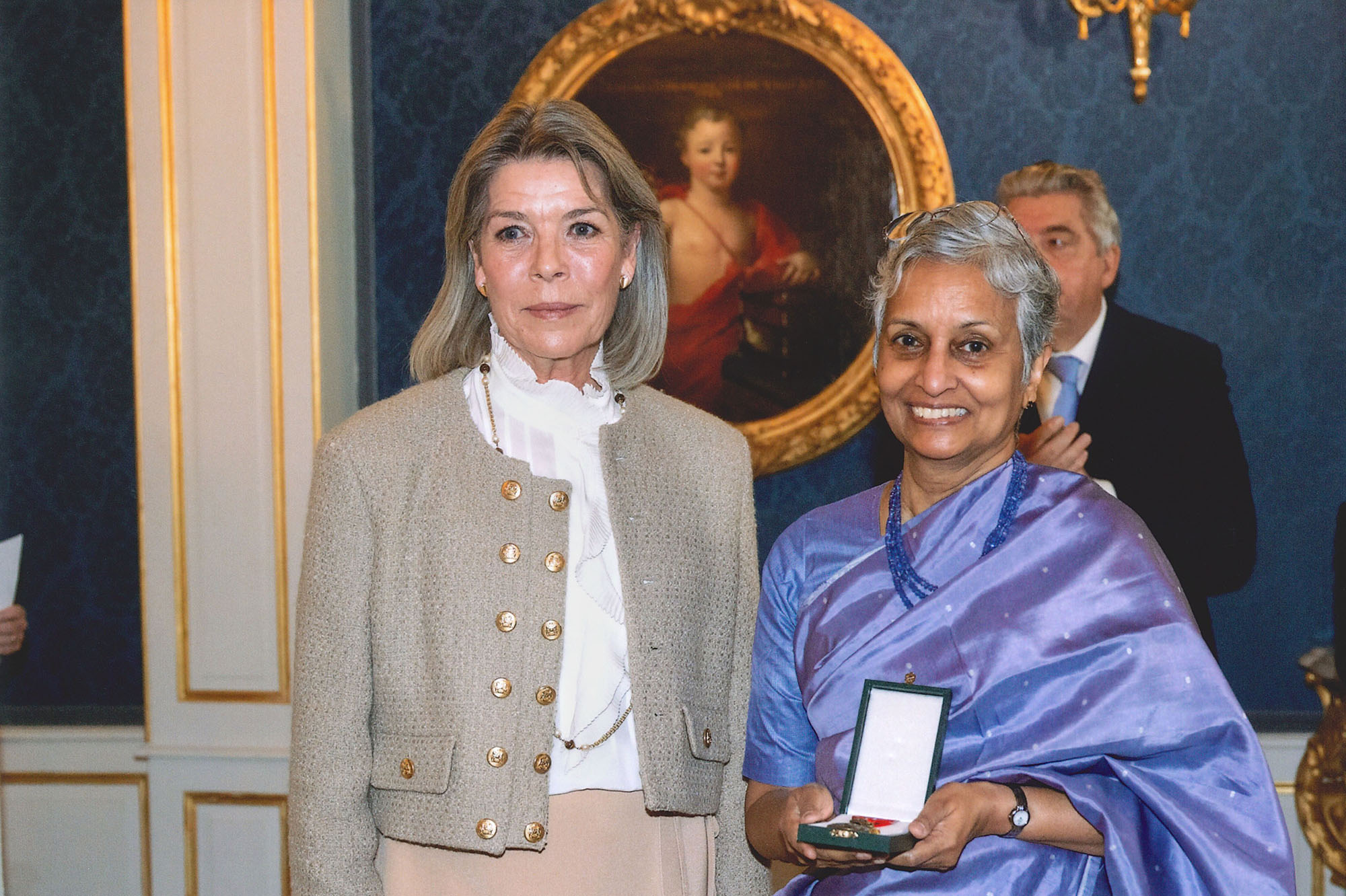
Image: In 2022, Prof Sathyendranath was awarded the Knight of the Order of Cultural Merit. HRH Princess Caroline of Hanover, sister of HSH Prince Albert II of Monaco, presented the award at a ceremony at the Prince’s Palace in Monaco.
And in 2021, Shubha was awarded the A.G. Huntsman medal in recognition of her research achievements in the development of the use of optics and satellites in marine science.
Beyond her scientific achievements, Shubha has also been a passionate advocate for nurturing future generations of marine scientists and supporting greater international collaboration and inclusion within ocean science.
She has devoted considerable effort to capacity building in developing countries, for which she has received the UNESCO/IOC Pannikkar Memorial Medal.
And, perhaps her most personal endeavour, in 2023, Shubha organised the launch of the Trevor Platt Science Fund, in memory of her late husband and lifelong collaborator Professor Trevor Platt, whose work – much of which was in collaboration with Shubha – transformed understanding of marine ecosystems and the ocean’s role in sustaining life on Earth.
Trevor was also a firm believer in sharing his knowledge, nurturing the next generation of scientists and above all, providing encouragement and guidance to countless young researchers. Continuing his legacy, the Trevor Platt Science Fund was born; to support activities such as education, training courses, engagement initiatives, internships, mentorship and awareness building relating to the environmental sciences, with a focus on meaningful capacity building in developing countries.
Last year, Monolisha Sundar Raj, who was chosen to undertake a Fellowship at PML through the Trevor Platt Science Fund, spoke of the difference this made to both her scientific career – and her life:
“It is with immense happiness that I share that I am the first woman to receive the prestigious Trevor Platt Fellowship. This achievement is not just a personal milestone but also a tribute to the inspiration and guidance I received from Prof. Platt and Prof. Shubha Sathyendranath. I look forward to carrying forward his legacy and contributing to the field of marine biogeography and remote sensing. The journey from being born as a slum girl to becoming a science fellow, hasn’t been easy, and every challenge I’ve faced has only strengthened my resolve.”
Some of Shubha’s most influential scientific papers include:
- 1981, An optical classification of coastal and oceanic waters based on the specific spectral absorption curves of phytoplankton pigments, dissolved organic matter, and other particulate materials. This was a foundational paper that helped define key observational and methodological approaches in aquatic biogeochemistry, shaping how marine ecosystem processes are measured and interpreted.
- 1988, Oceanic Primary Production: Estimation by Remote Sensing at Local and Regional Scales. A landmark study that helped establish the use of satellite ocean colour data to estimate global marine primary productivity, transforming large-scale ocean ecosystem research.
- 1989, A three-component model of ocean colour and its application to remote sensing of phytoplankton pigments in coastal waters. An early and influential contribution to quantitative remote sensing methods that underpinned modern satellite-based environmental observation techniques.
- 1995, An estimate of global primary production in the ocean from satellite radiometer data. An important advancement in plankton ecology at the global scale, improving how phytoplankton growth and population dynamics are quantified and modelled in natural systems.
- 2001, Remote sensing of phytoplankton pigments: A comparison of empirical and theoretical approaches. A key paper refining satellite retrieval algorithms, improving the accuracy of translating remote sensing signals into oceanographic and environmental variables.
- 2004, Discrimination of diatoms from other phytoplankton using ocean-colour data. An influential ecological study linking marine biological patterns of diatoms to environmental variability, strengthening ecosystem-based interpretations of ocean data.
- 2019, An Ocean-Colour Time Series for Use in Climate Studies: The Experience of the Ocean-Colour Climate Change Initiative (OC-CCI). A modern remote sensing/sensor technology paper contributing improved methods for long-term environmental monitoring using climate quality ocean colour data.