Project
Closing the budget in marine atmospheric Oxidative Capacity through the quantification of Oceanic VOC emissions (COCO-VOC)
Roughly half of the oxidation of methane (a key greenhouse gas) and non-methane volatile organic compounds (VOCs) occurs over the oceans via reactions with the hydroxyl radical (OH). Some of these reactions lead to secondary organic aerosols (SOA), which are important for cloud formation, and ozone, another greenhouse gas and a principal component of air pollution.
However, the oxidant chemistry in these remote atmospheres is poorly understood, likely in large part due to unaccounted-for and/or underestimated marine VOCs. COCO-VOC will combine state-of-the-art field observations, laboratory production rate measurements, and modeling to make a holistic assessment of the emissions and burdens of marine VOCs, their transformations to SOA, and their impact on atmospheric oxidative capacity, clouds and climate.
This work will transform our current understanding of reactive carbon cycling in the marine environment and better constrain the sensitivity of global atmospheric oxidative capacity and aerosols to changes in anthropogenic and natural emissions. Accurate predictions of atmospheric chemistry, aerosols, air pollution, and climate fit firmly within the NERC remit of “pushing the frontiers of understanding” and “healthy environment.”
Objectives and key outcomes
- Improved air/sea flux estimates and reconciliation of bottom-up/top-down emissions in already-identified VOCs including acetaldehyde, benzene, toluene, glyoxal, methanol, acetone, isoprene, and monoterpenes
- Identifications of previously unquantified oceanic emissions of VOCs and OVOCs (e.g. aromatics, acids, aldehydes and ketones), which may be precursors to other OVOCs or aerosols
- Closure of the budgets in VOC burden and total OH reactivity in marine air
- More realistic descriptions of productions/consumptions of VOCs near the air-sea interface and development of models that capture the key chemical, biological, and physical processes.
- Determination of the impacts of marine VOC on global oxidative capacity, organic aerosols, O3, CH4, and radiative forcing in the present day and future
Fieldwork
Fieldwork will focus on the lower atmosphere and surface ocean at two sites: (I) near Cape Verde, and (II) west of Ireland. The choice of (I) is motivated by: a) the tropics accounting for disproportionally high CH4 loss due to OH; b) the close proximity to the Mauritanian upwelling that stimulates marine biological activity; and c) the existence of unique, co-located atmosphere and ocean observatories with substantial infrastructure and a long track record. The choice of (II) is motivated by: a) strong seasonal phytoplankton bloom and biogenic VOC sources; b) concurrent aircraft sampling providing additional horizontal and vertical coverage afforded by the funded NERC CARES (Constraining the role of the marine sulfur cycle in the Earth System) project; c) northeast Atlantic air being the background for the UK. Both within the two research campaigns (spatially across biological gradients, including transects through oligotrophic waters) and between them (tropical vs. mid-latitude), the large range in marine biological activity and photochemistry will enable the derivation of more robust parametrizations of VOC emissions compared to areas with less variability.
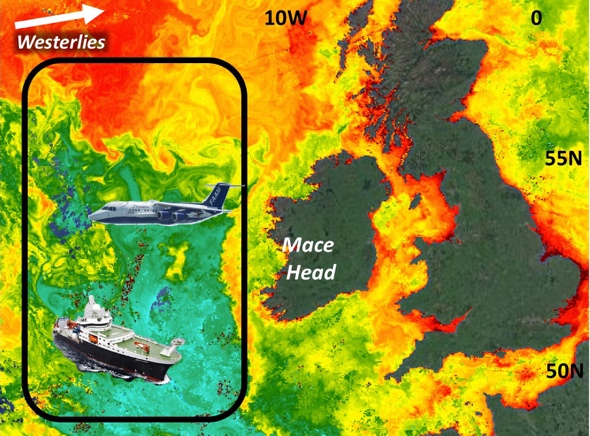
Above: Map showing the fieldwork location off the West of Ireland taking place in May-June 2025
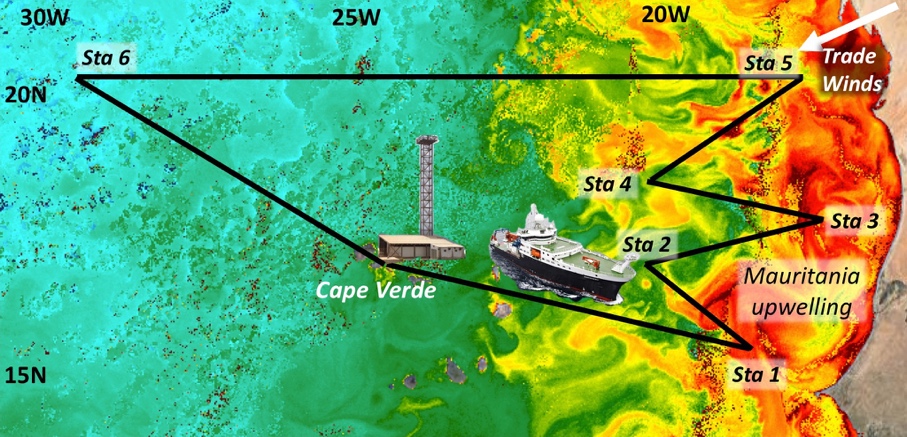
Above: Map showing the fieldwork location near Cape Verde taking place in summer 2026
Linked projects
CARES – ConstrAining the Role of the marine sulfur cycle in the Earth System
Project dates: 2023-2028
View more information
GOOSE – Gaps in the Observation of Ocean Sulfur Emission and its modeling
Project dates: 2023-2027
View more information
Partners
The COCO-VOC project is a collaboration between:

Plymouth Marine Laboratory
(Lead organisation)