Story | 14 May 2026
PML’s data architect selected for prestigious national DAFNI Fellowship
PML’s Dr Tom Mansfield has been selected as a 2026 Fellow of the Data & Analytics Facility for National Infrastructure (DAFNI), where he will explore how data systems can strengthen the resilience of UK offshore wind infrastructure.
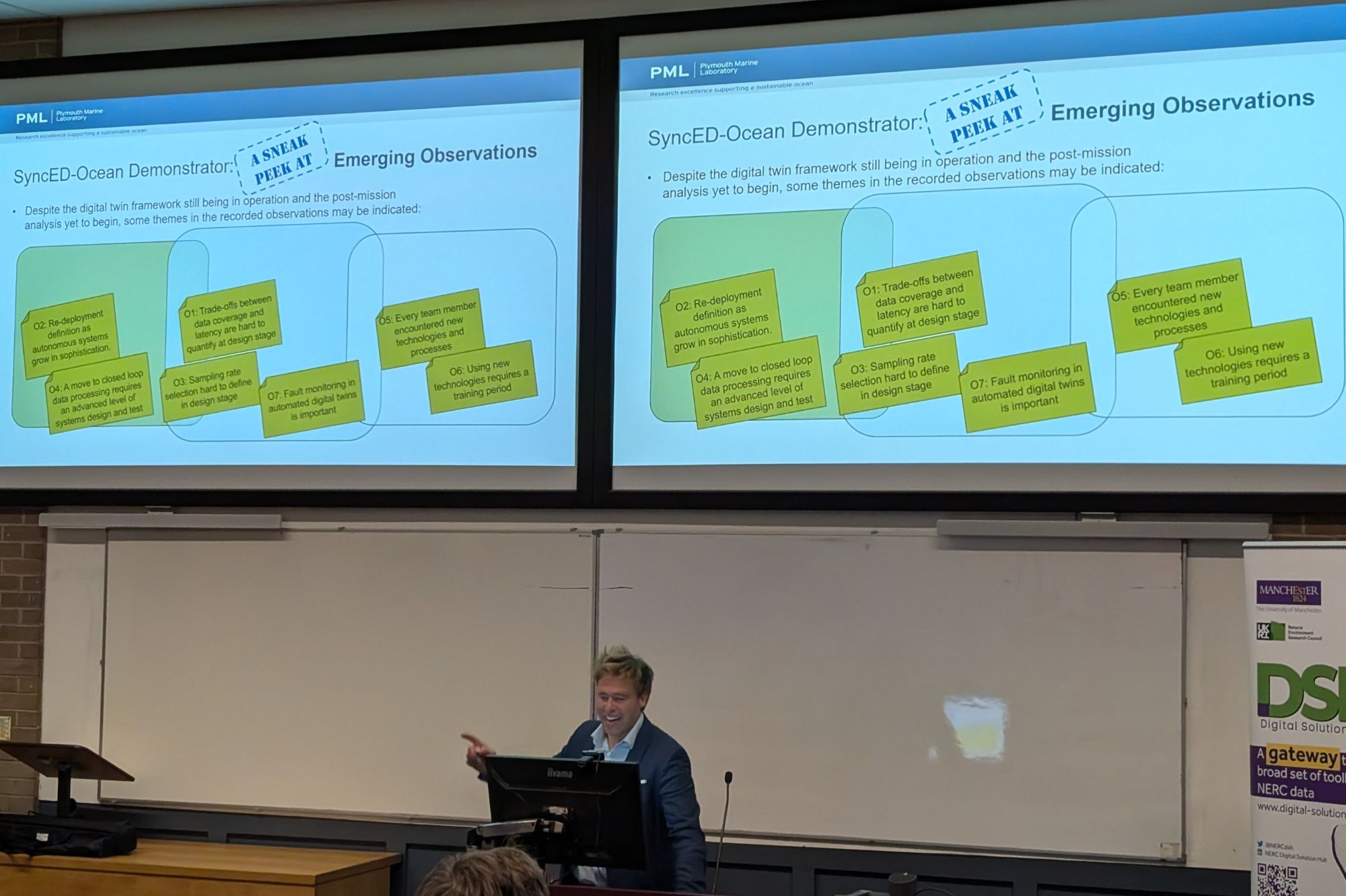
Image: PML’s Dr Tom Mansfield presenting the SyncED-Ocean project – which will develop a state-of-the-art digital twin for harmful algal bloom monitoring.
Dr Tom Mansfield is a Data Systems Architect at Plymouth Marine Laboratory (PML), helping scientists unlock the full value of marine and environmental data.
His work focuses on improving how complex scientific data are organised, connected, and shared – making it easier for researchers, industry, and policymakers to collaborate, generate insights, and make informed decisions about the environment.
Drawing on experience across industry, academia, and research, Tom develops innovative digital systems that support everything from environmental modelling and digital twins, to large-scale infrastructure planning. His expertise lies in creating trusted, reusable data systems that allow scientific information to be more easily accessed and applied to real-world challenges.
Selected through a nationally competitive process involving 116 applicants, Tom’s Fellowship recognises his expertise in developing innovative approaches to managing complex environmental data and supporting resilient national infrastructure.
As part of the fellowship, he will investigate how federated data architecture approaches could improve the way environmental and infrastructure data are connected, accessed, and reused across UK offshore wind programmes.
Offshore wind projects generate vast and highly complex datasets spanning environmental monitoring, engineering performance, ocean conditions, and ecological impacts. However, these datasets are often spread across multiple locations, organisations and systems, creating barriers to collaboration and slowing the delivery of actionable insights.
Tom’s research will explore how federated approaches – where data remain securely within organisations while still being accessible and connected across systems – could improve collaboration and support faster, more coordinated decision-making across industry, government, and research communities.
“PML’s scientists are working tirelessly to explore and unlock the ocean’s secrets – and find solutions to pressing environmental issues,” said Dr Mansfield. “My role is to help access the data that drives this work while maximising the impact of emerging data to provide insights, accelerate collaboration, and improve decision making.”
“I’m very much looking forward to applying these approaches with DAFNI to support the UK’s offshore wind sector. Offshore renewable energy is going to play a critical role in the UK’s future resilience and sustainability, and better-connected data systems can help unlock more effective collaboration, faster innovation, and more informed decisions across the industry.”
The DAFNI Fellowship is Dr Mansfield’s latest external funding success for activities that aim to innovate in the field of collaborative data analysis, following his recent leadership of the award-winning “Octopulse” team at the 2025 Blue-Cloud Hackathon. The multidisciplinary PML-led project secured international recognition and funding to develop innovative tools aimed at helping coastal communities predict future octopus blooms in the Southwest – combining ocean observations, modelling, and digital infrastructure to support more resilient marine decision-making.
Find out more about the ‘Octopulse’ project >>
The DAFNI Fellowship will also promote collaboration across the UK marine-data community through workshops, demonstrations, and engagement activities within Plymouth’s growing innovation ecosystem and beyond. The project aims to develop practical guidance and reusable approaches that support future national infrastructure planning and offshore energy resilience.
The Fellowship programme supports research into challenges including artificial intelligence, climate resilience, extreme weather, and infrastructure decision-making. Fellows receive funding and support to advance their research, strengthen collaboration networks, and contribute to the UK’s national infrastructure resilience agenda.
Each Fellow is awarded £10,000 to support activities including staff time, travel, conferences, knowledge exchange, and dissemination.
DAFNI Leader Brian Matthews said:
“Our new DAFNI Fellows initiative represents the dual benefit of funding and an exciting opportunity for successful applicants to further their research and careers in infrastructure.”
The fellowship runs from 1 April 2026 to 30 June 2027. During this time, Fellows will work with the DAFNI team to identify improved routes to integrate data, models, and research outputs into the national DAFNI platform, helping improve long-term accessibility, collaboration, and reuse.
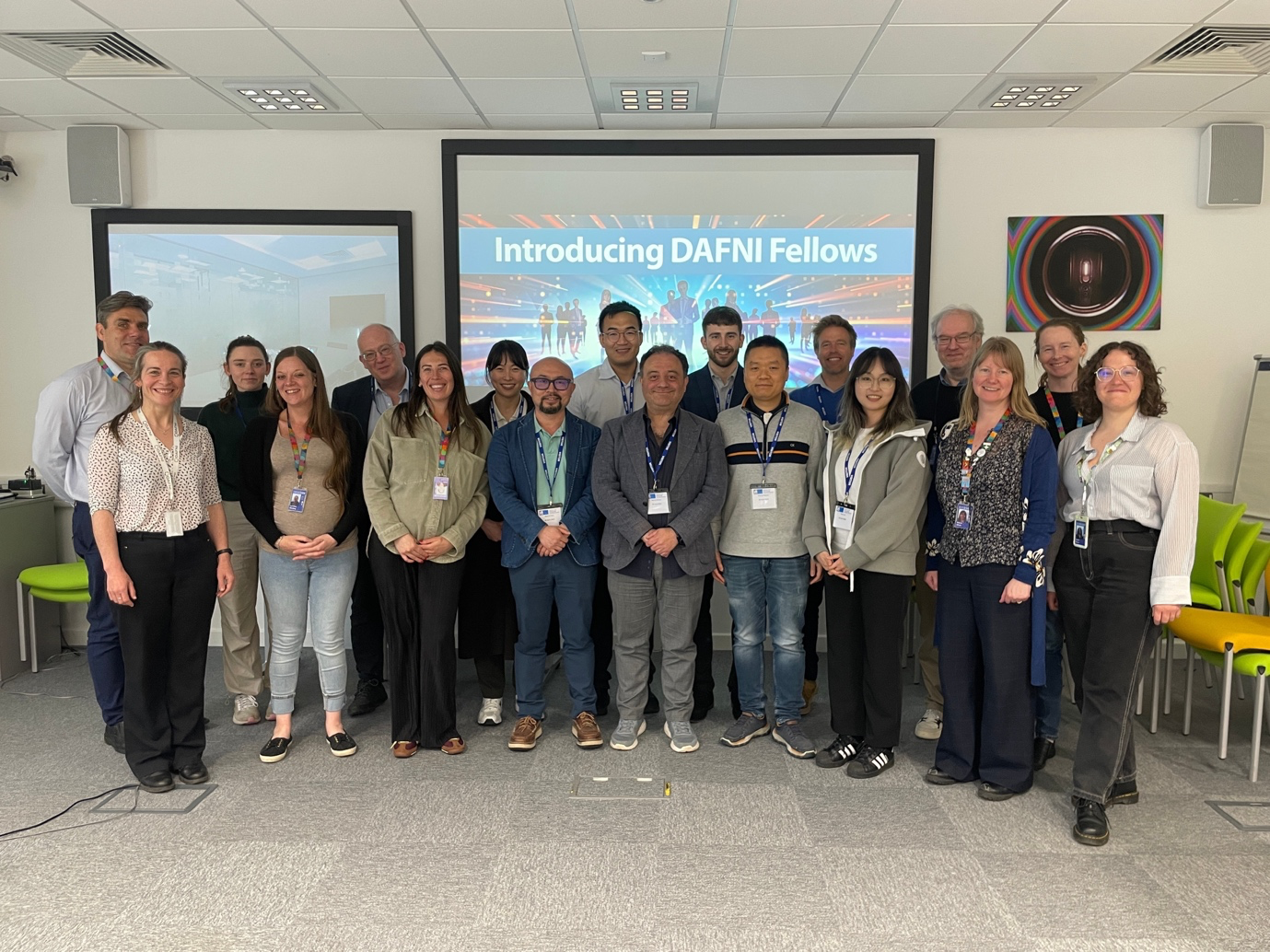
Image: The DAFNI team alongside the 2026 DAFNI Fellows, pictured in their first meeting on the 28th April
- Ms Ji-Eun Byun, Lecturer in System Risk & Resilience, University of College London – a resilient digital twin for transport networks
- Mr Xiaohui Chen, Associate Professor in Civil and Environmental Engineering at the University of Leeds –next-generation AI-for-Science frameworks that integrate physical modelling and data-driven approaches to support national infrastructure resilience
- Ms Yitian Dai, Post-Doctoral Research Associate at The University of Manchester – climate resilient electricity networks on DAFNI and cascading failure analysis
- Ms Amy Green, Research Associate at Newcastle University – focus on addressing key challenges in the quality, accessibility and interoperability of climate data, particularly on extreme rainfall
- Mr Manuel Herrera, Lecturer (Assistant Professor) in Hydrology at Newcastle University – trustworthy AI for infrastructure, lessons from flood management
- Ms Qiuchen Lu, Professor at The Bartlett School of Sustainable Construction, University College London (UCL) – focus on building on the IMPACT project, developing an integrated road-sewer-human digital twin
- Mr Thomas (Tom) Mansfield, Data Systems Architect at Plymouth Marine Laboratory, University of Plymouth – a structured analysis of federated data-architecture approaches across UK offshore-wind programmes.
- Mr James McKenna, Research Associate in Hydrodynamic Modelling at Newcastle University – optimising risk management in urban flood resilience
- Mr Khuong Nguyen, Associate Professor of Smart Transport at Royal Holloway University of London –Reliable AI Modelling for Railway Disruption – how to model uncertainty in compound rail disruptions
- Mr Mingshu Wang, Reader in Geospatial Data Science at the University of Glasgow – GeoAI-enabled workflows for decision-ready infrastructure evidence