Story | 20 July 2026
State of the South-West’s Seas 2025 report highlights warming waters and octopus boom
Marine heatwaves, rising sea temperatures and a boom in Common Octopus populations are among the standout findings in the newly published State of the South-West’s Seas 2025 report. Produced by the South-West Marine Ecosystems (SWME) programme, with key contributions from PML scientists, the annual report provides a comprehensive assessment of the region’s marine environment.
The twelfth SWME State of the Seas report reveals the past year’s observations on a wide range of marine conditions and species, set in the context of longer-term changes to the south west’s marine environment. It includes detailed chapters on south west oceanography and storms, plankton, the seashore and seabed, fish and turtles, coastal birds, seals, whales, dolphins and porpoises, and management chapters on marine planning, marine protected areas, fisheries and plastics pollution.
PML’s Director of Science, Prof. Tim Smyth, led the Oceanography chapter and Senior Marine Ecologist at PML and lead of the Western Channel Observatory, Prof. Angus Atkinson MBE, led the Plankton chapter.
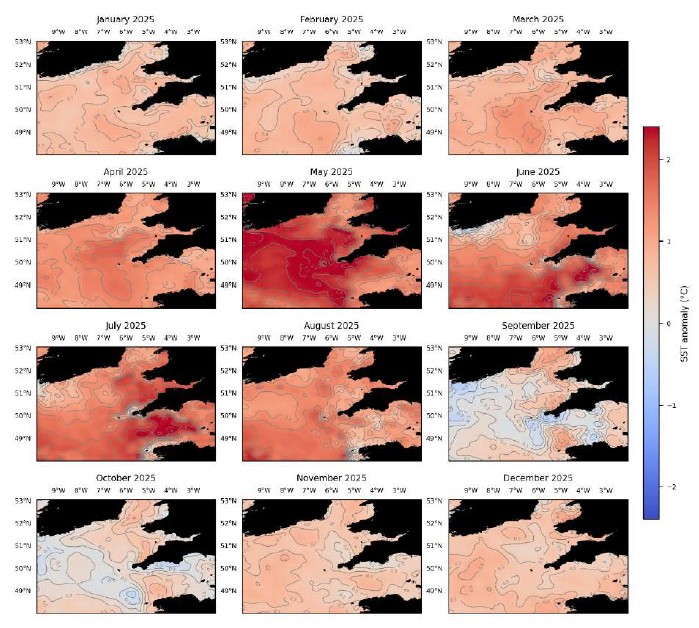
Temperature was a major theme in interpreting change in 2025. Sea surface temperature (SST) around the UK generally shows a significant warming trend of around 0.3°C per decade over the last 40 years. Model simulations indicate a continuing warming trend around the UK, with average annual mean SST values predicted to be up to 3.11°C (±0.98°C) greater at the end of the century (2079–2098) compared to current conditions (2000–2019), under a high baseline emission scenario. Temperatures are also projected to increase on the seafloor, with increases up to 2.49 (±0.94°C) expected by the end of the century.
2025 was also termed the ‘Year of the Octopus’ with an explosion of Common Octopus, causing them to become a keystone species in south-west. The impact on crab, lobster and scallop populations on which octopus preys has been significant but it has also become a key food source for seals, Risso’s dolphins, Blue Shark and Conger Eels. Some inshore fishermen have been able to adapt to market their catches of Octopus. Although Common Octopus breeding has been recorded in past SWME reports in 2023 and 2024, this bloom has been remarkable and one hypothesis is that it has been prompted by the localised marine heat waves that have been recorded in the south-west since 2023.
Summary of findings
Oceanography
- In the English Channel (near Plymouth), the spring and summer consistently achieved temperatures that can be categorised as a Marine Heat Wave (MHW), which is the third year in a row that this has happened. Temperatures for the autumn were around the long-term average but with MHW conditions recommencing in mid-November.
- High temperatures and bright sunshine in early summer caused bleaching of some intertidal algae.
- There were lowered salinities in the English Channel for almost the entire duration of 2025.
- The winter storms of 2025/26, especially in the January – February period (2026), resulted in a major bird wreck, which was the first for many years and produced wrecks of shallow sediment species as well as significant damage to coastal infrastructure.
Plankton
- Continued low summer abundance of Calanus and lower numbers of gelatinous species (Mauve Stinger, Crystal Jellyfish and salps) compared to recent previous years.
- Exceptional observations include anomalously low numbers of picoeukaryotes (tiny, non-bacterial primary producers) and some rare/ first records of some warmer water and potentially toxic dinoflagellates in summer.
Shore and seabed marine life
- Massive explosion of Common Octopus damaging shellfisheries for lobsters, crabs and scallops and in turn, becoming a major food source for seals, Risso’s Dolphins, Blue Shark and Conger Eels. The octopus ‘explosion’ has been linked to higher temperatures.
- The great increase in abundance of Spiny Lobsters (Palinurus elephas)
- The lower numbers of some starfish species reported for 2024 continued in 2025. However, for Common Starfish (Asterias rubens), there was a boom in late summer/early autumn off the south coast and offshore with very large numbers of small individuals being seen in places.
- The Hair Curler Seaslug (Spurilla neapolitana) was a new record for Britain and there were some algae which had been found in previous years were confirmed new records to Britain in 2025.
- Seagrass continued to thrive and expand in extent although the importance of seagrass for biodiversity continued to be untested and unmonitored.
- The first record of the non-native ascidian seasquirt (Didemnum pseudovexillum) was published in 2025.
Fish
- A number of fish species doing well and the populations of Comber, Blackspot (Red) Bream and the Black Bream are continuing to grow and extend their range. Ballion’s Wrasse was observed nesting from the Plymouth area. The explosion in juvenile ‘bootlace’ Conger Eels continues.
- Changes to planktonic systems have supported significant changes to fish populations since the 2014-2015 period. Small forage fish Sardine, Anchovy and Sprat are doing well but with large inter-annual changes in the biomass, whilst apex predators like the Atlantic Bluefin Tuna and Blue Shark are doing very well.
- The decline in surface sightings of Basking Sharks (three sightings) continued and they have undergone a range shift.
- Another poor year for summer catches of Mackerel was recorded.
- Rare fish findings for 2025 include another record of single Sturgeon, a single Halibut, Two Banded Bream and single White Bream, Blue Skate and Flapper Skate.
Turtles
- The number of turtles reported in 2025 was about the average for the region.
Marine and coastal birds
- Impressive numbers of southerly seabird breeders from land, such as the 53,000 Great Shearwaters estimated off the Lizard in September 2025 and approx. 3,000 Balearic Shearwaters in Lyme Bay in July.
- A good year for terns and healthy numbers of Puffins, Guillemots and Razorbills where recorded.
- MARINELife recorded their first Wilson’s Storm-Petrel in Lyme Bay in 20 years of surveying.
Seals
- The range of migration of Grey Seals linked Cornwall travelling to Ireland, Wales France and Holland was extensive.
- The Grey Seal population was undetermined as this is an open population across the entire Celtic Sea but various metrics suggest it is stable.
- The pupping season for Grey Seals is changing rapidly.
- Disturbance is a huge issue for Grey Seals.
- There were 39 Harbour Seal sightings with up to a maximum of five at 12 locations. No successfully weaned Harbour Seal pups were recorded.
Whales, Dolphins & Porpoises
- The data suggest a significant northward shift in the distribution of Common Dolphins in the Bay of Biscay, as well as a coastal shift during summer, autumn, and winter.
- The upward trend in effort-corrected sightings of Risso’s Dolphins has continued and is likely linked to increased numbers of cuttlefish and octopus in south-west coastal waters.
- Coastal Bottlenose Dolphins are no longer being recorded in the western part of the region during the summer months. However, observations of the offshore ecotype of Bottlenose Dolphins continue to increase.
- Humpback Whales continue to be recorded in the region. In 2025, they were consistently observed along the North Cornwall coast during January and February.
Marine Planning
- The first three-year report on the South West Marine Plan was published in 2025 encompassing data from 2021-2023. MMO will start data collection during summer 2026 for the second three-year report which is due for sign off by the Secretary of State and be published in summer 2027.
- Five new evidence projects were published. These can be viewed on the MMO evidence projects register.
- In August 2025, White Cross wind farm was consented as a test and demonstration site.
Development
- The Celtic Sea becomes a hub for floating offshore wind research. Multiple major projects, including ECOFlow Frontline, on which PML is a partner.
- Falmouth Docks redevelopment raises serious contamination concerns. A proposed £150 million expansion of Falmouth Docks would require dredging over 643,000 m³ of sediment.
- Devon and Severn IFCA challenges evidence base of Fingleton Nuclear Regulatory Review regarding fish mortality at Hinkley Point.
Marine Protected Areas (MPAs)
- According to the new Wildlife Trusts’ MPA Recovery Assessment, 58% of UK MPAs are currently in ‘degraded’ or ‘degrading’ condition, while only 15% are classified as recovered or recovering.
- MPAs Progress was made through Stages 3 and 4 of the MMO’s offshore MPAs fisheries management programme, with Stage 3 proposing measures to protect seabed features across 42 MPAs and Stage 4 developing options to manage pressures on highly mobile species such as harbour porpoise.
- The Government announced a review of the English MPA network and proposals for strategic compensation within MPAs linked to offshore wind development.
Plastics
- 2025 was a year where organisations reporting plastic pollution saw the presence of plastic on the south-west coastline hold steady for another year. Evidence gathered by local coastal clean-ups shows at least 21,100 kg of pollution was removed by 15,300 volunteers, whose time was worth over £396,000.
- Again, the top plastic pollution items recovered were ghost fishing gear and pollution stemming from single-use plastic.
- 2025 was also a year that saw the issue of micro- and nano-plastics hit headlines and the public health impacts of plastic pollution start to be considered. We eat a credit card’s worth of plastic a week, with growing evidence of links to infertility, respiratory disease and cancer through the whole lifecycle of plastic production. From extraction to production, distribution, use and disposal.
- Plastic production is set to double by 2040. While the task of tackling its pollution of the coastline and seas of the south-west may seem daunting, there are opportunities on every level to influence and drive change.
To aid the development of these interdisciplinary and comprehensive annual reports, the South-West Marine Ecosystems (SWME) programme brings the marine and coastal community together annually to consider the changes that are taking place in local seas. This years’ SWME conference, titled Past & Future Change’, was hosted at PML in April and welcomed over 100 participants keen to learn about and discuss the ecological changes being observed in the waters of the south west of England during 2025.
Overall, the report highlights the accelerating pace of change across south-west marine ecosystems and the importance of long-term monitoring programmes, such as the Western Channel Observatory. Through initiatives such as SWME, researchers, regulators, industry and local communities continue to build a clearer understanding of how climate change and other environmental pressures are reshaping the region’s seas.