Story | 27 June 2026
Decline in plankton across North East Atlantic sends stark warning for ocean health
A new study, involving scientists from PML, found there were no habitats assessed as being of ‘Good Environmental Status’ in a region stretching from Portugal to Norway.
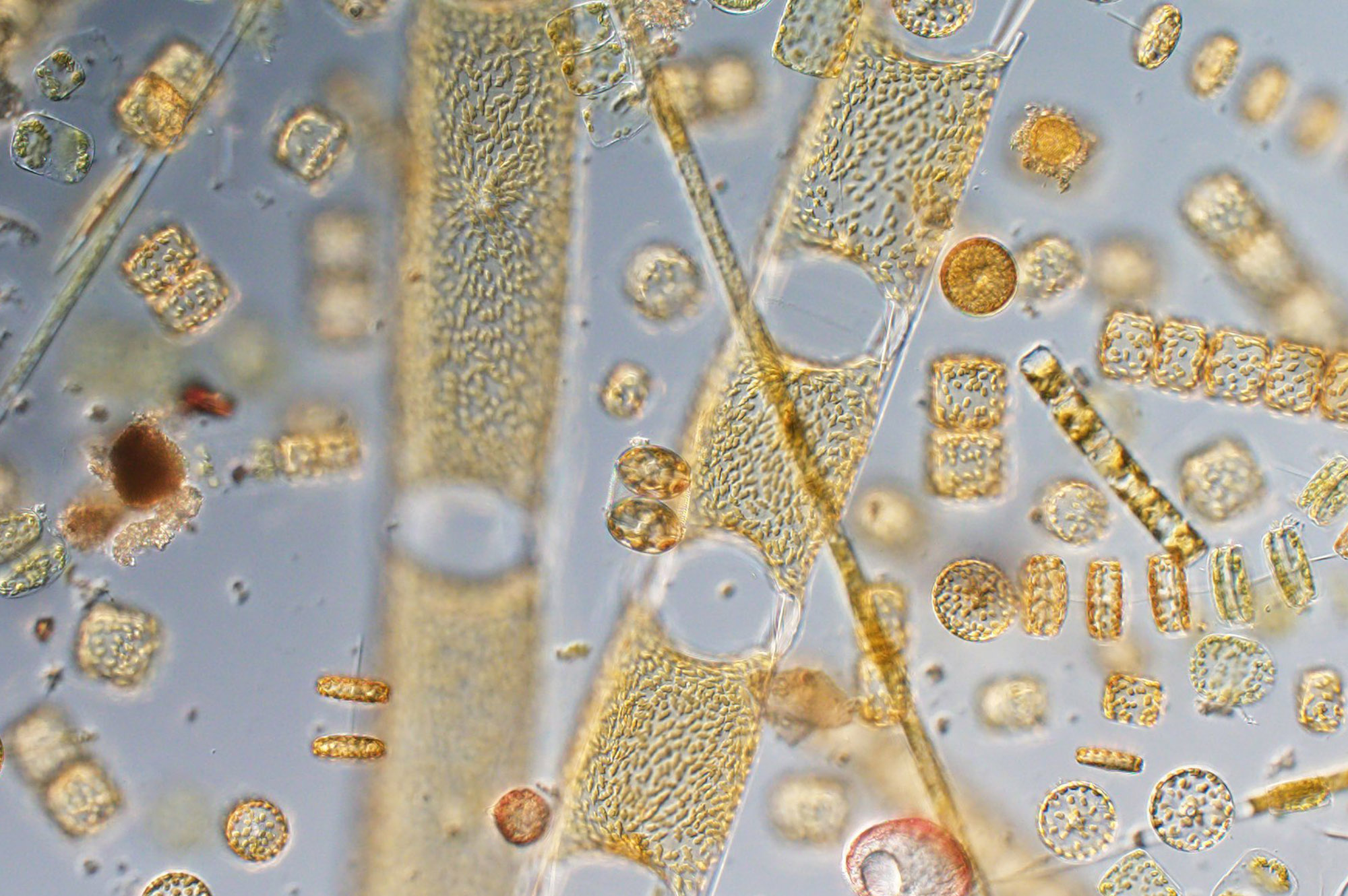
Plankton. Bryony Squires, Plymouth Marine Laboratory
Microscopic plankton are among the most important organisms on Earth. Phytoplankton produce around half of the oxygen we breathe, while plankton as a whole underpin marine food webs, support fisheries, help regulate carbon and sustain life across the ocean.
A new study has used more than six decades of data to show that concerningly, plankton abundance is declining across vast swathes of the North East Atlantic. This region covers the Atlantic Ocean from Portugal to Norway, and the entirety of the North Sea.
The research used 23 plankton datasets from 13 research institutions, including the long-term Western Channel Observatory dataset managed by PML, alongside satellite data, to generate the first ever quantitative and integrative assessment of whether the open-sea (pelagic) habitats of western Europe are in Good Environmental Status, as defined by the EU and UK Marine Strategy Framework Directive.
These pelagic habitats are the open-water regions dominated by plankton and are central to ocean functioning. However, until now assessments for policy have largely described changes in plankton without being able to integrate them quantitatively into a clear regional status assessment.
This new work filled that gap by combining marine monitoring data from a range of sources then scientists expertly integrating that data across plankton indicators and habitat types, to derive regional environmental status.
No pelagic habitats rated as ‘good’
The results showed there were no pelagic habitats anywhere in the North East Atlantic rated as good, with six pelagic habitat-region combinations assessed as ‘Not Good’, three as ‘Uncertain’, and one ‘Unassessed’ due to lack of data.
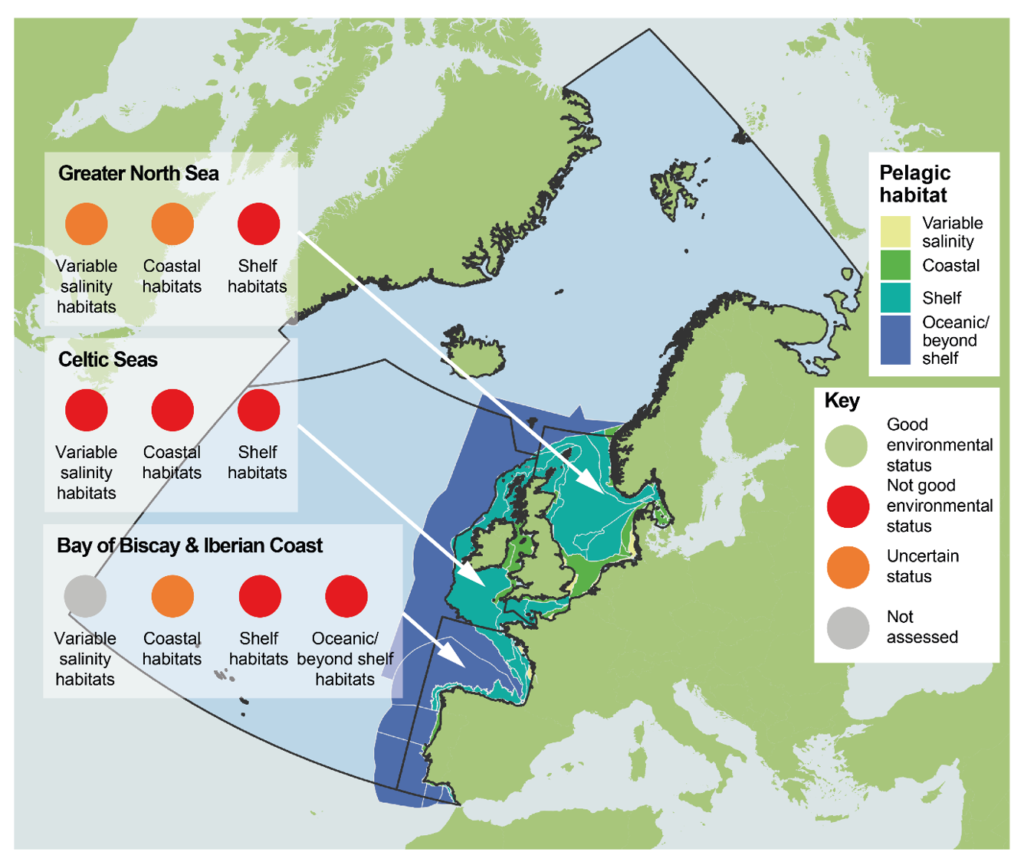
At regional scale, the Celtic Seas and the Bay of Biscay and Iberian Coast were assessed as ‘Not Good’, while the Greater North Sea was assessed as ‘Uncertain’. The poorest status was generally found in shelf habitats, where changes in plankton communities and declines in phytoplankton biomass and zooplankton abundance were most clearly detected.
The research also found rising sea surface temperatures, changing nutrient conditions, declining pH and altered ocean mixing to be among the key factors associated with changes in plankton and their habitats.
As a result, the researchers say the most important action to protect the functioning of pelagic habitats is to mitigate ongoing climate change through supporting global reductions in carbon emissions.
They have also called for stronger action to reduce nutrient pollution, particularly nitrogen, and for sustained investment in plankton monitoring. Several long-term plankton datasets in the OSPAR assessment area are currently paused or at risk due to reduced resources, despite being essential for detecting ecological change and informing marine policy.
PML’s Professor Atkinson MBE, Senior Marine Ecologist and Lead Co-ordinator of the Western Channel Observatory, helped in the development of indicators and characterisation of the changes in plankton that were observed, as well as linking the changes to environmental stressors.
Professor Atkinson, commented:
“What’s striking is how much this assessment relied on stitching together decades of monitoring effort from many different institutions and countries. It underlines why we can’t afford to lose the long-term datasets on which this kind of analysis depends. If monitoring stops now, or switches suddenly to a new technology or method, we lose the ability to tell whether things are getting better or worse in the future.”
Study lead, Abigail McQuatters-Gollop, Professor of Marine Conservation at the University of Plymouth, said:
“I’ve been studying plankton for more than two decades, but for the most part they are totally underappreciated. The majority of people don’t even know what they are, which is crazy when you think they are responsible for half of the breaths we take, form the diet of species such as blue whales and basking sharks, and are key to cycling carbon and removing it from our atmosphere.
“Our study is the first to provide a quantitative assessment of the state of plankton across key regions such as the Celtic Sea, the Bay of Biscay and the North Sea. It has shown there is an urgent need to improve the health of these waters and to reduce the harm we are causing to the ocean, at both a local and a global level. It has also shown we need to establish new ways that science and policymakers can work together to generate more data and figure out how we transition to good status in the future.”
“The warning is clear: plankton are changing across some of Europe’s most important seas, and those changes matter far beyond the plankton themselves. They affect food webs, fisheries, carbon cycling and the wider benefits people receive from the ocean. The challenge now is to use this evidence to drive practical action, from climate mitigation to better nutrient management and long-term monitoring.”
The study drew on contributions from around 40 plankton experts working through OSPAR, the Regional Seas Convention for the Northeast Atlantic. It builds on the OSPAR Quality Status Report 2023, which provides a wider assessment of the health of the Northeast Atlantic marine ecosystem.
The researchers say future assessments should include more long-term plankton datasets, better coverage of coastal and estuarine areas, and new technologies such as imaging and environmental DNA to capture parts of the plankton community that are currently under-represented.
The study was led by the University of Plymouth and involved partners from: UK – University of Plymouth, Plymouth Marine Laboratory (PML), Environment Agency, Marine Directorate of the Scottish Government, Centre for Environment, Fisheries and Aquaculture Science, Marine Biological Association, Scottish Association for Marine Science; FRANCE – University of Lille, PatriNat, Muséum National d’Histoire Naturelle; NETHERLANDS – Netherlands Institute of Ecology, Deltares, Ministry of Infrastructure and Water Management; GERMANY – AquaEcology GmbH & Co KG; DENMARK – Aarhus University; SWEDEN – Swedish Meteorological and Hydrographic Institute.