Story | 08 July 2026
What is AMOC? And what is the North Atlantic ‘cold blob’? PML’s Dr de Mora breaks down the science
The Atlantic Meridional Overturning Circulation (AMOC) may not be a household name – and neither might the North Atlantic ‘cold blob’ – but the climate phenomenon has been making headlines across the world, especially since the “cold blob” is linked to the heat dome exacerbating the current UK heatwave.
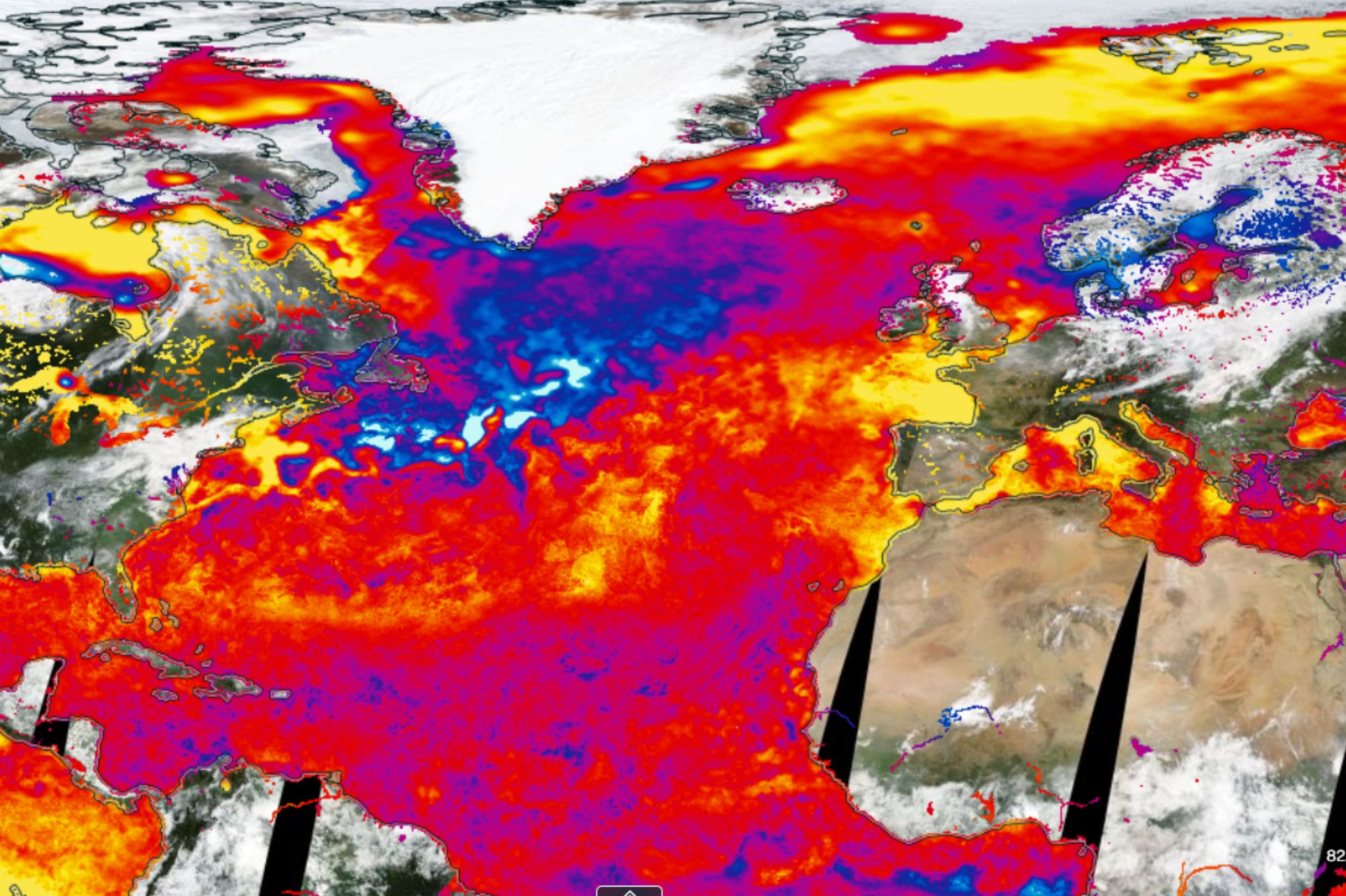
Image: The ‘cold blob’ pictured here, 7th July 2026, in The North Atlantic Sea Surface Temperature Anomalies (L4, MUR). Image taken from Group for High Resolution Sea Surface Temperature (GHRSST), https://worldview.earthdata.nasa.gov/
Dr Lee de Mora is an Earth System Modeller at Plymouth Marine Laboratory (PML), where he uses complex computer simulations to forecast what our future ocean and climate may look like, and is actively researching what the future of the Atlantic Ocean may look like.
Earlier this week, he was featured in The Independent article: “We’re in the middle of a heatwave, so why is the ‘cold blob’ in the North Atlantic causing so much concern?”, after an interview with The Independent features writer Helen Coffey.
In the article, he discusses the North Atlantic ‘cold blob’, the Atlantic Meridional Overturning Circulation (AMOC), and what scientists currently understand about the potential weakening of this important ocean circulation system.
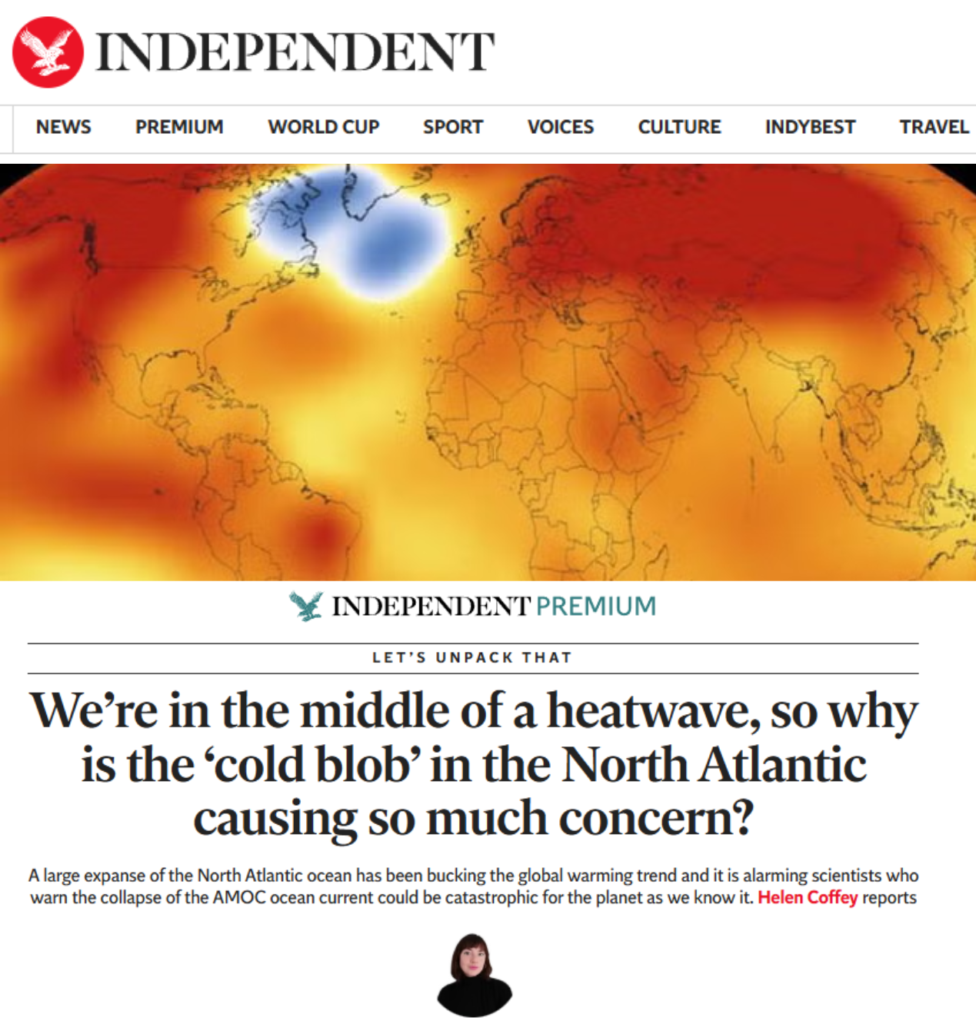
(Subscription to The Independent required)
The AMOC is one of Earth’s most important ocean circulation systems, helping to regulate weather patterns around the world. But what happens when this vast ocean conveyor belt shows signs of change – and how does the “cold blob” fit into the picture? Dr de Mora kindly sat down with us to explain the science behind these phenomena and what they could mean for our future climate.
What is the Atlantic Meridional Overturning Circulation (AMOC)?
“The AMOC is essentially a massive system of ocean currents that act like a giant, global “conveyor belt”. The AMOC is also often described as a huge “central heating system” for Earth, that redistributes heat around the planet.”
“Despite being in the Atlantic, it affects weather systems across the world.”
“How does it do this? Well, through these currents, the AMOC transports warm, salty water from the tropics, northwards into the North Atlantic. As the water moves further up north, it cools – and becomes denser – and sinks deep into the ocean, before flowing south again.”
“Salty water is denser than fresher water, so it sinks, whereas fresh water is lighter and floats. And similarly, cold water sinks, whereas warm water rises.”
“This continuous circulation is a natural phenomenon, and it affects us all on Earth. It helps redistribute heat around the planet, influences weather patterns, and enables the ocean to absorb carbon dioxide from the atmosphere.”
More closely to the lab, it is the reason why the UK and Western Europe enjoy relatively mild, temperate winters. The heat transported by the AMOC keeps the UK significantly warmer and wetter than its high northern latitude would otherwise dictate.
“Without it, the UK’s winters could be drastically colder, and the country’s climate would actually resemble that of subarctic regions! Plymouth is actually further North than, for instance, Quebec City, but due to the Gulf Stream (which is part of the AMOC), our winters are mild and frost is rare, but it’s common for Quebec City to drop below -20 in the winter!”
“Because Plymouth and the rest of the UK sit between the 50°N and 60°N parallels – which is the same latitude as places like Labrador, Canada, and southern Alaska – the UK’s relatively mild, temperate climate is largely a gift of these ocean currents carrying warm water up from the tropics.”
“The AMOC has been receiving significant media coverage in recent times, as scientists have long predicted that climate change could weaken this circulation and a newly published study predicted a ~50% AMOC weakening by the end of this century.”
How does climate change affect AMOC? And what is the ‘cold blob?’
“The AMOC relies on cold, salty water sinking in the North Atlantic.”
“As global temperatures rise, increasing amounts of freshwater from melting Greenland ice enter the ocean. Because freshwater is less dense than salty water, it remains near the surface, making it harder for water to sink and slowing the circulation.”
“This process is also linked to the so-called North Atlantic “cold blob” – an unusual region of cooler ocean that has persisted despite global warming. Recent research suggests this cold patch is likely caused by less warm water reaching the region, rather than increased heat loss to the atmosphere.”
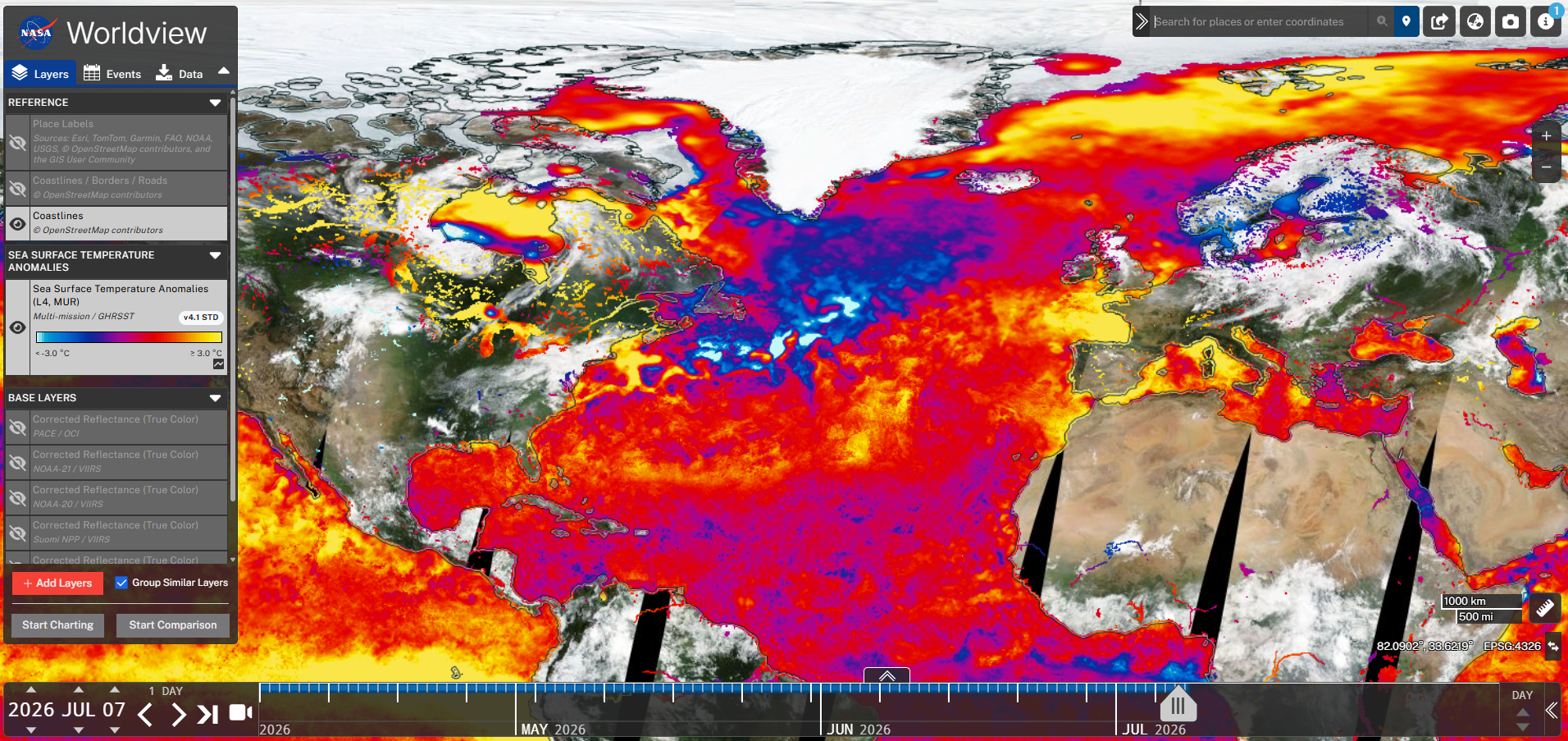
Image caption: The ‘cold blob’ pictured here, 7th July 2026, in The North Atlantic Sea Surface Temperature Anomalies (L4, MUR). Image taken from Group for High Resolution Sea Surface Temperature (GHRSST), https://worldview.earthdata.nasa.gov/
“The cold blob is thought to be linked to changing weather patterns in the UK. The air above the cold blob is also affected, and this disrupts the flow of the jet stream, forcing it to go around the cold blob. This is an “omega block”, as it is shaped like the Greek letter (Ω). Inside the loop, high pressure dominates, clearing clouds, and trapping intense heat at ground level – creating a heat dome, like we’re seeing this week.”
Does this mean AMOC is collapsing?
A recent study, ‘Warning of a forthcoming collapse of the Atlantic meridional overturning circulation’, suggested that the AMOC could reach a tipping point around the middle of this century under a high-emissions scenario, with potentially severe consequences for global climate. The findings attracted widespread media attention, including some highly dramatic headlines portraying an AMOC collapse in apocalyptic terms.
So, should we be expecting a collapse of the AMOC? According to Dr de Mora, the answer is not straightforward.
“Not necessarily. And it is important to distinguish between a slowdown and a collapse.”
“Climate models consistently project that the AMOC is likely to weaken during this century as greenhouse gas emissions continue. However, there is currently no direct observational evidence that the circulation has already begun weakening, although that is partly because the monitoring record is still relatively short.”
“Scientists estimate around 60 years of continuous observations are needed to confidently detect long-term changes, and current monitoring spans around only half that period.”
“A complete collapse of the AMOC is considered a low-likelihood but high-impact scenario in the latest Intergovernmental Panel on Climate Change (IPCC) assessment. Though the next IPCC report is underway, so we’ll soon see whether that has changed.”
Even it doesn’t collapse, does it matter if the AMOC weakens?
“Even a gradual weakening could have significant consequences. A weaker AMOC could completely change weather patterns across Europe and North America, contribute to regional sea level changes, affect marine ecosystems, and reduce the ocean’s ability to absorb carbon dioxide from the atmosphere.”
“The ocean currently absorbs around a quarter of human-produced carbon dioxide emissions. As less water sinks into the deep ocean, less carbon can be transported away from the atmosphere, potentially reinforcing climate change.”
The importance of long-term monitoring
“We think it could take around 60 years of observations before we can confidently detect long-term changes in the AMOC. Without sustained monitoring, we’re effectively trying to understand one of Earth’s most important climate systems without seeing the full picture.”
“Continuous monitoring programmes allow scientists to detect subtle changes, improve climate models and build the evidence needed to understand how our oceans are responding to climate change.”
This is why PML are proud to uphold the Western Channel Observatory – the longest, near-continuous marine dataset in the world, which began back in 1903.
Stay tuned: Dr Lee de Mora will soon be publishing new research exploring the future of the Atlantic Meridional Overturning Circulation (AMOC). Stay tuned for updates via our website and social media channels.