Story | 10 August 2026
Building trust in AI for better ocean forecasting
The International Telecommunication Union recently published their ‘AI for Good, Innovate for Impact’ interim report 2026, which features a PML-led case study that offers potential for trustworthy, lower-cost marine early warning and climate-ready ecosystem forecasting.
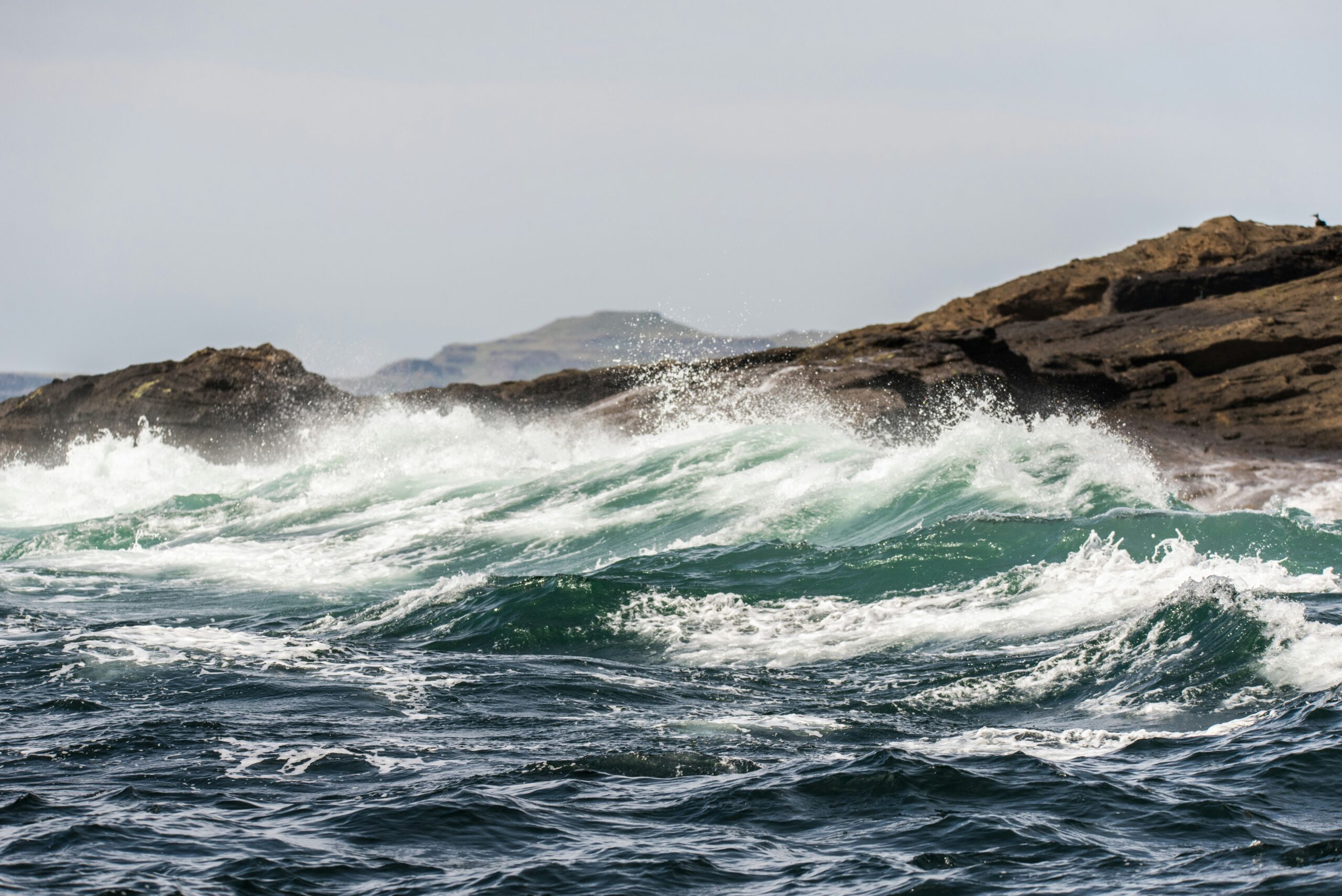
Ramon Vloon | Unsplash
The International Telecommunication Union (ITU)’s ‘AI for Good, Innovate for Impact’ Interim Report 2026 aims to identify, evaluate and promote AI solutions that deliver measurable social, economic and environmental benefits. The initiative is part of ITU’s broader ‘AI for Good’ programme, which focuses on scaling practical artificial intelligence (AI) applications that support sustainable development and digital inclusion.
The PML-led project ‘Trustworthy Hybrid Physics-AI for Ocean Forecasting and Early Warning’ was feature as one of 267 global case studies and one of only 23 European case studies.
The team, with partners from PML (UK), National Centre for Earth Observation (UK), Bolding & Bruggeman ApS (Denmark) and University of Oxford (UK), developed an innovative approach that combines AI with traditional ocean science models to improve forecasts of marine ecosystem health.
The goal is to provide more reliable early warnings of environmental risks, such as harmful algal blooms, poor water quality, and low oxygen levels that can damage marine life, pose risks to human life and have negative impacts upon fisheries, aquaculture and coastal economies.
Current ocean forecasting systems often struggle to accurately predict important indicators, such as chlorophyll, which is a measure of microscopic ‘plant’ life in the ocean, nutrients and dissolved oxygen. These forecasts are particularly challenging when observations from satellites are unavailable due to cloud cover or when monitoring networks are limited. Existing solutions often require expensive computing resources and frequent data updates from observations, making them difficult for many organisations to operate.
PML’s solution uses a hybrid physics-AI framework, meaning that AI works alongside established scientific models rather than replacing them. The AI is trained using satellite observations, ocean measurements and biological data, learning where the model tends to make errors. Once deployed, it provides carefully-controlled corrections to improve forecast accuracy whilst remaining grounded in accepted ocean science. If conditions fall outside the AI’s area of expertise, the system falls back to the underlying scientific model when conditions fall outside the AI’s validated range.
The approach was tested on the Northwest European Shelf using data from 2017 to 2023 and results showed improvements in predicting chlorophyll and oxygen levels, with performance that can rival more computationally intensive forecasting methods.
As it reduces reliance on constant observational updates and high-performance computing, it could make advanced marine forecasting more accessible to organisations with limited resources.
The benefits include:
- More reliable forecasts when observations are sparse or unavailable.
- Lower computing costs compared with traditional forecasting approaches.
- Improved early warnings for water quality issues, harmful algal blooms, oxygen stress, and habitat degradation.
- Potential to support reliable long-term climate projections.
The technology supports global efforts to strengthen early warning systems and climate resilience. By improving predictions of ocean health and reducing barriers to deployment, it has the potential to help governments, environmental agencies, fisheries managers and coastal communities make more informed decisions and respond more effectively to emerging marine risks.
Deep S. Banerjee, Modelling Scientist at PML and lead researcher on the ‘Trustworthy Hybrid Physics-AI for Ocean Forecasting and Early Warning’ case study, commented:
“AI should strengthen ocean models, not replace the science inside them. Our approach embeds lightweight, controlled AI corrections within established numerical models, improving forecasts while reducing dependence on repeated observational updates and costly computing”.
Currently, the system is a pre-operational prototype undergoing further development and validation. The team plan to expand its capabilities, test it in additional regions and move towards wider operational use and future open-source availability.
Deep added:
“Our next step is to extend this towards an energy and cost-efficient 3D hybrid system for climate-ready forecasting, from UK and surrounding waters to the global ocean”.