Story | 13 July 2026
PML welcomes UK ratification of the High Seas Treaty
A “landmark moment” for ocean protection, with PML experts warning that the real challenge now lies in delivery.

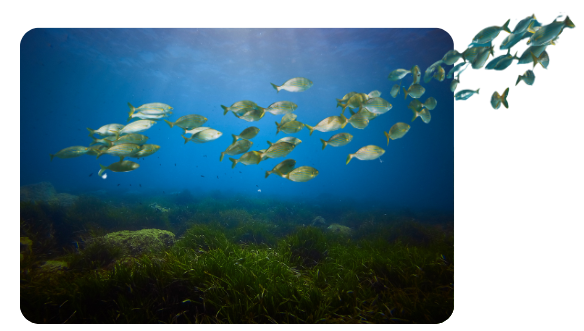
Open ocean. Pierre Goiffon | Unsplash
Plymouth Marine Laboratory (PML) has welcomed the UK Government’s ratification of the Biodiversity Beyond National Jurisdiction Agreement (BBNJ Agreement), also known as the High Seas Treaty, which is designed to help protect the two-thirds of the world’s Ocean that exist beyond national jurisdiction.
On 10 July it was announced that the UK Foreign Secretary had formally deposited the ratification document with the United Nations in New York, completing the final step of a process that began when the UK was among the first countries to sign the Agreement in 2023.
The Treaty establishes, for the first time, a legal framework for the conservation and sustainable use of biodiversity in the nearly two-thirds of the world’s Ocean that lies beyond national jurisdiction. It includes mechanisms to create marine protected areas on the high seas, helping to conserve vulnerable habitats and species for future generations.
PML has been involved from the outset in helping shape the Treaty’s implementation, convening international experts, providing input on BBNJ as members of international advisory committees, contributing to the UK’s own BBNJ legislation, delivering international training on science and the BBNJ, and developing research programs to address knowledge gaps.
Earlier this year, PML led a scientific delegation to the Third BBNJ Symposium in Rio de Janeiro, where Professor Matt Frost, PML’s Head of the International Office, chaired a satellite event on climate-smart pathways for the high seas – an area of research being led by PML’s Professor Ana Queiros and vital to ensure long-term success for BBNJ implementation.
“The BBNJ is an incredible opportunity, including in terms of how it will facilitate sustainable development, greater ocean equity and global marine protection goals. But making the rules is actually only the beginning – ensuring delivery is where the real challenge lies,” said Professor Frost.
“This unprecedented exercise in global diplomacy requires the strategic mobilisation of the best available scientific data, expertise and technology, alongside major capacity-building in those geographic areas where resources have historically been limited or inaccessible.”
PML researchers also published a comprehensive scientific roadmap for delivering on the Treaty’s ambitions, identifying critical knowledge gaps and the innovations needed to close them across the Treaty’s four pillars: Marine Genetic Resources, Area-based Management, Environmental Impact Assessments, and Capacity Building and Technology Transfer.
Less than 30% of the deep sea has been mapped to modern standards and an estimated 90% of marine species remain undiscovered, underlining the scale of the scientific challenge now facing the Treaty’s implementation.
Find out more: The PML-led Deep Vision project, supervised by Professor Kerry Howell (PML’s Biodiversity Lead), is using AI to map Vulnerable Marine Ecosystems across the Atlantic.
The roadmap warns that the high seas are not simply a bigger version of coastal waters, but a fundamentally different scientific challenge, requiring new technologies, smarter monitoring systems, and increased international collaboration if science is to keep pace with the Treaty’s ambitions.
With the Treaty now in force and the first Conference of Parties due to take place in January 2027, PML says the focus must now shift to ensuring the science that underpins the Agreement can be mobilised at the scale and speed the ocean demands.
“There is a great sense of optimism around the BBNJ, plus a clear need to learn from, and harmonise it with, the commitments under the UNFCCC, the CBD and the anticipated Plastics Treaty,” said Professor Frost. “We need the best science informing delivery of BBNJ and all our international obligations.”
More information on the Biodiversity Beyond National Jurisdiction Agreement (BBNJ Agreement)
- The BBNJ Agreement (sometimes referred to as the High Seas Treaty) was adopted by UN member states in 2023 following more than a decade of negotiations.
- Palau was the first country to ratify, in January 2024, and states from every region of the world have since followed suit, with the Agreement now counting well over 80 Parties and some 145 signatories overall.
- The Treaty reached the 60-ratification threshold required for entry into force in September 2025, when Morocco and Sierra Leone became the 60th and 61st parties to ratify, and it formally entered into force on 17 January 2026.
- The UK’s ratification followed Royal Assent of the Biodiversity Beyond National Jurisdiction Act 2026 on 12 February 2026.