Story | 21 August 2026
Sun, sea and sunscreen: what happens when UV filters enter the ocean?
PhD researcher Anneliese Hodge speaks to BBC World Service about what we know – and don’t yet know – about the environmental impacts of UV filters in sunscreen.
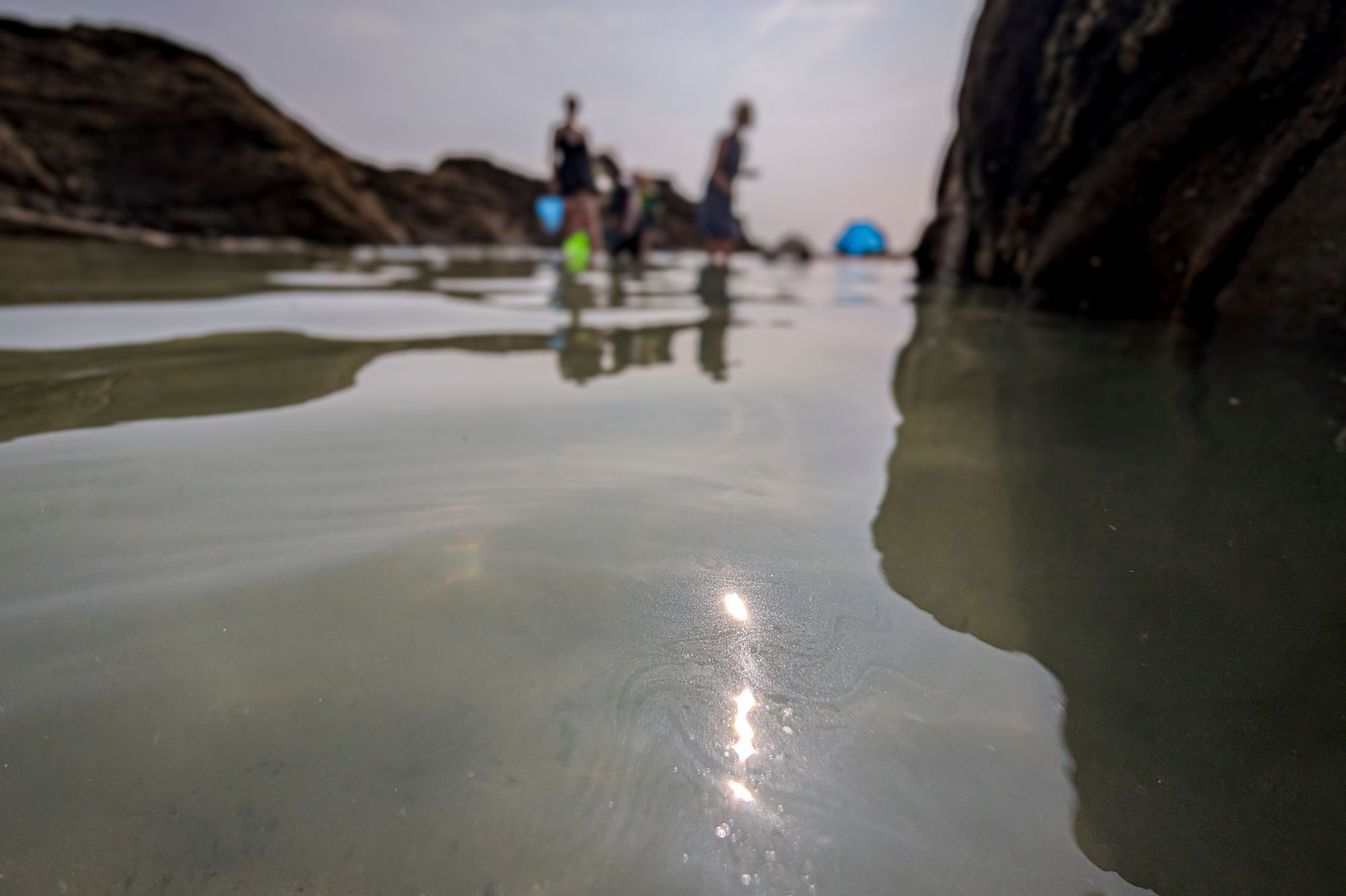
Image: Sunscreen washed into a rockpool. Image credit: Jon White – Plymouth Marine Laboratory
From coral reefs to the Arctic, ultraviolet (UV)-filtering chemicals used in sunscreens have been detected in marine environments around the world.
Sunscreen compounds can enter marine environments in several ways – from being washed directly into the sea by bathers, to entering water systems when washed off in the shower.
But what happens when these compounds enter the ocean, and what could they mean for marine life?
Anneliese Hodge, PhD researcher with Plymouth Marine Laboratory and the University of Plymouth, recently joined BBC World Service programme Unexpected Elements to discuss her research into the effects of sunscreen compounds on marine primary producers, including algae.
Listen to the episode here (14 minutes in – and available to listen for over a year) or read the transcript from the interview below.
BBC World Service: What exactly are UV filters?
Anneliese Hodge: UV filters can be organic or inorganic. Organic UV filters are carbon-based chemical compounds, while inorganic UV filters include minerals or metal-based compounds such as titanium dioxide and zinc oxide. There are also nanoparticle versions, which are essentially much smaller particle sizes of these minerals.
These compounds have been detected in many different environments, including marine and freshwater surface waters, sediments, inshore waters, soils and sand. They’ve even been detected in geographically isolated regions such as the Arctic and Antarctica.
Recent estimates suggest that between 6,000 and 14,000 tonnes of UV filters are released into coral reef zones every year. We also know that at least 25% of sunscreen can be washed off during sea bathing.
Based on these estimates, scientists have calculated that for every 1,000 visitors wearing sunscreen on a single beach, more than 35 kg of sunscreen could potentially be deposited into the marine environment each day.
BBC World Service: That’s a lot of sunscreen being washed into the ocean. How can these compounds affect marine life?
Anneliese Hodge: There are different levels at which UV filters have been shown to impact marine life.
At a molecular level, we’ve observed things such as DNA damage and endocrine disruption – in other words, disruption to hormones. At a cellular level, organic UV filters have been shown to affect growth and enzyme production and cause something called oxidative stress.
Oxidative stress is essentially an imbalance between molecules and antioxidants in the body, which can have knock-on effects on other components such as lipids and proteins.
At the individual level, we’re talking about things such as reproductive impacts, hatching and development rates. For example, previous studies have found impacts on the hatching of zooplankton, as well as structural impairments to the sperm of sea urchins.
We can also see effects at the community level. Coral bleaching, for example, can affect a large proportion of a coral population.
BBC World Service: Your research focuses particularly on algae, doesn’t it?
Anneliese Hodge: My work focuses on the effects of UV-filter compounds on marine primary producers. Algae are marine primary producers – they sit at the bottom of the marine food chain.
The health of the whole marine ecosystem essentially depends on the health of these primary producers. Any impacts on their health can have knock-on effects further up the food web, affecting higher trophic levels such as fish and mammals.
My research is therefore trying to understand what effect sunscreen compounds can have on these primary producers.
Can they impair photosynthesis? Do they affect chlorophyll production? How do the compounds interact with the algae? Do they influence their structure? Do they cause mortality or affect their growth?
These are some of the different markers of stress that I’m looking at.
BBC World Service: You’ve found that a large part of the public aren’t really aware of this issue. Is that right?
Anneliese Hodge: Absolutely. We recently published a study looking at awareness of sunscreen pollution in Plymouth, UK. We found that 55% of the 281 participants had not considered that sunscreen might harm the marine environment.
I think this really highlighted the lack of awareness surrounding this topic, and there could be many reasons for that.
Some people may be reluctant to consider that a product designed to protect human health can also have environmental downsides. There can also be a disconnect between people thinking that the issue of sunscreen and the marine environment isn’t relevant to them because they don’t live near the sea.
However, if you’re wearing sunscreen at home – perhaps while gardening, for example – even if you don’t live near the coast, when you wash that sunscreen off in the shower or bath, that wastewater goes to a wastewater treatment plant.
Most wastewater treatment technologies aren’t sufficient to remove the majority of these UV-filter compounds from the water they process.
I think this lack of knowledge about sunscreen use can feed into the overall lack of public awareness about the issue.
BBC World Service: Some sunscreen products claim to be ‘marine friendly’ or ‘reef friendly’. How true are these claims?
Anneliese Hodge: A lot of research has focused on specific chemicals, such as oxybenzone. This is an organic UV filter that has been widely used in sunscreens around the world.
It’s also a compound that helped to spark concerns about coral bleaching and eventually led to restrictions on its use, along with some other organic UV filters, in places including Hawaii, Palau and the US Virgin Islands.
There’s been a lot of media attention around this particular compound. Some products will therefore use terms such as ‘reef safe’, ‘reef friendly’ or ‘marine friendly’.
However, these terms are unregulated. Products may use these slogans simply because they don’t contain oxybenzone, and instead contain other organic UV filters that we still don’t know a huge amount about.
We don’t necessarily know whether these other compounds are marine friendly or not. Some studies have shown that certain alternatives can have environmental impacts, but because these terms are unregulated, it can be incredibly difficult for consumers to navigate the market.
It’s not necessarily transparent enough to help consumers make an informed decision.
BBC World Service: What advice would you give to people who want to protect themselves from the sun without harming the environment?
Anneliese Hodge: It’s important to know that this research and this science is not about telling people to stop wearing sunscreen.
Our research is trying to assess which compounds have less of an impact on the marine environment, while also providing sufficient sun protection.
The science currently suggests that both chemical and some mineral UV filters can have an effect on marine life. However, a lot of research points towards non-nano mineral UV filters having less of an impact on the marine environment.
BBC World Service: Anneliese, thank you so much for coming on to Unexpected Elements.
Anneliese Hodge: Thank you so much for having me.
Further information:
Full interview with Anneliese on BBC World Service >>
Over half of people are unaware of environmental effects of sunscreen, study shows >>
Sunscreen’s potential impact on marine life needs urgent investigation, new study reveals >>