Story | 02 June 2026
MEDIA: Uncertainty about weakening Atlantic currents isn’t a reason to wait – it’s a reason to act
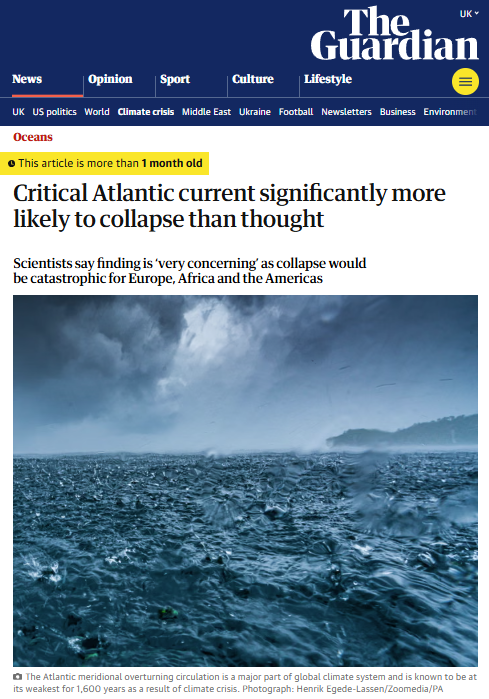
PML’s Professor Helen Findlay has written for Mongabay.com about the growing concerns surrounding the Atlantic Meridional Overturning Circulation (AMOC) – a vast system of ocean currents that play a crucial role in regulating climate, weather, and marine ecosystems – which is shifting due to climate change and at risk of collapse.

In response to growing concerns surrounding the collapse of the Atlantic Meridional Overturning Circulation (AMOC), PML’s Biological Oceanographer Professor Helen Findlay has written a thought-piece for Mongabay.com about the urgency of climate action.
“The potential outcomes could be even more severe than projected, and the uncertainty around timing and thresholds is not a reason to delay, but an argument for action now.”
In the article, Helen explains that while scientists cannot yet predict exactly when or how dramatically the AMOC may weaken, uncertainty should not be mistaken for safety. Instead, she argues that the risks associated with a weakening circulation system – including impacts on biodiversity, fisheries, and already-stressed marine ecosystems – are significant enough to warrant action now.
What is the AMOC?
“The Atlantic Meridional Overturning Circulation (AMOC) is the system of ocean currents that mediates weather on both sides of the Atlantic, and research suggests it’s shifting due to climate change in ways that threaten marine ecosystems, wildlife, agriculture and more. The AMOC is often described as a giant conveyor belt of Atlantic currents. Warm, salty surface waters flow north from the tropics to the subpolar North Atlantic. On its way, the water releases heat to the atmosphere, so that by the time it reaches the subpolar region, it has cooled and become denser. Here it sinks and returns southward into the deep ocean. This movement is part of the driving force for circulating water around the entire planet, which helps shape climate across the Atlantic region and beyond.”
“It is also an engine for ocean ecosystems. Ocean circulation redistributes heat, oxygen, carbon and nutrients, and those physical and chemical conditions set the stage for life, from microscopic plankton to commercial fish stocks and marine mammals. When circulation changes, the location and timing of productivity can change, too. Put simply: Currents don’t just move water; they move the conditions that marine food webs are built on.”
[Excerpt from Prof Findlay’s thought-piece in Mongabay]
The AMOC has made major headlines in recent months.
New research, published in April this year, and led by the Inria Centre de recherche Bordeaux Sud-Ouest in France, combined real-world ocean observations with the models to determine the most reliable future AMOC prediction to reduce the spread of uncertainty. They found an estimated slowdown of 42% to 58% in 2100, a level almost certain to end in collapse.
Lead author, Dr Valentin Portmann said:
“We found that the Amoc is going to decline more than expected compared to the average of all climate models. This means we have an AMOC that is closer to a tipping point.”