Story | 08 October 2026
New paper highlights the ocean‘s role in uniting global environmental action
The article, co-authored by PML’s Office for International Affairs, presents scientific and policy rationales for positioning the ocean as a unifying agenda to advance major international environmental treaties.

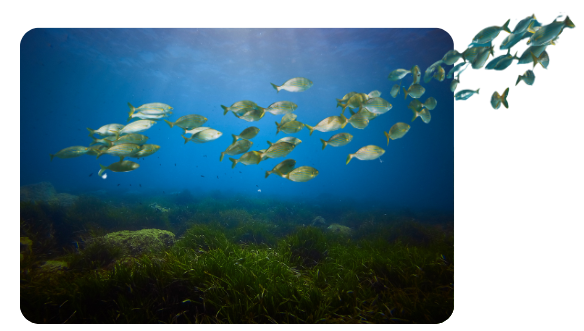
Image credit: Shawn on Unsplash
Climate change, nature loss, land degradation.
These urgent – and deeply interconnected – environmental issues are sometimes described as ‘wicked problems’ – that is, complex challenges that are difficult to solve, with no single, quick-fix solutions.
And the impacts of these challenges – and the proposed solutions – are felt at every level, from local communities to national governments and international institutions. As such, the international agreements designed to address them can be fragmented.
While climate change, biodiversity loss and land degradation are increasingly recognised as interconnected challenges, opportunities to strengthen coordination across the international agreements that address them remain.
A new paper, co-authored by PML’s environmental policy experts Professor Matthew Frost and Thecla Keizer argues that the ocean offers a shared agenda through which climate, biodiversity and land degradation objectives can be pursued in a more integrated and mutually reinforcing way.
The paper, titled, ‘The ocean as a unifying agenda across the climate, biodiversity, and land degradation conventions’, presents scientific and policy rationales for positioning the ocean as a unifying agenda across the Rio Conventions. The authors also propose a framework to help policymakers identify areas where coordinated ocean action can simultaneously deliver climate, biodiversity and sustainable land-use benefits.
What are the Rio Conventions?
The term refers to three conventions created at the 1992 Earth Summit in Rio de Janeiro.
- UNFCCC (United Nations Framework Convention on Climate Change): The UNFCCC sets an overall framework for intergovernmental efforts to tackle the challenge posed by climate change.
- CBD (Convention on Biological Diversity): Focuses on the conservation of biological diversity, the sustainable use of its components, and the fair and equitable sharing of the benefits arising from commercial and other utilization of genetic resources. The agreement covers all ecosystems, species, and genetic resources.
- UNCCD (United Nations Convention to Combat Desertification): The UNCCD aims to combat desertification and mitigate the effects of drought in countries experiencing serious drought and/or desertification, particularly in Africa, through effective actions at all levels
Each has its own mandate, but they share a common goal: protecting the planet while supporting sustainable development.
To encourage cooperation, the three conventions work together through mechanisms such as the Joint Liaison Group and joint capacity-building initiatives. You can find out more at: https://rioconventions.org/
‘Climate change, desertification and biodiversity loss are heavily interlinked and pose existential challenges to humanity. Governments came together to discuss and address such existential challenges at the 1992 Earth Summit in Rio de Janeiro.’ [Source: UNFCCC]
Professor Matt Frost, Head of Office for International Affairs at PML, and co-author of the study, said:
“Climate change, biodiversity loss and land degradation are are deeply interconnected challenges. Despite this, we continue to tackle these challenges through fragmented agendas, which limits our collective impact.”
“Our paper argues that the ocean offers a shared agenda through which these challenges can be addressed in a more integrated way. The ocean provides a practical basis for strengthening synergies across international environmental agreements.”
Co-author Thecla Keizer (Deputy Head of Office for International Affairs & International Business Development and Marketing Executive at PML), added:
“The success of international action to protect the ozone layer demonstrates what is possible when science, policy and international cooperation align around a common goal.
As parties and reflect on the recent land degradation COP and prepare for the biodiversity and climate COPs in the coming weeks there is an opportunity to build on existing efforts to strengthen synergies across climate, biodiversity and land degradation processes, with the ocean offering a shared agenda through which to advance collective action.”
*2026 Rio Convention COPs dates:
- 17-28 August 2026: UNCCD COP17 (Land/Desertification COP)
- 19-30 October 2026: CBD COP17 (Biodiversity COP)
- 9-20 November 2026: UNFCCC COP31 (Climate COP)
Further information:
The paper ‘The ocean as a unifying agenda across the climate, biodiversity, and land degradation conventions’ was led equally by Katie Geddes and Gabriella H. Berman or the University of Miami, and an initiative of a number of the Research and Independent Non-Governmental Organizations (RINGO) Ocean Group.