Story | 26 August 2026
Satellites are helping scientists track changes in the health of the ocean - and a new study shows their precision is growing
Scientists at Plymouth Marine Laboratory (PML) have conducted the largest ever global assessment of the accuracy of satellite data designed to monitor ocean health on climate-relevant timescales.
The new PML-led paper, published in Frontiers, focuses on merged satellite ‘ocean colour’ products which combine measurements from multiple satellites to create long-term records of Ocean health. These products are particularly important for monitoring changes over climate-relevant timescales, providing the ‘bigger picture’; a longer, more consistent record of how the ocean is changing over time.
Titled, ‘Global assessment of merged multi-sensor ocean-colour chlorophyll-a products’, the new paper focuses on the evaluating the accuracy of long-term satellite ocean colour data records used to estimate the amount of microalgae in our ocean. Microalgae – commonly known as phytoplankton – are microscopic plant-like marine organisms.
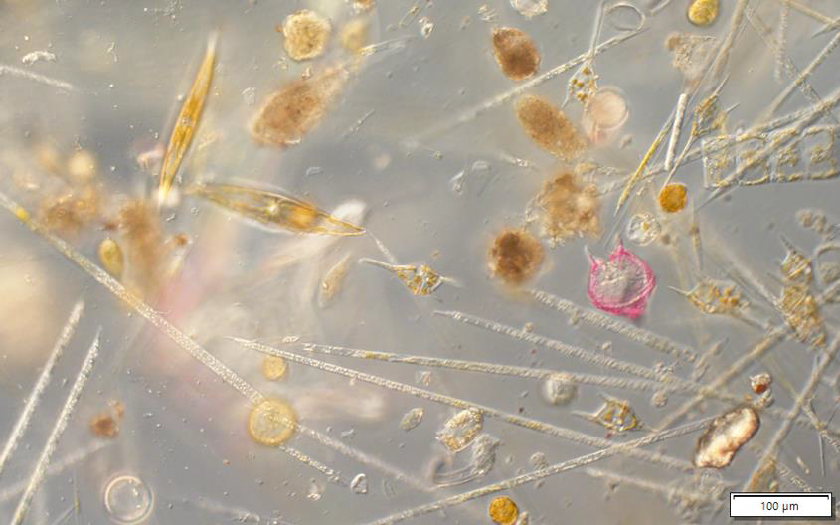
Image: A world of plankton life observed through the microscope, in just a single drop of water. Plankton sample from PML’s L4 monitoring site [about six miles south of Plymouth], June 2026. Credit: Plymouth Marine Laboratory – Bryony Squires.
Whilst individual phytoplankton organisms are microscopic, there can be thousands of them in just a single drop of seawater, and, when there are enough of them together, the presence of phytoplankton can change the colour of the ocean – which enables us to detect them from space.
See below: A coccolithophore bloom – a type of mixoplankton – observed by satellite:
Sentinel-3A OLCI 300m resolution enhanced ocean colour, 3-day composites from 11 Jul. to 15 Aug. 2026, English Channel. Processed by PML’s Dr Peter Miller using the NEODAAS service.
Why should we care about phytoplankton?
These tiny marine organisms are essential to all life on Earth.
Phytoplankton sit at the base of the ocean food web, turning sunlight, carbon dioxide and nutrients into energy through photosynthesis. That energy supports everything higher up the food chain: from tiny zooplankton and krill, to fish, seabirds, whales – and ultimately humans.
They also play a vital role in regulating our climate- not only do phytoplankton absorb CO₂ from the atmosphere and lock it away, but they also produce around half of the oxygen here on Earth.
That makes phytoplankton important not just for ocean life, but for fisheries, food security, economies, and all life on land.
Phytoplankton are also often described as ‘sentinels of change’, because they respond quickly to changes in their environment, such as shifts in water temperature, ocean stratification, light penetration, and nutrient availability. This means that any changes in their abundance, distribution and composition can act as early warning signs of change in the health of marine ecosystems.
How do we measure phytoplankton from space?
When sunlight enters the ocean, it interacts with substances in the sea, such as marine algae – the phytoplankton, mineral particles and dissolved organic matter, that absorb and scatter the light. A proportion of this scattered light is reflected back to the atmosphere and can be detected by satellite ocean colour sensors as the apparent hue or colour of the dominant particles or material.
From this ‘remotely-sensed’ reflectance, the quantity of the different materials suspended in seawater can be estimated. Microscopic marine algae – the phytoplankton are seen in the reflectance data as green, red-brown or chalky white, depending on the species. The green colour arises from the fact that blue and red light is absorbed by the pigment, Chlorophyll-a, commonly the dominant pigment in phytoplankton.
Through their estimation of Chlorophyll-a, scientists can use satellites to monitor phytoplankton biomass across the global ocean – something that would be impossible to achieve through measurements taken from ships alone.
Satellite data for global ocean colour chlorophyll-a now spans over 25 years.
And over this period, there has been a concerted effort to combine data from different satellite sensors into merged products – to allow scientists to track changes in Chlorophyll-a over longer, climate-relevant timescales.
This includes the European Space Agency’s Ocean Colour Climate Change Initiative (OC-CCI) – led by PML – which aims to produce long-term multi-sensor time-series of satellite ocean-colour data with a particular focus for use in climate studies.
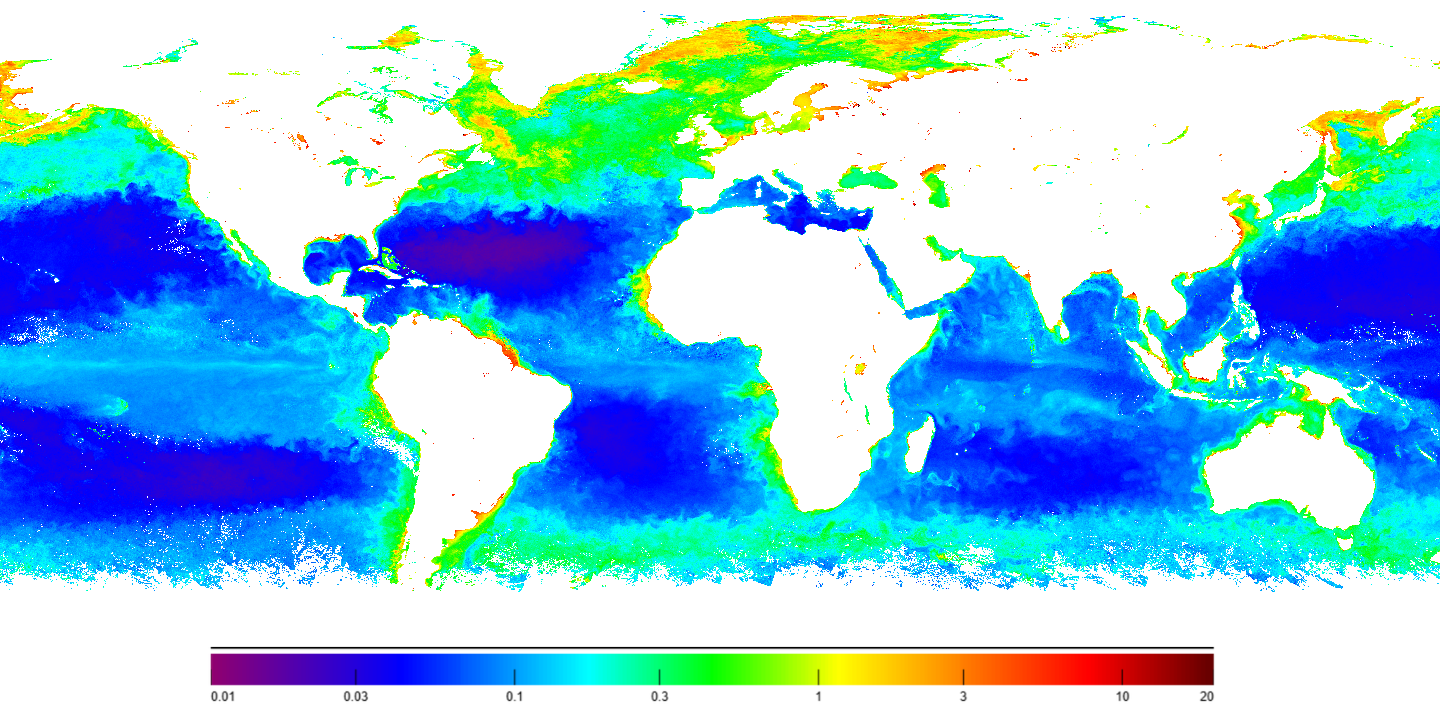
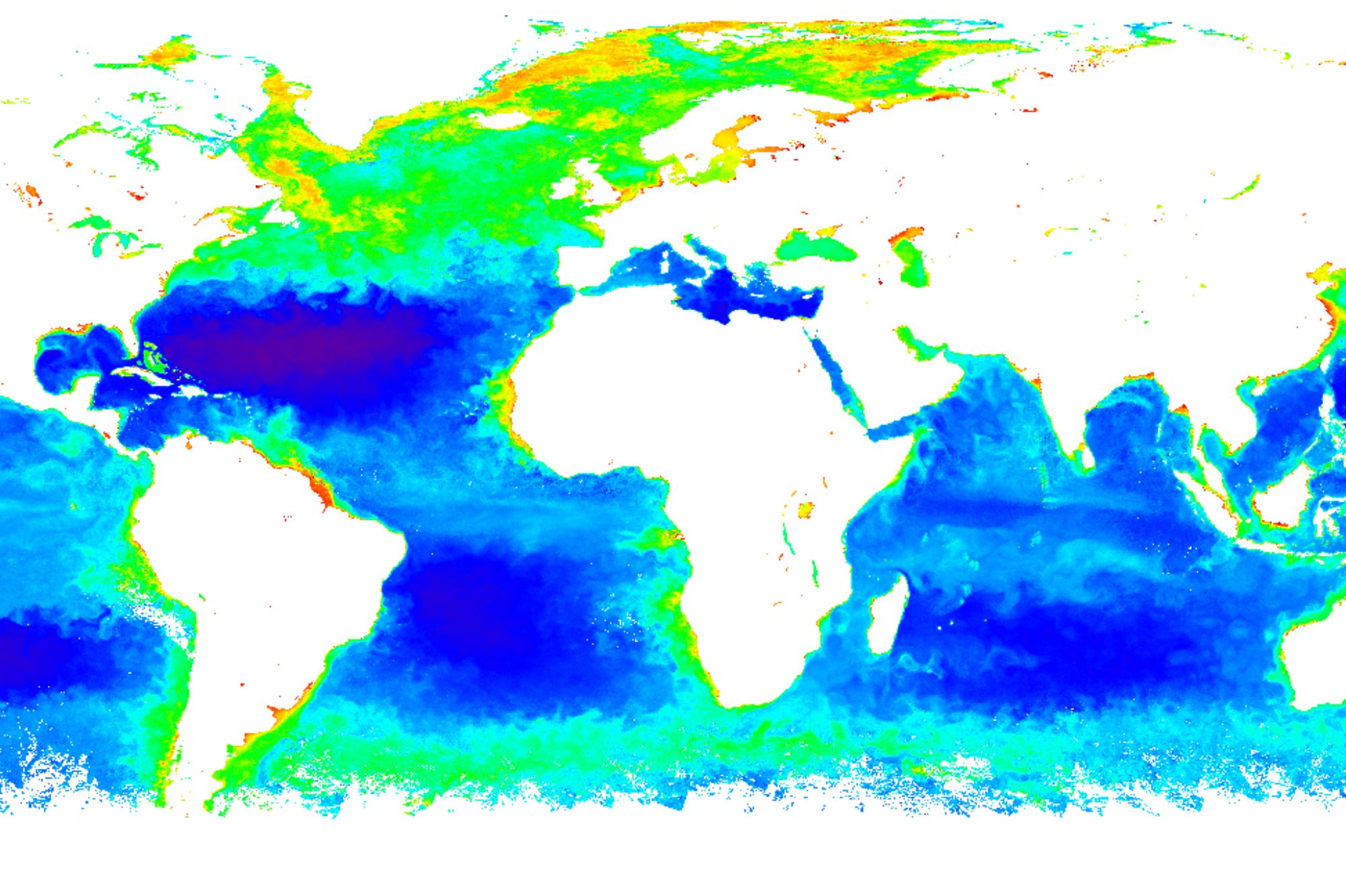
Image: Monthly Global satellite chlorophyll-a concentration for May 2026 from the European Space Agency’s Ocean Colour Climate Change Initiative (OC-CCI) .
However, to date, the comparative performance of these merged chl-a products has not been thoroughly assessed: just how accurate are those satellite estimates?
Some satellite products have shown subtle differences in the trends they detect in phytoplankton biomass. For example, both Ocean Colour Climate Change Initiative (OC-CCI), the European Copernicus Marine Environment Monitoring Service Ocean Colour (CMEMS) and the Global Ocean Colour for Carbon Cycle Research record (GlobColour) data show a global decrease in ocean colour chlorophyll-a between 1997 and 2018 – but the decline was more pronounced in the GlobColour data.
To assess the accuracy of these satellite products, there has been a concerted push by the Space Agencies, such as the European Space Agency (ESA) and National Aeronautics and Space Administration (NASA) for research institutes to collect very high quality in situ measurements of Chlorophyll-a.
This means collecting reference measurements directly from the ocean and using them to assess the accuracy of the satellites.
PML scientists have a long history of providing these measurements – to support the validation of satellite data, chiefly through the Atlantic Meridional Transect (AMT) research program.
This new study was a collaboration between past and present PML scientists who worked on AMT and related ESA projects.

Image: PML scientists and colleagues ahead of shipping out on the AMT30 research expedition. These expeditions have been conducted almost every year from the UK to the South Atlantic.
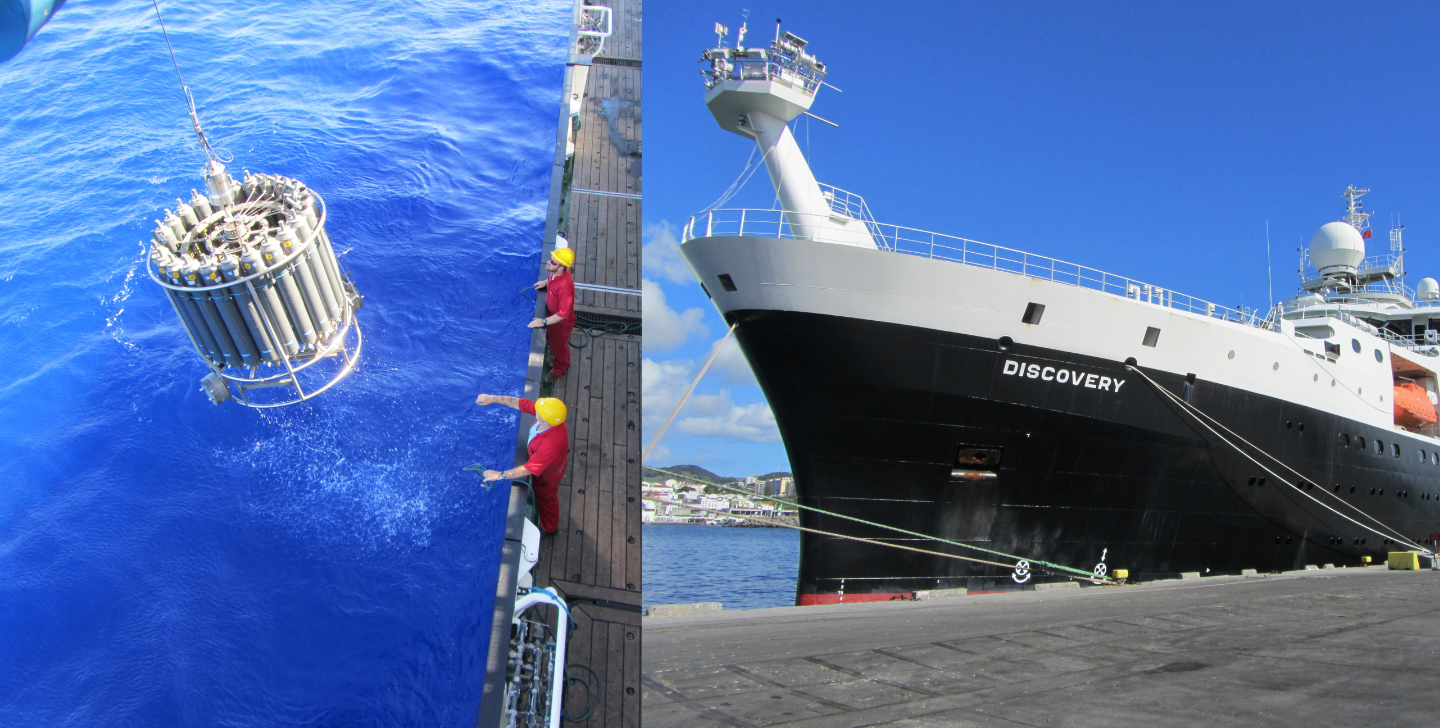
Image: (Left) A rosette sampler being lowered into the ocean to collect samples on the AMT29 research expedition on the RRS Discovery (right).
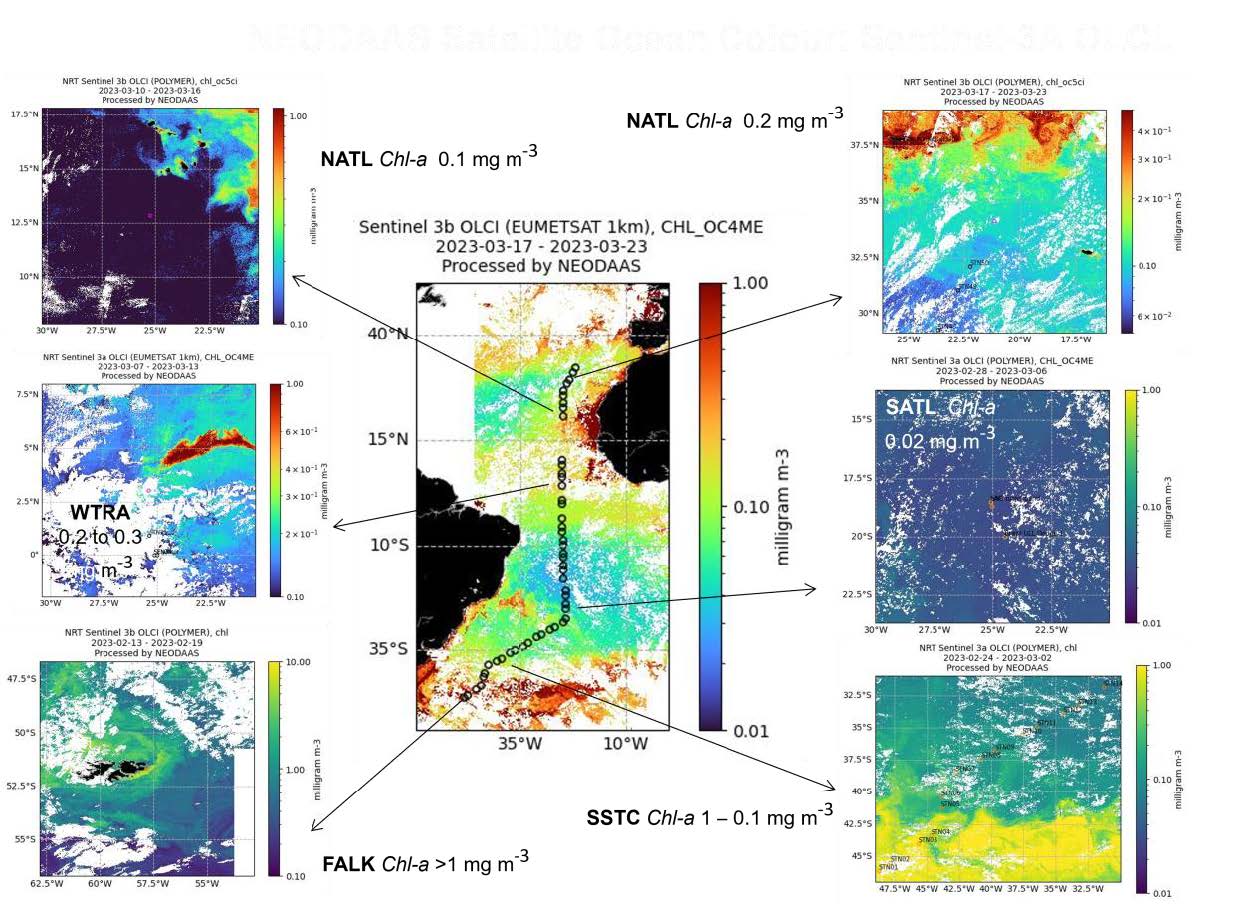
Image: Ocean Colour Satellite image of the Atlantic Ocean showing the Atlantic Meridional oceanographic cruise track in 2023 (open circles) and features in the satellite imagery along the track that we test to ensure that ocean colour satellites are giving the correct chlorophyll concentrations.
Through the AMT programme, PML secured support from the European Space Agency (ESA) through projects including AMT4CO2Flux, AMT4OceanSatFlux and AMT4SentinelFRM. This funding helped the team establish standardised methods for using autonomous optics systems to collect highly accurate measurements that can be used to validate satellite observations of ocean colour.
As the research vessel travels across the Atlantic, these instruments continuously record measurements of remote-sensing reflectance, and chl-a derived from water absorption, capturing a new set of observations approximately every minute. This provides a detailed, high-quality record of ocean conditions along the ship’s route.
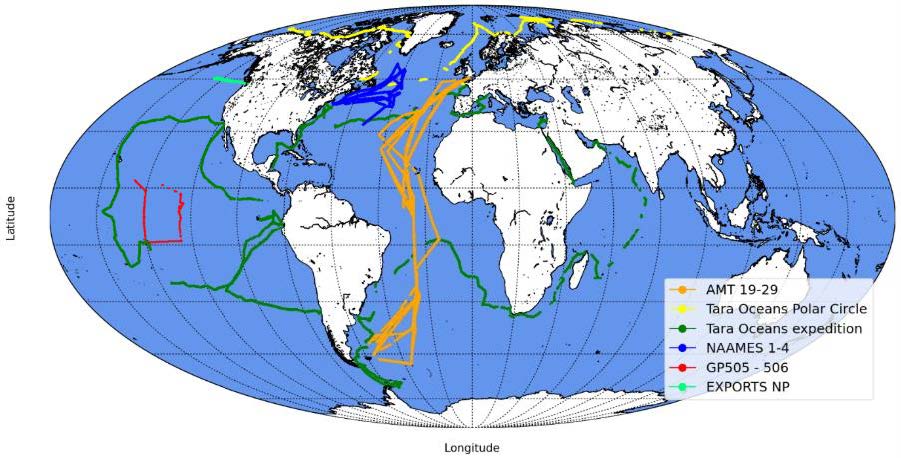
Image: Compilation of a global database of autonomous ship borne measurements for assessing the accuracy of the multi-mission satellite ocean colour products.
The team then combined these observations with comparable measurements collected by research groups in the US. Supported by additional funding from the National Centre for Earth Observation (NCEO), this created a global dataset of more than 13,000 measurements that could be directly matched to satellite observations taken as the ship passed beneath.
Using this extensive dataset, the researchers assessed the performance of seven multi-mission ocean colour products. Overall, the products showed broadly similar levels of accuracy, although OC-CCI and CMEMS CCI version performed marginally better than the others.
Dr Gavin Tilstone, Bio-optical oceanographer at PML, and joint lead author of the study, underlined the significance of the study:
“Phytoplankton are critically important for life in the sea and on land, yet human pressures on the ocean – including climate change and pollution – are impacting their health and abundance across the globe.”
“We need to observe and understand what is driving long-term changes in phytoplankton – and the feedback that these changes might have on marine ecosystems and biogeochemical cycles.”
“Modern satellite sensors can measure light very precisely, with a target error set by Space Agencies of 5% for the derived remote-sensing reflectance of blue and green light in the open ocean. However, converting reflectance into estimates of chlorophyll-a (chl-a) introduces additional uncertainty, as the process is influenced by a range of physical, biological and mathematical factors.”
“As a result, Space Agencies have set a target of less than 35% error for satellite-derived chl-a estimates. Our research set out to determine whether these merged satellite products are meeting that target. Quality assured satellite ocean colour data is a vital tool for scientists to assess the state and health of our global ocean.”
“Through our study, our analysis of more than 13,000 match-ups between in situ and satellite data showed that all seven products met this target, with a mean error of just 30%.”
PML’s Dr Tom Jordan, co-author of the study, who is an Earth Observation Scientist and a specialist in ocean optics, underlined the importance of “sea-truthing”:
“Field campaigns such as the Atlantic Meridional Transect, which samples across multiple oceanographic regions with a wide range of environmental conditions, enables us to produce high-quality reference data that are fundamental to assessing the accuracy of a range of ocean colour satellite products.”
Dr Tilstone concluded:
“As more satellites are launched by the space agencies and for existing missions, research funding is also required for expert laboratories who make high-quality fiducial reference measurements to sea-truth satellite data in key remote areas of the ocean over a wide range of chlorophyll concentrations”.
Pardo S, Tilstone GH, Dall’Olmo G, Jordan TM, Brewin RJW and Casal TGD (2026) Global assessment of merged multi-sensor ocean-colour chlorophyll-a products. Front. Remote Sens. 7:1825086. doi: 10.3389/frsen.2026.1825086